Introduction
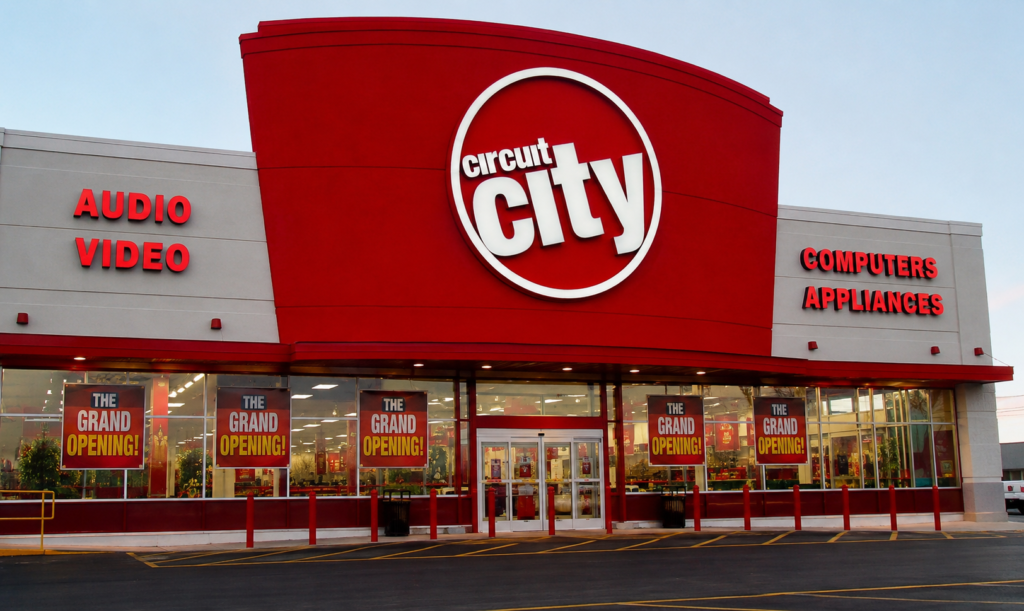
Circuit City is one of those retail names that can instantly bring back memories for people who grew up shopping for televisions, computers, stereos, video games, appliances, and other electronics in the United States. At its peak, the company was far more than another electronics store. It was a major force in American retail, helping shape how consumers compared technology, talked with sales associates, and purchased increasingly complicated electronic products. For decades, the red-and-white Circuit City name was a familiar sight in shopping centers and commercial areas across the country.
What makes the Circuit City story especially interesting is that it is not simply a story about a company that disappeared. It is a story about innovation, rapid expansion, changing consumer habits, management decisions, competition, and the enormous shift from traditional stores toward online shopping. The original retail chain filed for Chapter 11 bankruptcy protection in 2008 and eventually closed its remaining stores in March 2009. Contemporary reporting described the shutdown as the end of what had been the nation’s second-largest consumer electronics retailer.
Yet the name did not completely disappear. The Circuit City brand continued through different ownership and eventually returned to the internet as part of an attempted modern revival. The company’s current corporate history says the brand was acquired by Systemax in 2009, later acquired by its current ownership in 2016, and that CircuitCity.com was relaunched in 2018 as a direct-to-consumer and business-to-business e-commerce platform. That unusual second chapter is what makes Circuit City worth examining today.
The Early History of Circuit City
The roots of Circuit City go back much further than the familiar electronics-store chain most people remember. According to the company’s own historical account, Samuel Wurtzel opened the first Wards Company store in Richmond, Virginia, in 1949. The business gradually expanded and developed from a local operation into a larger retail organization.
The company went through several important stages as it grew. Wards Company became publicly traded and continued building its national footprint through expansion and acquisitions. In 1984, the company changed its name to Circuit City Stores Inc. and began trading on the New York Stock Exchange under the ticker symbol CC. That transition reflected a business that was becoming much more ambitious than its original regional roots.
The timing was important because the consumer electronics industry was entering an exciting period. Televisions, VCRs, stereos, personal computers, and other technologies were becoming increasingly important parts of everyday life. Consumers wanted places where they could see products, compare specifications, ask questions, and receive help before spending substantial amounts of money. Circuit City was well positioned to take advantage of that trend.
How Circuit City Became a Retail Powerhouse
Circuit City’s biggest success came from understanding that electronics were not always simple products to buy. A customer purchasing a television or stereo system might have questions about picture quality, connections, speakers, warranties, compatibility, and installation. In the pre-smartphone era, knowledgeable store employees could make a major difference in the buying experience.
The company’s stores became known for large selections and organized displays that allowed shoppers to compare products. Instead of simply treating electronics like ordinary merchandise, Circuit City built an identity around technology and specialized retailing. That helped distinguish the company from traditional department stores that might have carried only a smaller selection of electronics.
At its height, Circuit City was a major national retailer. The company’s own historical materials describe it as a Fortune 500 company for more than two decades and as the second-largest U.S. electronics retailer after Best Buy during its strongest years. The company says its operations generated more than $15 billion annually during that period.
The Circuit City Shopping Experience
For many longtime customers, Circuit City represented a very specific kind of shopping experience. Walking into one of its stores could feel like entering a technology showroom. Large televisions were displayed prominently, computers were arranged for comparison, and audio equipment occupied significant sections of the sales floor.
The physical environment mattered because electronics were changing quickly. A customer could walk into a store without knowing exactly what they needed and leave with a much clearer understanding of available products. Sales associates could explain differences that were difficult to understand from a newspaper advertisement or printed catalog.
That personal interaction became part of Circuit City’s identity. The company wasn’t simply selling boxes; it was helping people understand technology. In an era when consumers could not instantly search thousands of reviews online, that role gave electronics specialists significant influence over purchasing decisions.
Circuit City and the Growth of Consumer Technology
Circuit City’s rise happened alongside a remarkable transformation in consumer technology. Home video, personal computing, portable electronics, gaming, and increasingly sophisticated televisions created new categories that did not exist in anything like their modern form a few decades earlier.
As consumers became more interested in technology, electronics stores became destinations rather than merely places to purchase replacement products. People visited to see the newest televisions, listen to sound systems, compare computers, and learn about products they had seen advertised.
Circuit City benefited from this enthusiasm. Its large stores provided room for products to be demonstrated and compared. The company also became part of the broader culture surrounding consumer electronics, where owning the latest technology increasingly became associated with entertainment, productivity, and modern living.
The Expansion of Circuit City
Growth was one of Circuit City’s greatest strengths, but eventually it also became part of the challenge. The company expanded its presence across the United States and developed different store formats. Its historical materials mention the introduction of Circuit City Express, a mall-based format that reached more than 55 locations.
Expansion allowed the company to reach millions of consumers and build a powerful national brand. A shopper who moved from one city to another could often recognize the Circuit City name and expect a relatively familiar experience.
However, national scale also created pressure. Large stores require significant real estate, staffing, inventory, logistics, utilities, and management. When consumer behavior changes, a large physical footprint can become a disadvantage because the company has many fixed costs that smaller or more flexible competitors may not face.
Competition From Best Buy and Other Retailers
Circuit City did not operate in isolation. One of its most important competitors was Best Buy, which eventually became the dominant American electronics retailer. The competition between the two companies is one of the most interesting parts of Circuit City’s history because both businesses were responding to many of the same consumer trends.
Best Buy developed a strong reputation for broad product selection and increasingly competitive pricing. As electronics became more standardized, consumers had more opportunities to compare prices and features. The advantage of having knowledgeable employees remained important, but price and convenience became increasingly powerful factors.
Circuit City also faced competition from department stores, warehouse retailers, specialized computer businesses, and eventually online merchants. The more places consumers could purchase electronics, the harder it became for one large retailer to maintain a dominant position.
The Rise of Online Shopping
Perhaps the most important long-term challenge for Circuit City was the growth of e-commerce. The internet fundamentally changed how people researched and purchased consumer electronics.
Online shopping offered something traditional stores struggled to match: enormous selection without requiring a giant physical showroom. Customers could compare prices, read reviews, check specifications, and order products from home. They could also search for older models or niche accessories that might not be available at a nearby store.
This shift was particularly damaging to retailers whose business models depended heavily on physical locations. Electronics were especially vulnerable because many products could be described through specifications, photographs, customer reviews, and videos. Consumers increasingly discovered that they did not always need to visit a store before buying.
Circuit City’s Management Challenges
Technology alone does not explain Circuit City’s downfall. Business decisions and management strategy also played significant roles. The company was attempting to control costs while competing in a market where customer service and product knowledge mattered.
One controversial decision came in 2007, when Circuit City announced plans to eliminate thousands of positions held by higher-paid hourly employees and replace them with lower-paid workers. The decision became widely criticized because experienced salespeople were an important part of the company’s traditional value proposition.
This illustrates a difficult retail lesson: reducing labor costs can look attractive on a spreadsheet while creating hidden costs elsewhere. If experienced employees provide better customer service and help shoppers make purchasing decisions, replacing them with less experienced workers can weaken the customer experience.
Over time, the distinction between cost cutting and value destruction can become difficult to recognize. A company may save money on payroll while simultaneously losing customers who no longer feel that they are receiving the same level of assistance.
The 2008 Bankruptcy
Circuit City’s problems became much more serious during the financial crisis of 2008. The company filed for Chapter 11 bankruptcy protection in November 2008, entering a period when consumers were already becoming more cautious about major purchases.
The timing could hardly have been worse. Electronics purchases can be delayed when households are worried about jobs, income, debt, and the broader economy. A major retailer already dealing with competitive pressure has far less room for error when consumer spending suddenly weakens.
Circuit City ultimately could not find a sustainable path forward under bankruptcy protection. In January 2009, the company announced plans to liquidate its remaining U.S. stores. The Washington Post reported that 567 stores were scheduled for liquidation and that approximately 34,000 employees would be affected.
The Closure of the Original Stores
The closure of Circuit City’s stores was a major event in American retail. For years, the company had been one of the most recognizable names in electronics, and suddenly its locations were disappearing.
Liquidation sales attracted customers looking for discounted televisions, computers, appliances, cameras, accessories, and other products. The end of a major retailer often creates an unusual combination of nostalgia and bargain hunting. People who had spent years shopping at Circuit City returned one final time, while others visited simply because the discounts were difficult to ignore.
By early March 2009, inventory was disappearing rapidly. Contemporary reporting said the stores were expected to close for good, marking the end of the physical retail operation that had once ranked among America’s largest consumer electronics chains.
What Happened to the Circuit City Brand?
The closure of the stores did not mean that the Circuit City name immediately vanished. The brand and certain related assets were acquired by Systemax in 2009. Systemax relaunched CircuitCity.com that same year, positioning the website as an online electronics retailer.
That move was interesting because it showed how valuable a recognizable retail brand could remain even after the original company failed. Circuit City had spent decades building awareness, and the name still meant something to consumers.
The online relaunch also represented a major shift in business philosophy. The original Circuit City depended heavily on large physical stores. The revived operation could instead use e-commerce, centralized fulfillment, and online product discovery. In other words, the brand was being adapted to the very retail environment that had contributed to the original chain’s decline.
The 2018 Circuit City Comeback
Circuit City later entered another chapter. In 2018, the company announced plans for a comeback after years without traditional stores. The relaunch focused heavily on e-commerce and technology-driven shopping experiences rather than simply rebuilding the old network of giant electronics stores.
The strategy was noticeably different from the original Circuit City model. Reports described plans involving an online shopping experience, kiosks, store-within-a-store concepts, and eventually showroom-style locations. The company also discussed technologies such as augmented reality, search-by-photo, video support, and artificial intelligence.
That approach made sense in a changing retail environment. Instead of pretending that the market had returned to the conditions of the 1980s or 1990s, the revived company attempted to build around modern shopping habits. The goal was not simply to recreate the old stores but to reinterpret what the Circuit City name could mean in a digital economy.
Circuit City as an E-Commerce Brand
According to Circuit City’s current corporate history, CircuitCity.com was relaunched in 2018 as a direct-to-consumer and business-to-business e-commerce platform. The company also says it surpassed projected revenue after the relaunch and later introduced a program called Powered by Circuit City.
This is an important distinction when discussing Circuit City today. The phrase “Circuit City” can make people imagine the huge stores that disappeared in 2009, but the modern brand has pursued a different business model.
The current version is better understood as a technology and commerce brand than as a recreation of the old national store chain. That distinction helps explain why people may encounter Circuit City online while not seeing rows of familiar stores in local shopping centers.
Why Circuit City’s Story Still Matters
Circuit City’s history provides an excellent example of how quickly retail can change. A company can be enormous, profitable, recognizable, and apparently secure while the foundations of its industry are shifting underneath it.
The story also demonstrates that technological disruption is rarely caused by one competitor or one invention. Online shopping did not suddenly destroy every physical retailer. Instead, consumer expectations changed gradually. People became accustomed to comparing prices online, reading reviews, shopping at any hour, and having products delivered directly to their homes.
The lesson for modern businesses is straightforward: success in one retail environment does not guarantee success in the next. Companies have to keep asking whether their customers’ reasons for choosing them are still relevant.
Lessons From Circuit City’s Customer Service Strategy
One of the clearest lessons from Circuit City’s decline involves the value of knowledgeable employees. In electronics retail, expertise can be a major competitive advantage because customers often need help understanding technical products.
A sales associate who knows the difference between competing televisions, explains compatibility problems, or recommends an appropriate computer can create real value. But that value disappears if the business treats employees as interchangeable labor rather than as part of the customer experience.
This does not mean every retail business must spend heavily on staffing. The more useful lesson is that companies should understand which parts of their operation customers actually value. Cutting costs is not automatically smart if the cuts eliminate the reason customers chose the business in the first place.
Circuit City and the Importance of Adaptation
Adaptation is another major theme in the Circuit City story. The company eventually faced a market where traditional stores were no longer enough, but the transition was difficult.
Modern retailers have to think beyond the question of whether they should have a website. Customers now move between websites, mobile devices, physical stores, social media, reviews, and delivery services without thinking about the boundaries between those channels.
The later Circuit City revival recognized this reality by focusing on e-commerce and technology. Whether a modern brand succeeds or not, the strategy demonstrates an important principle: a comeback cannot simply copy the past. It needs to fit the present.
The Emotional Side of the Circuit City Brand
There is also a strong nostalgic element to Circuit City. For many people, the brand is associated with childhood trips to electronics stores, buying a first computer, looking at large televisions, shopping for games, or discovering new technology.
That emotional connection can be valuable for a revived brand. Nostalgia creates recognition that a new company would otherwise have to spend years and enormous amounts of money building.
At the same time, nostalgia is not enough to create a successful modern business. Customers may remember a brand fondly without automatically becoming customers again. A revival needs to provide current value, competitive pricing, convenient service, and a shopping experience that makes sense today.
Circuit City’s Place in Retail History
Circuit City deserves a place in the history of American retail because it helped popularize the idea of the large-format electronics specialist. Its rise reflected the growing importance of consumer technology in American households.
Its decline, meanwhile, became an example of the risks facing traditional retailers during the rise of e-commerce. The company showed how difficult it can be to manage a large physical footprint while consumers increasingly move online.
Its later revival adds another layer to that history. Rather than ending permanently with the 2009 store closures, the brand was repositioned for a different retail environment. The current company describes its journey as extending from the original 1949 Wards Company business through the 1984 Circuit City name change, the 2009 brand acquisition, and the 2018 e-commerce relaunch.
What Consumers Can Learn From Circuit City
Consumers can learn something from the story too. Retail technology changes constantly, but good shopping fundamentals remain surprisingly consistent. Buyers still benefit from comparing prices, researching products, understanding warranties, checking compatibility, and thinking carefully before making expensive purchases.
The difference is that shoppers now have far more tools available. A customer can research a product online before visiting a store, compare several retailers from a phone, read thousands of reviews, and watch demonstrations before spending money.
That level of information has shifted power toward consumers. Retailers have to earn trust rather than simply rely on location and brand recognition.
Could Circuit City Ever Become a Major Store Chain Again?
The possibility of a physical Circuit City comeback is an interesting question, but rebuilding the old network would be a very different proposition today. Traditional large-format electronics retail faces strong competition from e-commerce, warehouse clubs, department stores, specialist retailers, and direct-to-consumer brands.
A modern physical strategy would probably need to be smaller, more experiential, and closely connected to online shopping. Instead of filling enormous buildings with inventory, stores could focus on demonstrations, consultations, installations, repairs, product testing, and experiences that are difficult to reproduce online.
The company’s 2018 plans already pointed in that direction, discussing kiosks, store-within-store concepts, and showroom-style locations rather than immediately rebuilding the old chain. That suggests that any successful physical comeback would likely need to be designed around modern consumer behavior.
The Modern Meaning of Circuit City
Today, the name Circuit City carries two meanings at once. For older consumers, it represents a major electronics retailer that once had hundreds of stores and played an important role in the development of American consumer technology.
For newer consumers, the name can represent a revived digital brand attempting to participate in modern commerce. The company’s own materials describe the current business as having evolved into an e-commerce platform and later expanding through its Powered by Circuit City initiative.
That dual identity is unusual. Most failed retailers simply disappear from public awareness. Circuit City instead became a case study in how a recognizable brand can survive, change ownership, disappear from physical retail, and later attempt to find a new role online.
Final Thoughts
Circuit City’s story is ultimately bigger than the story of one electronics retailer. It is a story about how businesses rise when they understand their customers and struggle when the environment changes faster than their strategy.
The company achieved extraordinary scale by making consumer electronics accessible, visible, and easier to understand. It became one of America’s most recognizable electronics retailers before financial pressure, management challenges, competition, changing consumer behavior, and the rise of e-commerce contributed to its collapse. Its original stores closed in 2009, ending an important era in American retail.
But the Circuit City name did not simply disappear. It was revived online, and the current company continues to describe an evolution from its historic retail roots toward e-commerce and technology-focused commerce. That makes Circuit City a particularly useful example of both retail failure and brand reinvention.
The biggest takeaway is simple: a successful company cannot afford to stand still. Customer expectations change, technology changes, competitors change, and entire business models can become outdated. Circuit City’s rise demonstrates the rewards of getting retail right, while its fall demonstrates the danger of failing to adapt quickly enough. Its later comeback shows that even a brand associated with a vanished retail era can potentially find a new life when its identity is reimagined for the modern marketplace.
YOU MAY HAVE MISSED