
Editorial approach: This article presents the Continuous Thrive Model as a practical business transformation and continuous-improvement framework. Because the phrase does not identify one universally standardized management methodology, the implementation phases below are explained as an adaptable strategic model rather than attributed to an unverified organization or proprietary framework.
The article focuses on business leadership, organizational development, operational excellence, employee engagement, innovation, performance measurement, and sustainable growth. It also includes a biography-style framework table, implementation roadmap, practical examples, and detailed FAQs.
Continuous Thrive Model Implementation Phases Explained for Business Leaders
Introduction
Business success is no longer determined solely by the ability to generate revenue, attract customers, or maintain a competitive position. Modern organizations operate in an environment shaped by technological disruption, changing customer expectations, economic uncertainty, evolving workforce priorities, and increasingly complex competitive pressures. Strategies that appear effective today may become inadequate tomorrow. For business leaders, the challenge is therefore not simply to achieve growth but to build an organization capable of sustaining progress, responding to change, and continuously improving its performance.
This is where the Continuous Thrive Model becomes a useful management concept. It represents an ongoing approach to organizational development in which businesses combine strategic clarity, operational discipline, employee participation, innovation, and measurable improvement. Rather than treating transformation as a one-time project, the model encourages organizations to develop a permanent capacity for learning, adaptation, and sustainable performance.
The concept of continuous thriving goes beyond conventional business growth. Growth generally describes an increase in measurable outcomes, such as revenue, market share, customer numbers, or productivity. Thriving involves a broader organizational condition. A thriving business can maintain financial stability, develop capable employees, deliver customer value, manage uncertainty, and create opportunities for future development. It does not merely expand; it becomes better equipped to succeed over time.
Understanding the continuous thrive model implementation phases explained for business leaders requires examining how organizations move from an initial assessment to long-term organizational maturity. Each phase has a distinct purpose, but the phases are interconnected. Strategic direction influences operational priorities, leadership behavior shapes employee participation, and performance measurement determines whether improvement efforts are producing meaningful results.
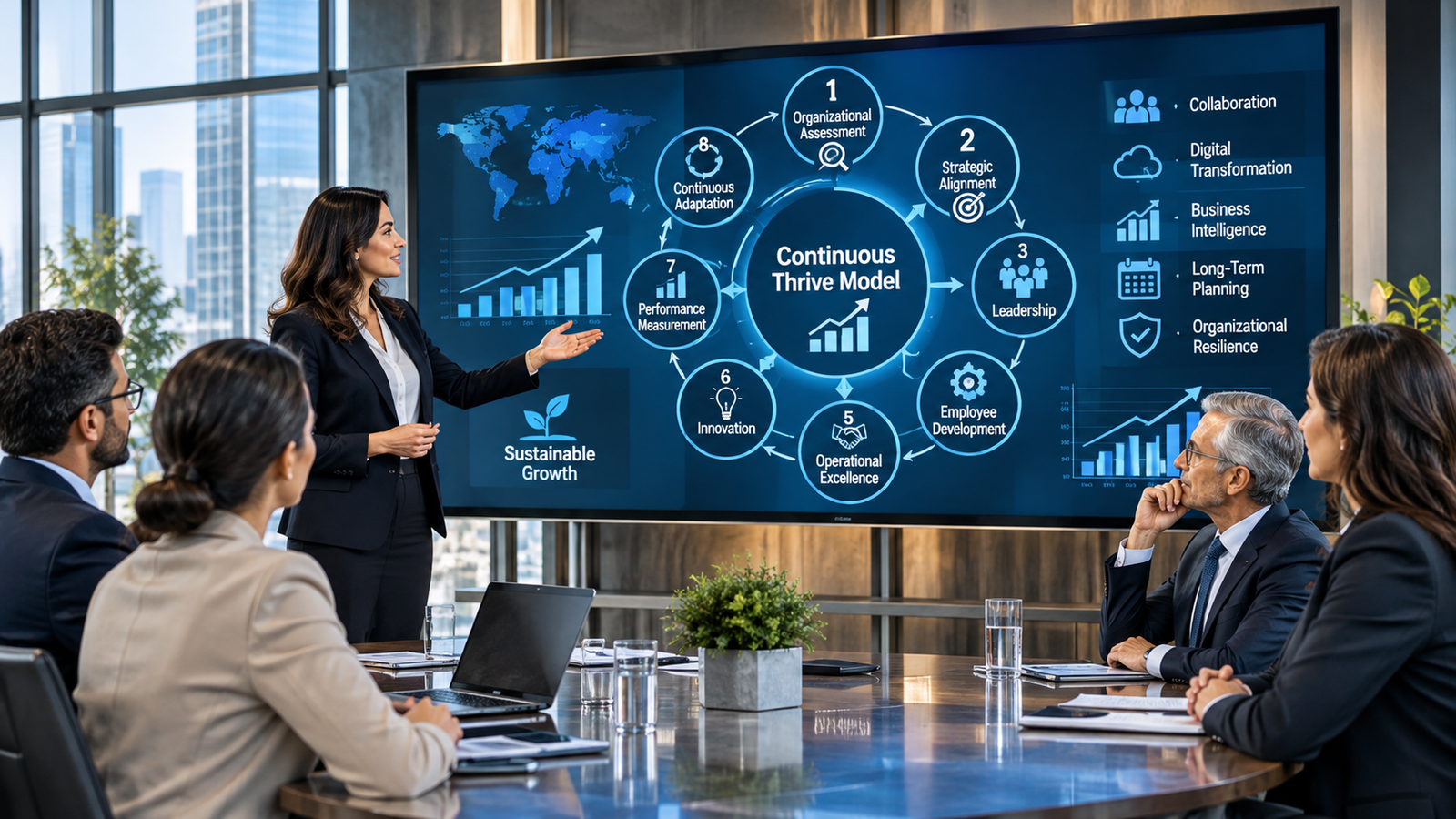
This guide explores the model through eight practical implementation phases: organizational assessment, strategic alignment, leadership commitment, capability development, operational integration, innovation and experimentation, performance measurement, and continuous adaptation. It also examines the responsibilities of business leaders, common implementation mistakes, performance indicators, practical examples, and the conditions required to sustain organizational progress.
The central principle is straightforward: organizations thrive when improvement becomes part of their everyday operating culture rather than an occasional management initiative.
What Is the Continuous Thrive Model?
The Continuous Thrive Model can be understood as a structured approach to building an organization that consistently improves its ability to create value. It connects business strategy with the people, processes, technologies, and management practices required to achieve sustainable results.
Traditional business planning often follows a project-oriented pattern. Leadership identifies a problem, develops a strategy, introduces a solution, measures the immediate outcome, and eventually moves on to another priority. Although this approach can be effective for specific objectives, it may fail to create lasting organizational improvement.
A continuous thriving approach takes a broader perspective. It recognizes that markets change, customer needs evolve, employees develop new expectations, and operational systems require regular adjustment. Consequently, organizations must establish mechanisms that allow them to learn from experience and improve their decisions over time.
The model is built around five interconnected principles.
1. Strategic Clarity
Every organization needs a clear understanding of its purpose, competitive priorities, and desired future position. Without strategic clarity, departments may pursue conflicting objectives, resources may be distributed inefficiently, and employees may struggle to understand how their responsibilities contribute to broader business outcomes.
Strategic clarity connects everyday activities with long-term ambitions. It helps leaders determine which opportunities deserve attention and which initiatives should receive limited organizational resources.
2. People-Centered Development
Employees are not simply operational resources. They contribute knowledge, creativity, judgment, relationships, and practical experience that influence organizational performance.
A business that expects continuous improvement must provide opportunities for employees to develop their skills, communicate ideas, receive feedback, and participate in decision-making. Employee development becomes a strategic investment rather than an isolated human resources activity.
3. Operational Excellence
Operational excellence involves making business processes more reliable, efficient, transparent, and responsive. It requires identifying unnecessary complexity, reducing avoidable errors, improving coordination, and using resources responsibly.
The objective is not to make every process faster regardless of quality. It is to improve the relationship between effort, cost, performance, and customer value.
4. Innovation and Adaptability
Organizations cannot thrive indefinitely by repeating existing practices. They must recognize emerging opportunities, experiment with improved approaches, and respond intelligently when market conditions change.
Innovation does not always require major technological breakthroughs. It can involve redesigning a customer journey, simplifying an internal approval process, improving product packaging, or changing how teams share information.
5. Measurable Improvement
Continuous thriving requires evidence. Leaders need reliable information about financial performance, operational efficiency, customer satisfaction, employee engagement, and strategic progress.
Measurement helps distinguish genuine improvement from temporary activity. It also creates accountability by showing whether initiatives are achieving their intended outcomes.
The continuous thrive model implementation phases explained for business leaders bring these principles together in a practical sequence. The model gives organizations a way to organize transformation while preserving the flexibility needed to respond to new circumstances.
Biography Table: Continuous Thrive Model at a Glance
Although the model describes an organizational approach rather than an individual, a structured overview table makes its central characteristics easier to understand.
| Category | Details |
|---|---|
| Framework name | Continuous Thrive Model |
| Framework category | Business management and organizational development |
| Primary purpose | Sustainable organizational improvement and long-term performance |
| Main audience | Business leaders, executives, managers, entrepreneurs, and transformation teams |
| Core philosophy | Continuous learning, adaptation, and measurable progress |
| Strategic foundation | Organizational purpose, business objectives, and long-term priorities |
| People focus | Employee development, engagement, collaboration, and leadership |
| Operational focus | Efficiency, process improvement, quality, and accountability |
| Innovation focus | Experimentation, technology adoption, and business adaptability |
| Measurement approach | Key performance indicators, feedback, and regular performance reviews |
| Implementation structure | Eight interconnected implementation phases |
| Initial phase | Organizational assessment |
| Strategic phase | Goal definition and alignment |
| Leadership requirement | Executive sponsorship and management accountability |
| Development requirement | Employee skills and organizational capabilities |
| Operational requirement | Process integration and consistent execution |
| Evaluation requirement | Performance measurement and improvement reviews |
| Long-term objective | A resilient, adaptable, and continuously improving organization |
| Implementation style | Iterative, collaborative, and evidence-driven |
| Expected business benefits | Improved coordination, stronger capabilities, greater adaptability, and sustainable performance |
This overview establishes the framework’s boundaries. It should not be confused with a fixed certification standard or a formally prescribed methodology. Organizations can adapt its phases according to their size, industry, maturity, available resources, and strategic objectives.
Why Businesses Need a Continuous Thriving Approach
Organizations face several challenges that make continuous improvement increasingly important. A company may experience strong revenue growth while its internal processes become inefficient. Another may introduce advanced technology without developing the workforce skills required to use it effectively. A third may attract new customers while customer satisfaction gradually declines.
These situations demonstrate that isolated success indicators do not necessarily represent organizational health.
A business can appear successful in the short term while accumulating weaknesses that threaten its future performance. The Continuous Thrive Model encourages leaders to examine the organization as an interconnected system.
Changing Customer Expectations
Customers increasingly expect convenience, responsiveness, personalization, consistency, and reliable service. Their expectations may change because of technological developments, competitor innovations, economic conditions, or experiences with other businesses.
Organizations that fail to monitor these changes risk losing relevance. Continuous improvement encourages regular customer feedback, service evaluation, and product development.
Increasing Competitive Pressure
Competition is no longer limited to businesses operating in the same traditional industry. Digital platforms, international suppliers, new distribution channels, and alternative business models can change the competitive landscape.
A company must therefore understand not only what its direct competitors are doing but also how customer needs and industry boundaries are evolving.
Workforce Transformation
Employees expect meaningful responsibilities, professional development, effective communication, and reasonable opportunities for advancement. Organizations that overlook these expectations may experience reduced engagement, higher turnover, and difficulties attracting capable professionals.
A thriving organization develops its workforce alongside its commercial strategy.
Technological Change
Automation, analytics, cloud computing, digital communication, and other technologies are changing how organizations operate. However, technology investments do not automatically generate value.
Businesses need to identify appropriate use cases, evaluate implementation risks, train employees, and measure actual improvements.
Economic and Operational Uncertainty
Supply chain disruptions, inflation, regulatory changes, financial pressures, and unexpected market developments can affect organizational stability.
Continuous improvement supports resilience by encouraging businesses to monitor risks, develop alternative plans, and make informed adjustments before problems become critical.
The Eight Continuous Thrive Model Implementation Phases
The implementation process can be organized into eight connected phases. Each phase addresses a different requirement, but organizations should treat the model as a repeating improvement cycle rather than a rigid sequence that ends permanently after the final stage.
Phase 1: Organizational Assessment and Current-State Analysis
The first phase establishes an accurate understanding of the organization’s current position. Before introducing new strategies, leaders must determine what is working, what is underperforming, where opportunities exist, and which internal limitations could affect implementation.
A transformation initiative built on inaccurate assumptions is likely to waste resources. For example, leadership may believe that customer complaints result from poor employee performance when the underlying problem is an outdated order-management system. Without proper investigation, the organization may introduce additional training while leaving the actual problem unresolved.
Current-state analysis prevents this type of mistake.
Examine Business Performance
The assessment should begin with a review of important business indicators. These may include:
- Revenue growth and profitability.
- Customer acquisition and retention.
- Operating costs and productivity.
- Product and service quality.
- Employee turnover and engagement.
- Project delivery performance.
- Customer complaints and resolution times.
- Technology utilization and reliability.
- Cash flow and financial stability.
Leaders should examine trends rather than relying on isolated reporting periods. A department may meet its monthly target while experiencing a gradual decline in productivity over several quarters.
Historical comparisons help identify these patterns.
Evaluate Organizational Capabilities
Financial performance alone cannot reveal whether a company is prepared for future challenges. Leaders should also assess employee capabilities, management systems, organizational culture, technology infrastructure, and internal communication.
Useful questions include:
- Do employees understand the organization’s priorities?
- Are managers equipped to lead change?
- Can departments exchange information effectively?
- Are important processes documented?
- Does the business have reliable performance data?
- Are technology systems suitable for future requirements?
- Can employees identify problems and recommend improvements?
The answers provide an initial picture of organizational readiness.
Identify Strengths and Weaknesses
A structured SWOT analysis can help leaders examine strengths, weaknesses, opportunities, and threats. However, the exercise should produce actionable findings rather than a generic list.
For example, strong customer relationships may represent an organizational strength. Slow product development may represent a weakness. Growing demand for digital services may create an opportunity, while a new low-cost competitor may represent a threat.
Each finding should be evaluated according to its business significance.
Establish a Baseline
A baseline provides the reference point against which future improvements can be measured. If customer retention is currently 78%, leaders need to record that figure before introducing initiatives intended to improve it.
Without a baseline, management may report progress without demonstrating whether actual performance has changed.
Expected output of Phase 1: A documented organizational assessment, a performance baseline, a list of critical gaps, and a prioritized set of improvement opportunities.
Phase 2: Strategic Vision, Objectives, and Organizational Alignment
Once the organization understands its current position, leadership must determine where it wants to go.
This phase translates broad ambitions into specific strategic priorities. A business may want to become more customer-focused, improve operational efficiency, increase profitability, strengthen its digital capabilities, or expand into new markets. However, these ambitions must be converted into clear objectives.
A vision without measurable direction can become an inspirational statement that has little influence on daily decisions.
Define the Desired Future State
The desired future state describes what the organization should look like after a period of meaningful development.
For example, a manufacturing company might aim to reduce production delays, improve product quality, strengthen supplier coordination, and develop a more skilled workforce.
A professional services business might focus on improving customer retention, shortening project delivery times, strengthening employee development, and increasing recurring revenue.
The objectives should reflect the organization’s actual business model.
Translate Vision into Measurable Goals
SMART objectives provide one useful method for defining clear targets. Goals should be specific, measurable, achievable, relevant, and time-bound.
Instead of stating that the business wants to improve customer service, leadership might establish an objective to increase customer satisfaction from 82% to 90% within twelve months.
A measurable objective makes progress easier to evaluate and helps employees understand the expected result.
Align Departments and Teams
Strategic alignment is one of the most important requirements of successful implementation.
An organization may have a strong executive strategy but still struggle because departments operate according to different priorities. Sales teams may focus on customer acquisition while operations teams prioritize cost reduction. Technology teams may pursue modernization without understanding the practical requirements of frontline employees.
Leadership must establish shared priorities and clarify how departmental responsibilities contribute to overall objectives.
Prioritize Initiatives
Organizations usually have more improvement opportunities than available resources. Trying to address every weakness simultaneously can overwhelm employees and weaken implementation.
Leaders should prioritize initiatives according to:
- Strategic importance.
- Expected business value.
- Implementation cost.
- Operational complexity.
- Available expertise.
- Time required to achieve results.
- Potential implementation risks.
A smaller number of well-executed initiatives can create more value than a large portfolio of poorly coordinated projects.
Expected output of Phase 2: A strategic vision, measurable objectives, departmental priorities, and an agreed improvement roadmap.
Phase 3: Leadership Commitment and Governance Development
A continuous improvement strategy requires visible leadership support. Employees are unlikely to embrace organizational change if executives treat it as an administrative exercise or delegate all responsibility to a small project team.
Leadership commitment establishes credibility, accountability, and direction.
Establish Executive Sponsorship
Senior leaders should explain why the organization is adopting the model, what it intends to achieve, and how the initiative supports its broader strategy.
Executive sponsorship must extend beyond public announcements. Leaders should participate in progress reviews, resolve resource conflicts, and demonstrate the behaviors they expect from others.
If management asks employees to embrace transparency but avoids discussing performance problems, the organization receives conflicting messages.
Define Governance Responsibilities
Governance clarifies who makes decisions, who monitors progress, and who is accountable for implementation.
A practical governance structure may include:
| Governance role | Main responsibility |
|---|---|
| Executive sponsor | Provides strategic direction and removes major obstacles |
| Steering committee | Reviews progress, priorities, risks, and resource requirements |
| Program leader | Coordinates implementation activities |
| Department managers | Translate strategic objectives into operational actions |
| Team leaders | Support daily execution and employee participation |
| Employees | Identify opportunities, provide feedback, and follow agreed improvements |
| Performance analysts | Monitor data, prepare reports, and identify performance trends |
The exact structure should reflect the organization’s size. A small business may not need a formal steering committee, while a multinational organization may require several governance levels.
Build Leadership Accountability
Accountability should be specific and visible. Every major objective needs an owner, a timeline, and a method of evaluation.
For example, the operations director may own process-efficiency targets, the human resources leader may oversee employee development, and the technology director may manage digital capability improvements.
Shared responsibility is important, but it should not create confusion about who is expected to make decisions.
Encourage Transparent Communication
Leaders should communicate progress honestly, including difficulties and delays. Employees are more likely to trust a transformation initiative when management acknowledges challenges rather than presenting every development as a success.
Transparency also allows teams to identify problems early.
Expected output of Phase 3: Executive sponsorship, defined governance responsibilities, leadership accountability, and a consistent communication structure.
Phase 4: Employee Engagement and Capability Development
People determine whether organizational strategies become operational realities. Even the most sophisticated business plan depends on employees who understand their responsibilities and possess the skills required to perform them.
This phase focuses on developing an environment in which employees can contribute to improvement while strengthening their professional capabilities.
Assess Skills and Capability Gaps
Leaders should compare the organization’s existing capabilities with those required to achieve its strategic objectives.
For example, a company adopting advanced analytics may need employees with data interpretation, reporting, and digital communication skills.
A business expanding into international markets may require stronger language capabilities, regulatory knowledge, and cross-cultural management skills.
A capability assessment helps identify where training, recruitment, mentoring, or organizational redesign may be necessary.
Develop Targeted Learning Programs
Training should be connected to practical business requirements.
Instead of delivering generic courses without clear objectives, organizations should design development programs around the skills employees need in their actual roles.
Possible approaches include:
- Professional training workshops.
- Technical certification programs.
- Leadership development.
- Mentoring and coaching.
- Cross-functional assignments.
- Job rotation.
- Peer learning.
- Digital learning platforms.
- Practical improvement projects.
Learning becomes more effective when employees can apply new knowledge immediately.
Involve Employees in Decision-Making
Employee participation creates valuable opportunities to identify operational problems. Frontline employees often understand customer difficulties, process delays, and unnecessary administrative tasks better than senior executives who are removed from daily operations.
Organizations should create appropriate channels for employees to submit suggestions, discuss challenges, and participate in improvement teams.
However, participation must lead to meaningful consideration. Asking employees for ideas and repeatedly ignoring their contributions can reduce trust.
Strengthen Psychological Safety
Psychological safety refers to an environment in which people can raise concerns, ask questions, acknowledge mistakes, and offer different opinions without unreasonable fear of humiliation or retaliation.
It does not mean removing accountability. Rather, it supports honest communication and responsible learning.
When employees feel comfortable identifying problems, organizations can address weaknesses before they become larger operational failures.
Expected output of Phase 4: A capability-development plan, employee engagement activities, defined learning priorities, and stronger participation in improvement efforts.
Phase 5: Operational Integration and Process Transformation
The fifth phase converts strategic intentions into practical operating changes.
An organization may have excellent strategic objectives and highly motivated employees, but its performance will remain limited if everyday processes are inefficient or disconnected.
Operational integration ensures that continuous improvement becomes part of normal business activity.
Map Important Business Processes
Leaders should identify the processes that have the greatest influence on organizational performance.
These may include:
- Customer acquisition.
- Sales and order processing.
- Product development.
- Procurement and supplier management.
- Manufacturing and service delivery.
- Customer support.
- Financial reporting.
- Recruitment and onboarding.
- Inventory management.
- Project execution.
Process mapping helps organizations understand how work moves between departments and where unnecessary delays occur.
Identify Operational Bottlenecks
A bottleneck is a point in a process that limits the performance of the entire system.
For example, a company may receive customer orders quickly but experience long delays because approvals require several managers. Another organization may produce goods efficiently but struggle with distribution because inventory information is outdated.
The objective is to identify the underlying cause rather than simply demand that employees work faster.
Simplify and Standardize Processes
Process standardization can reduce unnecessary variation and improve reliability.
Organizations should document important procedures, clarify responsibilities, remove redundant approval steps, and establish consistent quality requirements.
Standardization should not become excessive bureaucracy. Processes must remain flexible enough to accommodate legitimate customer requirements and unusual operating conditions.
Integrate Technology Carefully
Digital tools can support automation, communication, reporting, and process coordination. However, introducing technology without understanding operational needs may create new complexity.
Before investing in a system, leaders should identify the problem it is expected to solve, evaluate integration requirements, train users, and establish measurable success criteria.
Technology should improve the process rather than simply digitize existing inefficiencies.
Embed Continuous Improvement into Daily Work
Improvement should not depend entirely on occasional workshops or annual strategic reviews.
Teams can hold regular operational meetings, examine performance indicators, identify recurring issues, and agree on small corrective actions.
This creates a practical connection between strategic priorities and everyday behavior.
Expected output of Phase 5: Improved processes, clearer responsibilities, appropriate technology integration, and operational routines that support continuous improvement.
Phase 6: Innovation, Experimentation, and Adaptive Growth
A thriving organization must do more than improve existing processes. It also needs to explore opportunities that could strengthen its future position.
Innovation enables businesses to challenge assumptions, develop new products, improve customer experiences, and respond to emerging market conditions.
Establish an Innovation Mindset
Innovation should not be restricted to research departments or senior executives. Employees across the organization may identify opportunities for better services, more efficient processes, or improved customer communication.
Leadership can encourage innovation by providing clear channels for ideas and evaluating proposals according to business value.
Introduce Controlled Experimentation
Not every idea will succeed. Organizations should therefore test promising approaches on a manageable scale before committing substantial resources.
A pilot project allows the business to examine feasibility, costs, customer reactions, operational effects, and potential risks.
For example, a retailer might test a new inventory-management approach in one location before introducing it across the entire network.
The results should guide decisions about expansion, modification, or discontinuation.
Use Customer Feedback to Guide Innovation
Innovation becomes more valuable when it addresses genuine customer needs.
Organizations can examine complaints, customer interviews, support requests, purchasing patterns, satisfaction surveys, and product usage information to identify unmet expectations.
The objective is not to introduce novelty for its own sake. It is to develop solutions that improve customer value.
Encourage Cross-Functional Collaboration
Innovation often emerges when people with different expertise work together.
A product development team may benefit from the insights of sales employees, customer support representatives, operations managers, and technology specialists.
Cross-functional collaboration helps prevent the creation of solutions that work in one department but create difficulties elsewhere.
Balance Innovation with Risk Management
Experimentation should operate within appropriate financial, legal, operational, and security boundaries.
Leaders should define acceptable risk levels, approval requirements, and monitoring procedures.
An innovative culture does not mean that every idea should be implemented. It means that promising ideas should receive fair evaluation and that learning from unsuccessful experiments should be treated constructively.
Expected output of Phase 6: An innovation pipeline, pilot projects, customer-informed improvements, and stronger organizational adaptability.
Phase 7: Performance Measurement, Evaluation, and Accountability
The seventh phase determines whether implementation is producing the expected results.
Without meaningful measurement, continuous improvement can become a collection of activities with no reliable evidence of value.
Organizations need to monitor both immediate operational outcomes and broader strategic progress.
Develop a Balanced KPI Framework
Key performance indicators should represent the organization’s most important priorities.
A balanced framework may include several categories:
| Performance area | Example KPIs | Business purpose |
|---|---|---|
| Financial performance | Revenue growth, operating margin, cash flow | Measures financial sustainability |
| Customer experience | Retention, satisfaction, complaint resolution | Evaluates customer value |
| Operations | Productivity, cycle time, defect rate | Measures process effectiveness |
| Employees | Engagement, retention, training completion | Evaluates workforce development |
| Innovation | Pilot success, implementation rate, new-product revenue | Tracks innovation activity |
| Strategy | Milestone completion, objective achievement | Measures strategic progress |
| Risk management | Incident frequency, audit findings, control effectiveness | Evaluates organizational resilience |
Leaders should avoid collecting excessive data. Too many indicators can distract employees from the measures that genuinely influence performance.
Distinguish Leading and Lagging Indicators
Lagging indicators describe results that have already occurred. Revenue, profit, customer retention, and employee turnover are common examples.
Leading indicators provide information about activities or conditions that may influence future results. Training completion, qualified sales opportunities, preventive maintenance, and customer response times can provide early signals.
Both categories are important. Lagging indicators show outcomes, while leading indicators help leaders identify opportunities to influence those outcomes.
Establish Regular Performance Reviews
Performance reviews should occur at appropriate intervals.
Operational teams may review selected indicators weekly, departmental leaders may conduct monthly evaluations, and executives may examine broader strategic progress quarterly.
The purpose is to understand performance, identify causes, and agree on corrective action.
Meetings should not become exercises in explaining why targets were missed. They should produce clear decisions about what must change.
Connect Measurement with Accountability
Every significant performance gap should have an owner and a response plan.
If delivery times increase, leaders should identify the responsible process, investigate the cause, and determine which intervention is appropriate.
Accountability should encourage responsible action rather than creating a culture of blame.
Expected output of Phase 7: A balanced KPI framework, reliable reporting, performance review routines, and documented corrective actions.
Phase 8: Continuous Adaptation and Organizational Maturity
The final phase turns the implementation framework into a lasting organizational capability.
A business should not consider the model complete merely because it has introduced new processes or achieved its first improvement targets. Market conditions continue to change, and internal systems require regular evaluation.
The purpose of this phase is to make learning, adjustment, and improvement permanent features of organizational management.
Review Strategic Relevance
Business priorities should be reviewed when market conditions, customer expectations, technology, or competitive circumstances change.
An objective that was important twelve months ago may no longer deserve the same level of investment.
Leaders should examine whether current initiatives remain aligned with the organization’s purpose and future opportunities.
Institutionalize Learning
Organizations should document what worked, what failed, and why.
Project reviews, knowledge-sharing sessions, employee feedback, and performance analysis can help preserve useful experience.
Without knowledge retention, businesses may repeat mistakes whenever employees change roles or new managers join the organization.
Strengthen Organizational Resilience
Resilience involves maintaining important business functions during disruption and recovering effectively afterward.
Organizations can strengthen resilience through risk assessments, contingency planning, supplier diversification, data protection, leadership succession planning, and operational flexibility.
Continuous adaptation helps companies prepare for uncertainty instead of responding only after a crisis occurs.
Develop a Mature Improvement Culture
An organization reaches greater maturity when employees at different levels understand their role in improving performance.
Managers regularly evaluate processes, teams discuss evidence rather than assumptions, and leadership treats change as an ongoing responsibility.
Improvement becomes part of how the organization operates rather than a temporary program.
Expected output of Phase 8: A sustainable improvement culture, regular strategic reassessment, institutionalized learning, and a repeatable organizational development cycle.
How the Eight Phases Work Together
The eight phases should not operate as independent management projects. Their value comes from the relationships between them.
Organizational assessment identifies the current position. Strategic alignment establishes direction. Leadership commitment creates accountability. Employee development provides the necessary capabilities. Operational integration turns objectives into action. Innovation expands future opportunities. Performance measurement evaluates results. Continuous adaptation uses the findings to improve the next cycle.
The relationship can be summarized as follows:
| Phase | Primary question | Main deliverable |
|---|---|---|
| 1. Assessment | Where are we now? | Current-state analysis |
| 2. Strategic alignment | Where do we want to go? | Strategic roadmap |
| 3. Leadership and governance | Who will lead the change? | Accountability structure |
| 4. Employee development | What capabilities do we need? | Workforce development plan |
| 5. Operational integration | How will we improve daily work? | Process transformation |
| 6. Innovation | What new opportunities should we explore? | Innovation pipeline |
| 7. Measurement | Are we achieving meaningful results? | Performance dashboard |
| 8. Adaptation | How will we sustain progress? | Continuous improvement cycle |
The sequence provides structure, but organizations may revisit earlier phases when new information emerges. For example, performance reviews may reveal that an original strategic objective was unrealistic. Leadership may then need to reassess priorities rather than continue pursuing an ineffective target.
This flexibility is central to the continuous thrive model implementation phases explained for business leaders. The model is intended to support disciplined adaptation, not rigid compliance.
Practical Example: Applying the Model in a Growing Business
Consider a medium-sized manufacturing company experiencing rising customer demand but struggling with delivery delays, increasing production costs, and inconsistent product quality.
The company has experienced revenue growth, yet management recognizes that its operating model is not sufficiently prepared for further expansion.
The leadership team decides to apply the Continuous Thrive Model.
Step 1: Assess the Organization
The company examines production data, customer complaints, supplier performance, employee turnover, and operating costs.
The assessment reveals that production delays are associated with outdated scheduling practices, inconsistent inventory information, and approval bottlenecks.
Step 2: Establish Strategic Priorities
Leadership identifies three priorities:
- Reduce average order-delivery time.
- Improve product quality.
- Strengthen production planning and inventory visibility.
Each objective receives a measurable target and an implementation timeline.
Step 3: Establish Accountability
The operations director becomes the executive sponsor. Production managers oversee process changes, the technology team evaluates scheduling systems, and quality managers monitor defect rates.
Regular management reviews ensure that departments remain aligned.
Step 4: Develop Employee Capabilities
Employees receive training in updated production procedures, quality management, and digital scheduling tools.
Supervisors are trained to conduct improvement discussions and identify operational problems.
Step 5: Improve Processes
The company maps its production workflow and removes unnecessary approval stages.
Inventory records are improved, maintenance schedules are reviewed, and responsibilities are clarified.
Step 6: Test Innovations
Management introduces a scheduling pilot in one production unit.
The pilot is evaluated against delivery times, production efficiency, and employee feedback before broader implementation.
Step 7: Measure Results
The company monitors delivery performance, defect rates, operating costs, inventory accuracy, and employee participation.
Managers review results regularly and investigate any unexpected changes.
Step 8: Adapt and Expand
After identifying which improvements produce reliable benefits, the company expands successful practices and revises weaker initiatives.
The process continues as new customer requirements and production challenges emerge.
This example illustrates how the model can connect strategic thinking with operational execution. The framework does not guarantee a particular financial outcome, but it provides a disciplined way to identify problems, test solutions, and evaluate progress.
The Role of Business Leaders in Successful Implementation
Leadership is one of the strongest influences on whether a continuous improvement framework becomes embedded in organizational culture.
The responsibilities of business leaders extend beyond approving budgets and setting targets. They must establish an environment in which employees understand the purpose of change and have the support needed to contribute.
Communicating a Clear Purpose
Employees need to understand why the organization is changing.
A statement that management wants to improve performance is rarely sufficient. Leaders should explain which problems require attention, how the changes support customers, and what benefits the organization expects.
Clear communication reduces uncertainty and helps employees connect their daily responsibilities with wider objectives.
Demonstrating Consistent Behavior
Leadership credibility depends on consistency.
Managers who promote collaboration should actively share information. Leaders who encourage innovation should listen to reasonable proposals. Executives who expect accountability should accept responsibility for their own decisions.
Employees pay attention to behavior more than slogans.
Allocating Resources
Transformation requires time, money, expertise, and management attention.
Leaders should ensure that improvement projects receive realistic resources. Expecting employees to implement substantial changes while maintaining an unchanged workload may create unnecessary pressure and reduce effectiveness.
Supporting Managers
Middle managers play an essential role because they translate executive priorities into operational practice.
They need clear expectations, practical tools, decision-making authority, and support when implementation creates conflicts between existing responsibilities and new initiatives.
Protecting Long-Term Priorities
Short-term commercial pressures can cause businesses to abandon important improvement work.
Leaders must balance immediate results with investments in workforce development, process quality, technology, and innovation.
A sustainable organization cannot continually sacrifice its future capabilities to satisfy short-term performance demands.
Common Challenges During Implementation
Even well-designed improvement frameworks can encounter obstacles. Recognizing these challenges early allows leaders to develop practical responses.
1. Unclear Strategic Direction
If employees do not understand the intended outcomes, departments may interpret the initiative differently.
Solution: Define measurable priorities, communicate them consistently, and connect departmental targets with organizational objectives.
2. Resistance to Organizational Change
Employees may resist changes because they fear losing control, responsibilities, job security, or familiar working practices.
Solution: Explain the reasons for change, involve employees early, provide training, and create opportunities for honest feedback.
3. Weak Leadership Commitment
If executives delegate the entire initiative and rarely review progress, employees may conclude that the program is not important.
Solution: Establish visible sponsorship, regular review meetings, and clearly defined leadership responsibilities.
4. Too Many Simultaneous Initiatives
Launching too many projects can overwhelm employees and reduce the quality of implementation.
Solution: Prioritize initiatives according to strategic importance, expected value, and available resources.
5. Inadequate Performance Data
Unreliable or incomplete data can lead to poor decisions.
Solution: Establish clear KPI definitions, improve data quality, and assign responsibility for reporting accuracy.
6. Technology Without Process Improvement
Introducing new software does not automatically make an organization more efficient.
Solution: Evaluate existing workflows before investing in technology, and redesign processes where necessary.
7. Limited Employee Participation
If improvement is treated as an executive responsibility alone, valuable operational knowledge may be overlooked.
Solution: Establish practical employee feedback channels and involve frontline teams in problem-solving.
8. Failure to Sustain Progress
Organizations sometimes lose momentum after initial targets are achieved.
Solution: Integrate performance reviews, learning activities, and improvement responsibilities into normal management routines.
Measuring the Success of the Continuous Thrive Model
The success of implementation should be evaluated through a balanced combination of financial, operational, customer, workforce, and strategic indicators.
No single metric can represent the health of an entire organization.
Financial Indicators
Financial indicators help determine whether the business is creating sustainable economic value.
Examples include revenue growth, gross margin, operating profit, cash flow, cost efficiency, and return on investment.
These measures should be interpreted in context. Revenue growth accompanied by declining margins may indicate that expansion is creating operational pressure.
Operational Indicators
Operational measures evaluate how effectively the organization delivers products and services.
Examples include production cycle time, order accuracy, service response time, defect rates, equipment downtime, and project completion rates.
Improvement in these areas can support both customer satisfaction and financial performance.
Customer Indicators
Customer-related measures help determine whether the organization is delivering meaningful value.
Common indicators include customer retention, satisfaction scores, repeat purchases, complaint resolution time, and customer lifetime value.
Leaders should combine quantitative information with direct customer feedback.
Employee Indicators
Workforce measures provide insight into organizational capability and culture.
Useful indicators include employee engagement, retention, absenteeism, training participation, internal promotions, and employee feedback.
A company should avoid treating employee performance as a purely numerical issue. Qualitative feedback is also important for understanding workplace conditions.
Innovation Indicators
Innovation measures should evaluate whether new ideas are becoming useful business improvements.
Possible indicators include the number of tested initiatives, successful pilot projects, time required to move from concept to implementation, and revenue generated by new products or services.
The number of ideas submitted is not enough. Their actual value matters more than their quantity.
Strategic Indicators
Strategic measures evaluate progress toward long-term objectives.
These may include milestone completion, market expansion, capability development, strategic project performance, and progress against annual business priorities.
A balanced performance system enables leaders to understand both current results and the organization’s capacity to improve.
Creating a Continuous Thrive Implementation Roadmap
An implementation roadmap translates the framework into a manageable schedule.
The following example provides an illustrative twelve-month structure. Actual timelines will vary according to organizational complexity, available resources, and the scale of transformation.
| Period | Primary focus | Key activities |
|---|---|---|
| Months 1–2 | Assessment | Performance review, capability analysis, baseline development |
| Months 2–3 | Strategic alignment | Vision, objectives, departmental priorities |
| Months 3–4 | Leadership and governance | Executive sponsorship, ownership, communication |
| Months 4–5 | Employee development | Skills assessment, training, engagement |
| Months 5–8 | Operational integration | Process mapping, redesign, technology improvements |
| Months 7–9 | Innovation | Pilots, experiments, customer feedback |
| Months 9–11 | Performance evaluation | KPI reviews, gap analysis, corrective action |
| Months 11–12 | Adaptation | Lessons learned, strategy adjustments, maturity planning |
These periods overlap intentionally. For example, employee training may continue while operational improvements are being introduced. Innovation pilots may begin before every process change is complete.
The roadmap should therefore be treated as a planning guide rather than a universal implementation timetable.
How Small Businesses Can Apply the Model
Small businesses may not have dedicated transformation departments, large technology budgets, or extensive management structures. However, they can still apply the core principles.
The most practical approach is to keep implementation simple.
An owner-managed company might begin by reviewing revenue, customer retention, operating costs, and employee responsibilities. It can then identify two or three priorities that would create the greatest improvement.
Instead of establishing a formal steering committee, the owner may conduct monthly performance discussions with key employees. Training can be organized through short workshops, mentoring, or practical assignments.
Operational improvements might include simplifying customer inquiries, improving inventory tracking, or reducing unnecessary administrative work.
The business can test new approaches on a small scale before introducing them throughout the organization.
The most important consideration is consistency. Small businesses do not need complex management systems to develop a culture of learning and improvement. They need clear objectives, reliable information, open communication, and a willingness to review their decisions.
Applying the Model in Large Organizations
Large organizations face different implementation challenges.
They often operate across several locations, business units, countries, and regulatory environments. Departments may have different priorities, technology systems, management structures, and reporting practices.
For these businesses, implementation requires stronger coordination.
A central governance structure can establish common principles, performance definitions, and strategic priorities. Individual business units can then adapt the framework to their operating conditions.
Technology systems should support consistent reporting without preventing departments from addressing their specific requirements.
Large organizations should also consider cultural and regional differences. A communication approach that works well in one location may not be equally effective in another.
The continuous thrive model implementation phases explained for business leaders are especially useful in this context because they provide a common structure while allowing local adaptation.
The Relationship Between Continuous Thriving and Organizational Culture
Organizational culture influences how employees make decisions, communicate, solve problems, and respond to change.
A company may introduce new procedures, software, and performance targets, but those changes may not produce lasting results if its culture discourages collaboration or discourages employees from reporting problems.
A thriving culture supports several important behaviors.
Learning Instead of Blame
Employees should be encouraged to identify the causes of mistakes and develop practical solutions.
Accountability remains important, particularly when negligence or misconduct occurs. However, treating every mistake as a personal failure can discourage honest reporting.
Collaboration Instead of Departmental Isolation
Departments should understand how their decisions influence other parts of the organization.
Shared objectives, cross-functional projects, and regular communication can reduce internal barriers.
Evidence Instead of Assumptions
Management decisions should be informed by reliable information, practical experience, and careful analysis.
This does not mean that judgment becomes unnecessary. Rather, evidence improves the quality of judgment.
Improvement Instead of Complacency
Successful organizations must continue questioning whether their methods remain effective.
Past achievements provide useful experience, but they should not become an excuse to ignore new opportunities.
The model becomes more powerful when these behaviors are reinforced through leadership decisions and everyday management practices.
Technology and Digital Transformation Within the Model
Technology can accelerate continuous improvement, but its role should be determined by business needs.
Digital systems can improve visibility, automate repetitive activities, support collaboration, and provide faster access to performance information.
Examples include customer relationship management platforms, enterprise resource planning systems, business intelligence dashboards, workflow automation, and digital learning tools.
However, leaders should evaluate technology investments carefully.
A successful technology initiative should have a clearly defined problem, an accountable owner, an implementation plan, appropriate security controls, and measurable benefits.
Employee training is equally important. Even an effective system can fail to deliver value if employees do not understand how to use it or if the new technology creates unnecessary work.
Data governance also deserves attention. Organizations should establish appropriate rules for data quality, access, privacy, retention, and security.
Technology should support the continuous thrive model rather than become an independent objective that consumes resources without improving organizational performance.
The Future of Continuous Organizational Improvement
The business environment will continue to change as technology, customer expectations, workforce structures, and international competition evolve.
Organizations that rely entirely on historical success may find it difficult to respond to emerging pressures.
Future-ready businesses will need to develop stronger learning capabilities, more flexible operating models, better data practices, and leadership systems that support responsible experimentation.
Workforce development will remain particularly important. Automation may change the nature of many roles, but organizations will still depend on people who can interpret information, exercise judgment, communicate effectively, and solve unfamiliar problems.
Customer relationships will also require continuous attention. Businesses must understand not only what customers purchase but also why they choose particular products, services, and experiences.
Risk management will become increasingly connected with strategic planning. Operational resilience, cybersecurity, supplier reliability, and regulatory awareness should be considered part of long-term organizational development.
The continuous thrive model implementation phases explained for business leaders provide a useful structure for addressing these developments. The model encourages companies to develop the capacity to assess change, align priorities, improve capabilities, test opportunities, and adjust their strategies.
Its greatest contribution is not a promise that every initiative will succeed. It is the creation of a repeatable approach through which organizations can learn, improve, and respond more effectively to changing conditions.
A Practical Leadership Checklist for Implementation
Before beginning implementation, business leaders can use the following checklist to assess whether the organization has the necessary foundations.
Organizational readiness
- Have we evaluated current business performance?
- Do we understand our most important operational weaknesses?
- Have we established reliable performance baselines?
- Have we identified major organizational risks?
Strategic alignment
- Is our long-term direction clearly defined?
- Are our objectives measurable?
- Do departmental priorities support organizational goals?
- Have we identified which initiatives deserve immediate attention?
Leadership and governance
- Is there a visible executive sponsor?
- Are responsibilities clearly assigned?
- Do managers have the authority and resources to implement changes?
- Is progress reviewed consistently?
People and capabilities
- Have we identified important skills gaps?
- Are employees involved in improvement activities?
- Do managers have the capabilities required to lead change?
- Is feedback taken seriously?
Operational execution
- Have we identified important process bottlenecks?
- Are responsibilities and workflows clearly documented?
- Are technology investments connected to practical business needs?
- Are improvement activities integrated into everyday work?
Measurement and sustainability
- Are the right performance indicators being monitored?
- Do teams understand how results are evaluated?
- Are lessons learned documented?
- Is there a process for adjusting priorities when circumstances change?
This checklist can be used during planning meetings, management reviews, and periodic organizational assessments. It also helps leaders recognize that successful implementation depends on several connected capabilities rather than a single transformation project.
Frequently Asked Questions (FAQs)
1. What is the Continuous Thrive Model?
The Continuous Thrive Model is an adaptable business improvement framework focused on sustainable organizational development. It combines strategic planning, leadership accountability, employee development, operational excellence, innovation, and performance measurement to help businesses improve continuously.
2. What are the implementation phases of the Continuous Thrive Model?
The practical framework discussed in this guide contains eight phases:
- Organizational assessment and current-state analysis.
- Strategic vision and organizational alignment.
- Leadership commitment and governance development.
- Employee engagement and capability development.
- Operational integration and process transformation.
- Innovation and experimentation.
- Performance measurement and evaluation.
- Continuous adaptation and organizational maturity.
Together, these phases provide a structured approach to long-term business improvement.
3. Why is the Continuous Thrive Model important for business leaders?
It helps leaders move beyond short-term performance management and develop an organization capable of adapting to changing conditions. The approach encourages better decision-making, employee participation, operational improvement, and strategic alignment.
4. How does the model support sustainable business growth?
The model connects business expansion with the capabilities required to maintain quality, customer satisfaction, financial stability, and workforce effectiveness. Instead of focusing exclusively on increasing revenue, it encourages organizations to strengthen the systems supporting long-term performance.
5. How long does Continuous Thrive Model implementation take?
There is no universal implementation period. A smaller business may introduce initial improvements within several months, while a large organization may require a year or longer to establish consistent practices across departments. Continuous adaptation remains an ongoing responsibility after initial implementation.
6. Who should lead the implementation process?
Senior leadership should provide sponsorship and strategic direction. A designated program leader can coordinate implementation, while department managers and team leaders translate objectives into practical activities. Employees should also participate in identifying problems and evaluating improvements.
7. What are the most important KPIs for measuring success?
Important indicators depend on business priorities. Common measures include revenue growth, operating margin, customer retention, employee engagement, productivity, delivery time, product quality, innovation outcomes, and strategic milestone completion.
8. Can small businesses use the Continuous Thrive Model?
Yes. Small businesses can apply the framework without creating complex management structures. They can begin with a basic performance assessment, establish a few measurable priorities, involve employees, improve important processes, and review progress regularly.
9. What is the difference between continuous improvement and continuous thriving?
Continuous improvement generally emphasizes making products, services, and processes more effective. Continuous thriving takes a broader organizational perspective by connecting improvement with employee development, strategic adaptability, customer value, innovation, and long-term resilience.
10. What role does employee engagement play in implementation?
Employee engagement helps organizations access practical knowledge, identify operational problems, and improve acceptance of organizational change. Employees who understand the objectives and feel able to contribute are more likely to participate constructively in improvement activities.
11. How does technology support the model?
Technology can improve data visibility, communication, workflow automation, process coordination, and performance reporting. However, investments should be based on genuine operational requirements and supported by employee training, security controls, and measurable objectives.
12. What are the biggest challenges during implementation?
Common challenges include unclear objectives, resistance to change, weak executive sponsorship, inadequate data, insufficient employee training, resource limitations, and poor communication. These problems can be reduced through realistic planning, transparent leadership, and consistent performance reviews.
13. Is the Continuous Thrive Model suitable for every industry?
Its underlying principles can be adapted to manufacturing, retail, healthcare administration, professional services, technology, education, logistics, and other sectors. However, the specific objectives, KPIs, governance arrangements, and implementation activities should reflect each organization’s operating environment.
14. How often should businesses review the model?
Organizations should establish review intervals appropriate to their operations. Daily or weekly monitoring may be useful for important operational indicators, monthly reviews can examine departmental performance, and quarterly evaluations can assess strategic progress. Major changes in the business environment may require earlier reassessment.
15. Does implementing the model guarantee business success?
No management framework can guarantee commercial success. Results depend on leadership quality, organizational capabilities, market conditions, available resources, execution, and the relevance of strategic decisions. The model provides a disciplined approach to improvement rather than a guaranteed financial outcome.
16. What is the most important phase of the Continuous Thrive Model?
All eight phases contribute to successful implementation. However, organizational assessment and strategic alignment are particularly important starting points because they establish an accurate understanding of current performance and define the direction of improvement. Strong leadership and employee participation are equally important for sustaining progress.
17. How can businesses prevent the model from becoming another temporary management initiative?
Businesses should integrate improvement activities into regular management responsibilities, performance reviews, employee development, operational meetings, and strategic planning. Leaders must also provide ongoing resources and demonstrate consistent commitment.
18. What should leaders do after completing all eight phases?
They should begin another improvement cycle. The organization should reassess its performance, review changing market conditions, identify new opportunities, update priorities, and continue strengthening its capabilities. The process is ongoing rather than a one-time implementation exercise.
Building an Organization That Continues to Thrive
A successful organization is not defined only by the targets it achieves in a particular financial year. Its long-term strength depends on its ability to maintain performance, develop people, respond to uncertainty, and create value as circumstances evolve.
The Continuous Thrive Model provides a practical way to organize these responsibilities. Its eight implementation phases connect organizational assessment with strategic direction, leadership commitment, employee development, operational transformation, innovation, performance evaluation, and continuous adaptation.
For business leaders, the most important lesson is that lasting improvement requires consistency. A strategy must be translated into clear responsibilities. Employees must receive the skills and support necessary to perform effectively. Processes must be evaluated using reliable information, and management decisions must respond to changing evidence.
Organizations should also recognize that transformation is rarely perfectly linear. New information may require earlier decisions to be reconsidered, successful experiments may create new priorities, and unexpected challenges may require changes in resource allocation.
The real value of the continuous thrive model implementation phases explained for business leaders lies in establishing a repeatable approach to organizational learning and development. By making improvement part of everyday management, businesses can strengthen their resilience, improve their ability to serve customers, and build the capabilities needed for sustainable future growth.
Ultimately, thriving is not a destination that an organization reaches once. It is a continuing organizational commitment to learning, responsible leadership, meaningful progress, and the creation of lasting business value.
