
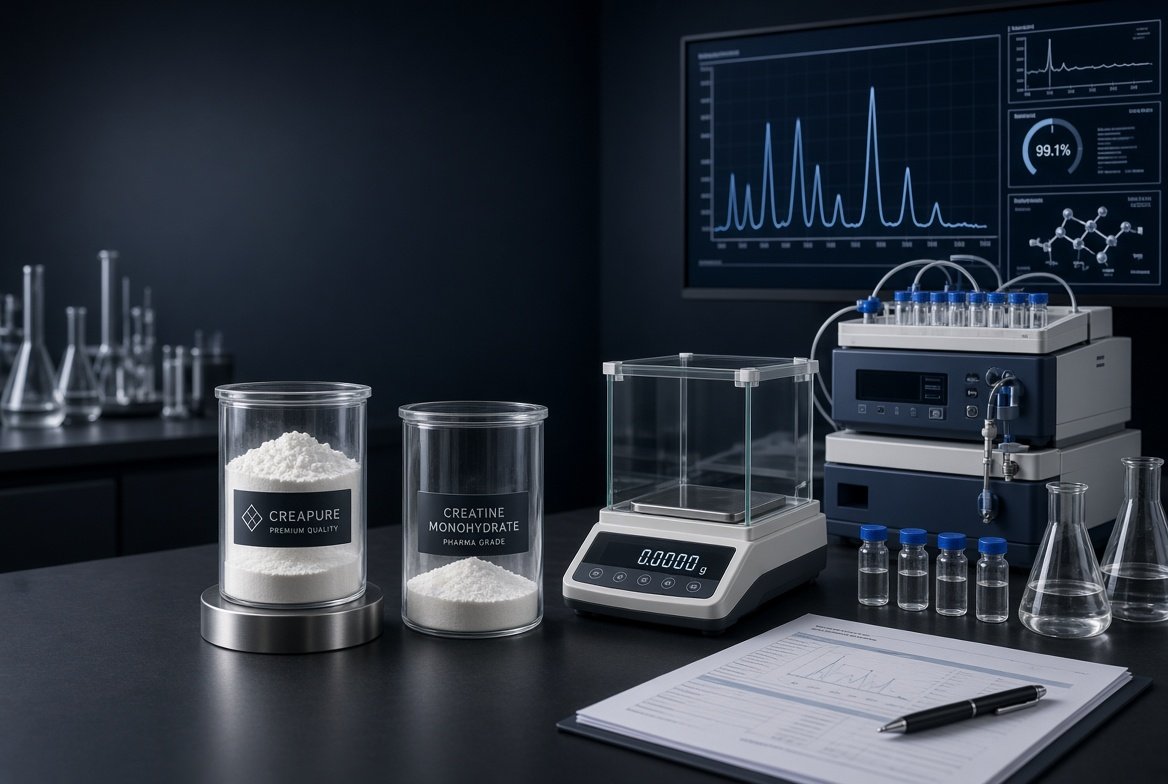
Creatine monohydrate is one of the most extensively researched ingredients in sports nutrition. Used by athletes, strength trainers, bodybuilders, and recreational fitness enthusiasts, it has earned considerable attention for its role in supporting short-duration, high-intensity physical performance. Despite its popularity, consumers face an increasingly complicated purchasing decision: should they choose premium branded creatine such as Creapure, or is generic creatine monohydrate equally suitable?
The discussion becomes more interesting when independent laboratory testing, Eurofins analytical services, and Informed Sport certification enter the picture. These names are frequently associated with supplement quality, ingredient verification, and contamination control. However, they do not all perform the same function, and understanding their differences is essential when evaluating a creatine product.
The creapure vs generic creatine monohydrate purity study eurofins informed sport topic brings together several important questions. Does branded creatine offer a measurable purity advantage? Can generic creatine meet the same chemical specifications? What does a laboratory purity analysis actually establish? Does Informed Sport certification guarantee that a product contains only pure creatine? And how should consumers interpret a certificate of analysis?
These questions deserve a careful, evidence-based examination rather than a simple branded-versus-unbranded comparison.
The central issue is not whether a premium label automatically makes a product better. It is whether the manufacturer can demonstrate the identity, purity, consistency, and quality of the ingredient through reliable documentation and appropriate testing.
This article examines the science behind creatine monohydrate, the distinction between Creapure and generic ingredients, the role of Eurofins laboratories, the purpose of Informed Sport testing, and the practical considerations that matter when selecting a supplement.
Biography Table and Key Information
Although this subject is a scientific product comparison rather than an individual’s biography, the requested biography-style table is useful as a structured reference. It identifies the principal ingredients, manufacturers, testing organizations, and quality concepts involved.
| Category | Details |
|---|---|
| Main subject | Creapure vs generic creatine monohydrate |
| Primary ingredient | Creatine monohydrate |
| Branded ingredient | Creapure® |
| Creapure manufacturer | Alzchem Trostberg GmbH |
| Manufacturing location | Trostberg, Bavaria, Germany |
| Claimed Creapure purity | At least 99.9%, according to its manufacturer |
| Generic creatine | Creatine monohydrate sold without the Creapure trademark |
| Important impurities | Creatinine, dicyandiamide (DCD), dihydrotriazine (DHT) |
| Common analytical technique | High-performance liquid chromatography (HPLC) |
| Independent testing organization | Eurofins |
| Sports supplement certification | Informed Sport |
| Informed Sport testing laboratory | LGC |
| Main purpose of purity testing | Verify identity, assay, and unwanted chemical residues |
| Main purpose of Informed Sport | Screen supplement batches for prohibited substances |
| Important quality documents | Certificate of Analysis (CoA), batch report, testing certificate |
| Relevant quality systems | GMP, HACCP, FSSC 22000, ISO/IEC 17025 |
| Main purchasing consideration | Verified ingredient identity, purity, traceability, and batch quality |
1. Understanding Creatine Monohydrate
Creatine is a naturally occurring nitrogen-containing compound found primarily in skeletal muscle. The human body produces it from amino-acid precursors, and smaller quantities are obtained through foods such as meat and fish.
Its primary role in exercise physiology involves the phosphocreatine energy system. This system helps regenerate adenosine triphosphate (ATP), the immediate energy source used by muscle cells.
During intense physical activity, ATP is broken down to release energy. Muscle cells have limited immediate ATP reserves, so they depend on energy-replenishment systems to sustain repeated muscular contractions.
Phosphocreatine helps replenish ATP rapidly, particularly during short periods of high-intensity exercise. This explains why creatine supplementation has become popular among people participating in resistance training, sprinting, and other activities involving repeated explosive movements.
What Is Creatine Monohydrate?
Creatine monohydrate consists of a creatine molecule associated with one molecule of water. It is a well-established supplemental form of creatine and has been investigated extensively in sports-nutrition research.
Its popularity comes from several characteristics:
- A substantial body of scientific research.
- Established manufacturing methods.
- A relatively straightforward chemical composition.
- Compatibility with different supplementation routines.
- Availability in powdered and capsule formulations.
- Extensive use in sports-nutrition products.
Creatine monohydrate should not be confused with creatine hydrochloride, buffered creatine, or other alternative formulations. These products may have different chemical characteristics, but monohydrate remains the principal reference form in the scientific literature.
The International Society of Sports Nutrition has identified creatine monohydrate as an effective supplement for improving high-intensity exercise capacity and supporting increases in lean body mass when combined with appropriate training. PMC+1
Why Purity Matters
The presence of creatine on a product label does not automatically establish that the powder consists entirely of the intended ingredient.
Manufacturing processes can produce residual substances, and inadequate purification or poor handling may introduce unwanted material.
A quality assessment should therefore consider more than the percentage of creatine in a sample. It should examine ingredient identity, unwanted chemical residues, microbial quality where relevant, heavy metals, manufacturing controls, and batch consistency.
This is the foundation of the creapure vs generic creatine monohydrate purity study eurofins informed sport discussion.
2. What Is Creapure?
BRANDED CREATINE INGREDIENT
Creapure® Creatin Monohydrat ProFuel (500g)
Creapure is a registered brand of creatine monohydrate produced by Alzchem Trostberg GmbH in Germany.
Unlike the generic description creatine monohydrate, Creapure identifies a particular ingredient associated with a specific manufacturer, production process, quality-control system, and traceability framework.
The brand is particularly well known in the sports-nutrition industry because it provides supplement manufacturers with an identifiable raw-material source.
Manufacturing and Production
Creapure is manufactured using chemical synthesis involving sarcosinate and cyanamide as starting materials.
According to the manufacturer’s quality information, production takes place in a dedicated facility in Trostberg, Bavaria. Its manufacturing approach incorporates documented controls, laboratory analysis, and batch-level quality checks. Creapure+1
The purpose of controlled manufacturing is to produce a consistent ingredient while minimizing unwanted chemical residues.
Creatine production requires careful control because incomplete reactions or inadequate purification may leave behind unwanted by-products.
The quality of the finished material depends on the complete manufacturing process, not simply the identity of its starting ingredients.
The 99.9% Purity Claim
One of Creapure’s most recognizable quality claims is its minimum purity specification of 99.9%.
This figure is important, but it needs to be interpreted correctly.
A purity percentage describes the proportion of material meeting a specified analytical definition under a particular test method. It does not independently establish that every conceivable contaminant is absent.
For example, a sample can have a high creatine assay while still requiring separate testing for particular chemical residues, heavy metals, or prohibited substances.
This is why a comprehensive quality assessment should consider multiple analytical measurements rather than relying on one headline percentage.
Creapure states that its batches undergo laboratory testing before release and that its production process is designed to control specific impurities. Creapure+1
The Importance of Batch Traceability
Traceability is another important feature of branded raw materials.
A manufacturer should be able to identify the ingredient’s production source, batch, analytical documentation, and supply-chain history.
Creapure uses a six-digit Quality Seal code on qualifying packaging. Consumers can use this code to verify whether a product belongs to its authorized partner network. Creapure+1
This provides a useful distinction between an authentic branded ingredient and a product that merely uses similar language in its marketing.
However, traceability should not be confused with independent verification of every aspect of the finished supplement. The brand’s raw-material quality and the finished product’s manufacturing quality remain separate considerations.
3. What Is Generic Creatine Monohydrate?
Análise de Pureza de Creatina: Qualidade, Segurança e Métodos Analíticos na Indústria de Suplementos
Generic creatine monohydrate refers to creatine sold without the Creapure trademark. It is not a separate chemical compound, nor does the word generic automatically mean inferior quality.
The essential ingredient is the same: creatine monohydrate.
However, generic creatine can come from different manufacturers, production facilities, suppliers, and distribution networks. Its quality depends on the processes and controls used by the particular producer.
This distinction is important because two generic products may have very different quality profiles.
One may come with a detailed certificate of analysis, documented manufacturing controls, and independent laboratory verification. Another may provide little information about its manufacturing origin or analytical results.
Does Generic Mean Lower Purity?
No. A generic creatine product can be highly pure.
A manufacturer using an effective synthesis process, appropriate purification procedures, and validated analytical testing can produce creatine monohydrate that meets demanding purity specifications.
The absence of a premium trademark does not establish that a product contains more impurities.
Likewise, an attractive package, low price, or claim of laboratory testing does not independently establish quality.
The correct approach is to examine the evidence for the individual product and batch.
Why Generic Creatine Can Differ
Several factors may contribute to differences between generic creatine products:
- Manufacturing technology and reaction control.
- Quality of starting materials.
- Purification and crystallization procedures.
- Drying and moisture-control conditions.
- Storage and transportation practices.
- Packaging and protection against contamination.
- Laboratory testing frequency.
- Supplier oversight and batch traceability.
These factors can influence the finished ingredient’s chemical composition and consistency.
Generic creatine should therefore be evaluated as a category containing different suppliers rather than as one uniform product.
Can Generic Creatine Reach 99.9% Purity?
Yes, it is chemically possible for a non-Creapure creatine monohydrate product to meet a 99.9% purity specification.
The important question is whether the manufacturer can demonstrate that result through a credible analytical report.
A marketing statement is not equivalent to a laboratory result. A certificate should identify the tested material, batch number, analytical method, measured value, and relevant acceptance criteria.
The creapure vs generic creatine monohydrate purity study eurofins informed sport comparison should therefore avoid treating branded and generic categories as automatic indicators of chemical quality.
The distinction is between documented and undocumented quality, not simply expensive and inexpensive powder.
4. The Chemical Impurities That Matter
Creatine monohydrate production involves chemical reactions that must be controlled carefully. Depending on the manufacturing process, residual starting materials and unwanted reaction by-products may require monitoring.
Three substances frequently discussed in creatine quality assessments are creatinine, dicyandiamide, and dihydrotriazine.
Creatinine
Creatinine is a breakdown product associated with creatine metabolism. It can also be relevant when examining the chemical quality of creatine raw materials.
Its presence should be interpreted according to the analytical method, concentration, and applicable specification.
A laboratory should distinguish creatinine from creatine rather than treating all related compounds as interchangeable.
Dicyandiamide (DCD)
Dicyandiamide is a chemical compound that may occur as an unwanted residue in certain creatine manufacturing pathways.
Its presence can provide information about the effectiveness of manufacturing and purification controls.
Testing for DCD is therefore relevant when evaluating raw-material quality.
Dihydrotriazine (DHT)
Dihydrotriazine is another manufacturing-related impurity discussed in creatine quality documentation.
Its potential presence makes it an important analytical consideration when assessing the quality of certain creatine ingredients.
Creapure’s manufacturer specifically identifies DHT and DCD as substances controlled through its production and analytical procedures. It reports that DHT is undetectable in its material and DCD remains below the applicable limits it references. Creapure+1
Why Testing Several Impurities Matters
A single purity number cannot answer every quality question.
For example, an assay indicating a high creatine concentration does not necessarily establish the absence of every unwanted reaction product.
A more complete assessment should consider:
- Creatine identity and assay.
- Creatinine concentration.
- DCD concentration.
- DHT concentration.
- Relevant heavy metals.
- Microbiological quality where appropriate.
- Moisture and other applicable physical specifications.
The exact testing panel should reflect the ingredient, manufacturing process, intended use, and relevant regulatory requirements.
This is why a detailed analytical certificate is more informative than a simple statement that a product is 100% pure.
5. Understanding the Eurofins Role in Creatine Purity Testing
Teste de creatina: como funciona a análise por HPLC e outras técnicas
Eurofins is an international laboratory testing organization that provides analytical services across food, supplements, pharmaceuticals, environmental testing, and other industries.
Its relevance to creatine quality comes from the role independent laboratories play in evaluating ingredient identity, chemical composition, and potential contaminants.
A supplement manufacturer may conduct its own quality-control testing, but independent analytical testing can provide an additional layer of verification.
What Can a Laboratory Test?
Creatine testing can involve several analytical questions.
Identity testing: Does the sample contain the ingredient declared on the label?
Assay testing: What proportion of the tested sample meets the defined creatine measurement?
Impurity testing: Are manufacturing-related residues present, and at what concentrations?
Contaminant testing: Are there unwanted substances such as heavy metals or microbiological contaminants?
Label verification: Does the finished product contain the declared amount of creatine per serving?
Eurofins specifically highlights the importance of validated testing for creatine identity, purity, creatinine, DCD, DHT, chemical contaminants, and microbial pathogens in supplement quality assessment. Eurofins
Why Independent Laboratory Testing Matters
Independent analysis can help reduce the information gap between manufacturers and consumers.
A company knows more about its production processes than a typical customer. Laboratory documentation provides measurable information that can be examined beyond promotional claims.
However, independent testing is only as useful as its scope.
A laboratory report that measures creatine concentration does not necessarily test for banned substances. A report that screens for banned substances does not necessarily provide a detailed assessment of chemical purity.
The report must be interpreted according to the actual tests performed.
What Does Eurofins Certification Mean?
It is important to avoid using the phrase Eurofins certified as though it automatically describes one universal supplement-quality certification.
Eurofins offers different testing and certification services, depending on the laboratory, product category, and analytical program.
A company may commission a specific test, receive an analytical report, or participate in a broader certification service. These arrangements are not identical.
Consumers should identify:
- The exact Eurofins laboratory involved.
- The name of the analytical service.
- The product and batch tested.
- The test methods used.
- The results and reporting limits.
- Whether the laboratory’s accreditation covers the particular method.
A report should never be interpreted as covering tests that were not actually performed.
Eurofins and the Importance of Method Validation
Analytical methods must be appropriate for the chemical being measured.
For creatine assay and related impurities, high-performance liquid chromatography is one of the relevant analytical techniques.
A properly developed method should demonstrate suitable selectivity, accuracy, precision, sensitivity, and reproducibility.
Method validation helps establish whether an analytical procedure can reliably measure the intended compound in the specific sample matrix.
This becomes especially important when the concentration of an unwanted impurity is very low.
A laboratory may report a result below its detection or quantification limit. That does not mean the substance is mathematically proven to be absent. It means the analytical procedure did not identify or quantify it above the relevant reporting threshold.
For that reason, phrases such as not detected should be interpreted alongside the method’s detection limit.
6. What Is Informed Sport Certification?
NOW Foods Creatine Monohydrate Powder – 600 g – One Last Rep
Informed Sport is a supplement testing and certification program established to help reduce the risk of prohibited-substance contamination in sports nutrition products.
It is particularly relevant to competitive athletes who are subject to anti-doping rules.
The program is operated through LGC’s analytical testing expertise and evaluates supplement batches for substances prohibited in sport.
According to its published program information, every batch of a certified product must be tested before commercial release. Products are also subject to ongoing blind testing and manufacturing oversight. Informed Sport+1
What Does Informed Sport Actually Test?
The program screens for substances that may create anti-doping risks.
Its published testing capabilities include more than 285 substances, covering categories such as:
- Anabolic agents.
- Stimulants.
- Beta-2 agonists.
- Diuretics.
- Masking agents.
- Drugs of abuse.
- Selected emerging prohibited substances.
The exact scope of testing and the substances included in an analytical panel can change over time. Informed Sport+1
Why Athletes Value This Certification
An athlete can purchase a supplement that contains the correct ingredient but still face a risk if the product is contaminated with a prohibited substance.
Such contamination may occur through shared production equipment, inadequate cleaning, contaminated raw materials, or weaknesses in supply-chain management.
Informed Sport addresses this concern through product and batch testing, manufacturer review, and ongoing monitoring.
Its value is therefore different from that of a conventional creatine purity test.
Does Informed Sport Guarantee 100% Pure Creatine?
No.
This is one of the most important distinctions in the entire discussion.
Informed Sport certification is primarily concerned with screening supplements for prohibited substances in sport. It should not automatically be interpreted as proof that a creatine product has a 99.9% creatine assay or contains no DCD, DHT, or creatinine.
Those questions require relevant chemical-purity testing.
Similarly, Informed Sport acknowledges that no supplement-testing program can screen for every possible substance on the World Anti-Doping Agency prohibited list. Informed Sport+1
The distinction can be summarized simply:
- Chemical-purity testing examines what the ingredient contains.
- Informed Sport testing examines the risk of prohibited-substance contamination.
- Manufacturing audits examine how the product is produced.
- Batch traceability establishes which material was tested and released.
These approaches can complement one another, but they are not interchangeable.
7. Eurofins vs Informed Sport: Understanding the Difference
Although both names are associated with laboratory quality and supplement confidence, they serve different purposes.
| Comparison | Eurofins | Informed Sport |
|---|---|---|
| Main function | Analytical testing and related certification services | Sports supplement testing and certification |
| Main focus | Depends on the commissioned test | Prohibited-substance contamination |
| Creatine assay | Can be assessed through an appropriate analytical service | Not the primary certification purpose |
| DCD testing | Available through appropriate chemical analysis | Not the primary certification purpose |
| DHT testing | Available through appropriate chemical analysis | Not the primary certification purpose |
| Banned-substance screening | Depends on the selected laboratory service | Central to the program |
| Batch testing | Depends on the testing agreement | Every batch before commercial release |
| Manufacturing oversight | Depends on the service | Part of the certification framework |
| Main consumer benefit | Evidence about specified chemical or product characteristics | Reduced risk of prohibited-substance contamination |
The most important point is that the name of a laboratory or certification program does not explain the complete scope of a test.
A consumer needs to know exactly what was measured and which batch was examined.
8. How a Proper Creapure vs Generic Purity Study Should Work
A meaningful comparison between Creapure and generic creatine requires a properly designed laboratory study.
Simply purchasing two tubs, comparing their labels, and reviewing their prices would not provide sufficient scientific evidence.
The investigation should use representative samples, consistent analytical procedures, and documented testing conditions.
Step 1: Select Representative Products
The study should include multiple products rather than relying on one branded sample and one generic sample.
For example, researchers could select several Creapure-based finished products and several generic creatine products from different manufacturers.
Each sample should be recorded with:
- Manufacturer.
- Product name.
- Ingredient declaration.
- Country of manufacture where verified.
- Batch or lot number.
- Expiry date.
- Packaging condition.
- Purchase location and date.
The researchers should also distinguish raw-material samples from finished consumer products.
A finished powder may contain flavouring agents, anti-caking ingredients, or other components that affect analytical interpretation.
Step 2: Establish a Standardized Testing Protocol
All samples should undergo the same relevant testing procedures.
The protocol should define the sample preparation method, analytical equipment, calibration standards, reporting limits, and acceptance criteria.
This reduces the possibility that differences in sample handling or laboratory procedures will distort the comparison.
Step 3: Measure Creatine Identity and Assay
The first question is whether each product contains creatine monohydrate as declared.
The next question is how much creatine is present.
An HPLC-based method may be used when properly validated for the sample and measurement.
The result should be reported with appropriate units and uncertainty information where available.
Step 4: Measure Manufacturing-Related Impurities
The analysis should include creatinine, DCD, and DHT where relevant.
These measurements help identify differences in the chemical quality of the raw materials.
A result should be reported numerically whenever possible rather than described only as pass or fail.
Step 5: Examine Other Quality Indicators
Depending on the product and risk assessment, researchers may also investigate heavy metals, microbiological quality, moisture, and packaging integrity.
Not every product requires an identical expanded panel, but the study should explain why particular tests were selected.
Step 6: Verify the Batch Documentation
A laboratory result is useful only when it can be connected to the material actually sold.
Researchers should verify that the sample’s batch number corresponds to the accompanying certificate and that the report has not been reused from a different production run.
Step 7: Compare Results Objectively
The final analysis should report the individual results, averages, ranges, and any meaningful differences.
It should also identify limitations, including sample size and the possibility that products from the same manufacturer may differ between batches.
This is the standard needed to make a credible comparison rather than an unsupported marketing argument.
9. An Important Evidence Limitation: Is There a Verified Eurofins Side-by-Side Study?
The search phrase creapure vs generic creatine monohydrate purity study eurofins informed sport suggests that a specific comparative laboratory investigation may exist.
However, the publicly available material reviewed for this article does not establish a complete, independently published Eurofins study directly comparing multiple Creapure and generic creatine products using identical analytical methods and disclosed batch-level results.
Eurofins provides information about creatine supplement safety and the importance of testing relevant impurities. Creapure publishes its own manufacturing and quality specifications. Informed Sport describes its separate banned-substance certification process. These sources should not be combined into a claim that Eurofins has independently proven every Creapure product superior to every generic product. Eurofins+2
This distinction is crucial.
A credible article should not invent laboratory measurements, percentages, sample sizes, or conclusions that cannot be traced to an actual study.
If a particular Eurofins report is available, its report number, sample identities, testing methods, and results should be examined before making a direct comparison.
Until then, the scientifically defensible conclusion is that Creapure offers a documented branded manufacturing and batch-control system, while generic products must be evaluated individually through their own evidence.
10. Certificate of Analysis: What Consumers Should Look For
A Certificate of Analysis (CoA) is one of the most useful documents when evaluating supplement quality.
It provides analytical information about a particular ingredient or product batch. However, not all certificates contain the same level of detail.
A good CoA should identify the tested material, relevant specifications, analytical methods, and actual results.
Essential Information in a CoA
| CoA element | Why it matters |
|---|---|
| Product identification | Confirms which ingredient was tested |
| Batch number | Connects the report to a specific production lot |
| Manufacturing date | Helps establish production history |
| Testing date | Shows when the analysis occurred |
| Analytical method | Explains how the measurement was performed |
| Creatine assay | Measures the declared ingredient |
| Creatinine result | Indicates the measured level of this related compound |
| DCD result | Reports the concentration of dicyandiamide |
| DHT result | Reports the concentration of dihydrotriazine |
| Heavy metals | Provides information about selected elemental contaminants |
| Microbiological results | Addresses relevant microbial risks |
| Authorized approval | Identifies the person or laboratory approving the report |
Why Batch Numbers Are Important
A company might publish an impressive laboratory report, but consumers need to know whether it applies to the product they actually purchased.
Imagine a manufacturer publishes a CoA showing 99.9% creatine purity. If the report belongs to a batch produced two years earlier, it does not automatically establish the quality of the current batch.
The same principle applies to third-party testing.
A report should match the product’s lot number whenever batch-specific verification is claimed.
Understanding Pass, Fail, and Not Detected
Laboratory reports often use three types of result descriptions.
Pass: The tested parameter meets the specified acceptance criterion.
Fail: The result does not meet the applicable specification.
Not detected: The analytical method did not detect the substance above its relevant detection threshold.
Not detected does not mean that a substance is scientifically proven to be completely absent. It means the substance was not detected at a level the method could identify.
This distinction is particularly important when interpreting trace impurities.
11. ISO/IEC 17025 and Laboratory Reliability
Laboratory accreditation is another important consideration.
ISO/IEC 17025 is an international standard addressing the competence of testing and calibration laboratories.
It evaluates factors such as laboratory management systems, technical competence, measurement procedures, equipment control, and the reliability of analytical results.
In the supplement industry, accreditation can help consumers and manufacturers assess the credibility of laboratory testing.
However, accreditation must be considered in context.
A laboratory may be accredited for certain analytical methods but not necessarily every test it offers. The specific method and scope of accreditation should therefore be examined.
Informed Sport identifies ISO/IEC 17025-accredited analytical methods as an important part of its testing framework. Informed Sport+1
Why Accreditation Is Not the Same as Product Certification
These terms are sometimes confused.
- Laboratory accreditation concerns the technical competence of a laboratory within its accredited scope.
- Product certification concerns whether a particular product meets defined requirements.
- Manufacturing certification concerns the systems and processes used to produce goods.
- Analytical testing provides measurements of specific product characteristics.
A creatine product does not become 99.9% pure simply because it has been tested by an accredited laboratory.
The actual result must demonstrate that level of purity.
12. Creapure vs Generic: Price, Value, and Consumer Expectations
Price is one of the most visible differences between branded and generic creatine products.
Creapure products often cost more than conventional creatine monohydrate. This premium may reflect ingredient sourcing, licensing, manufacturer documentation, supply-chain traceability, and quality-control arrangements.
Generic products may be less expensive because they use alternative suppliers, different distribution arrangements, or different branding strategies.
However, a higher price does not automatically establish a better finished product.
When the Creapure Premium May Be Worthwhile
The premium may be worthwhile for consumers who value:
- A clearly identifiable raw-material manufacturer.
- A recognizable ingredient trademark.
- Documented manufacturing procedures.
- Batch-level quality-control information.
- Supply-chain traceability.
- A verifiable branded ingredient seal.
These features can reduce uncertainty about the ingredient’s origin and manufacturing history.
When Generic Creatine May Offer Better Value
Generic creatine can represent good value when the manufacturer provides credible documentation and the product meets appropriate quality specifications.
For instance, a generic product with a current, batch-specific analytical certificate may offer strong evidence of ingredient quality.
Consumers should compare the actual evidence rather than assuming that every inexpensive product is inferior.
Is Paying More Always Necessary?
No.
If two products contain the same chemically verified creatine monohydrate, meet comparable purity specifications, and have appropriate manufacturing and testing controls, the more expensive product does not necessarily offer superior physiological benefits.
The difference may be primarily in the supply chain, documentation, and assurance systems.
This is the central commercial lesson of the creapure vs generic creatine monohydrate purity study eurofins informed sport comparison: consumers should pay for demonstrable quality rather than marketing language alone.
13. Does Creatine Purity Affect Performance?
Creatine purity is important for product quality, but it is necessary to distinguish chemical quality from physiological effectiveness.
Creatine monohydrate works by increasing the availability of creatine and phosphocreatine in muscle tissue.
When supplementation is combined with suitable exercise, it can support improvements in repeated high-intensity performance and training adaptations.
However, a product containing 99.9% creatine is not automatically more effective in the body than another properly manufactured product containing chemically equivalent creatine monohydrate at a comparable purity.
The primary requirement is that the product supplies the intended ingredient in an appropriate and accurately declared amount.
Creatine and Muscle Energy
During intense exercise, muscle cells use ATP to generate force.
Phosphocreatine contributes to ATP regeneration through the creatine kinase reaction.
This mechanism is particularly relevant to activities involving short, powerful efforts, including weightlifting, jumping, and repeated sprinting.
Creatine and Resistance Training
Research suggests that creatine monohydrate can improve the capacity to perform high-intensity exercise and support increases in lean body mass when used alongside resistance training.
These outcomes depend on several factors, including training quality, diet, supplementation consistency, and individual response.
Does Creapure Build More Muscle Than Generic Creatine?
There is no established physiological advantage simply because creatine comes from the Creapure brand.
If two products provide equivalent quantities of genuinely pure creatine monohydrate, there is no established reason to expect the branded ingredient to produce superior muscle growth solely because of its trademark.
The more meaningful distinction is whether both products actually meet comparable identity, purity, and quality standards.
14. Recommended Creatine Use and General Safety Considerations
Creatine monohydrate is commonly used in daily quantities of approximately 3–5 grams by healthy adults.
A loading phase is not essential. Consistent daily supplementation can gradually increase muscle creatine stores without a loading protocol.
People should follow the directions on the specific product and avoid assuming that larger quantities necessarily produce better results.
Hydration
Normal hydration practices are important when exercising and using creatine.
There is no universal requirement to consume excessive amounts of water simply because creatine is being taken. Fluid intake should reflect activity level, environmental conditions, and individual requirements.
Kidney Health and Medical Considerations
Creatine can affect measured blood creatinine levels, which may complicate interpretation of some kidney-function tests.
Anyone with existing kidney disease, a history of kidney problems, or a relevant medical condition should consult a qualified healthcare professional before beginning supplementation.
People taking medications that may affect kidney function should also seek individualized advice.
Pregnant or breastfeeding individuals should obtain professional medical guidance before using sports supplements.
Product Quality and Safety Are Different Questions
A pure ingredient is not necessarily appropriate for every person.
Similarly, an Informed Sport-tested product is not a substitute for medical advice or a balanced nutritional plan.
Product quality, anti-doping assurance, and personal suitability should be considered separately.
15. Common Mistakes When Comparing Creatine Products
Consumers frequently make several avoidable mistakes when researching creatine.
Mistake 1: Assuming All Generic Creatine Is Low Quality
Generic describes the absence of a particular trademark, not a universal chemical standard.
Some generic products may be manufactured under strong quality-control systems.
Mistake 2: Assuming 99.9% Purity Means Zero Contamination
A purity percentage does not establish the absence of every possible contaminant.
Separate testing may be needed for particular chemical impurities, heavy metals, microbiological risks, and prohibited substances.
Mistake 3: Confusing Eurofins Testing With Informed Sport Certification
These are not interchangeable quality indicators.
A chemical analysis and a banned-substance screening program answer different questions.
Mistake 4: Trusting an Old Certificate
A certificate must correspond to the relevant batch.
A document from an earlier production run cannot automatically verify the contents of a newly purchased container.
Mistake 5: Treating Made in Germany as a Complete Quality Guarantee
Manufacturing origin can provide useful context, but country of origin alone does not replace analytical evidence.
The same principle applies to products manufactured in other countries.
Mistake 6: Assuming Informed Sport Tests Every Possible Contaminant
The program focuses on prohibited substances in sport. Its certification should not be interpreted as a comprehensive chemical-purity report for every ingredient.
Mistake 7: Believing More Expensive Creatine Produces Better Results
Once comparable ingredient identity, purity, and dosage are established, price alone does not demonstrate greater physiological effectiveness.
16. A Practical Framework for Choosing Between Creapure and Generic Creatine
A sensible purchasing decision begins with the evidence available for the specific product.
Consumers can use the following framework to compare alternatives.
| Evaluation factor | What to look for |
|---|---|
| Ingredient identity | Explicit creatine monohydrate declaration |
| Ingredient origin | Identifiable manufacturer and supplier |
| Purity specification | Clear analytical specification |
| Certificate of Analysis | Current, relevant, batch-specific documentation |
| Creatinine | Measured result and applicable limit |
| DCD | Measured result and applicable limit |
| DHT | Measured result and applicable limit |
| Heavy metals | Relevant laboratory screening |
| Manufacturing controls | GMP and appropriate food-safety systems |
| Independent analysis | Credible laboratory and suitable methods |
| Anti-doping assurance | Verified Informed Sport certification when relevant |
| Authenticity | Verifiable branding and batch information |
| Value | Price relative to documented quality |
A Simple Decision Example
Consider two hypothetical products.
Product A contains Creapure and provides documentation identifying the raw-material manufacturer, batch, and relevant purity specifications.
Product B uses generic creatine monohydrate and provides an independent laboratory report showing comparable creatine assay and relevant impurity results.
If both reports are credible, current, and comparable, the generic product may represent a reasonable alternative.
Now consider a third product with no identifiable manufacturer, no batch information, and only a broad statement that it is 100% pure.
Even if that product is inexpensive, consumers have considerably less evidence on which to base a quality decision.
The comparison demonstrates why documentation matters more than the distinction between branded and generic labels alone.
17. The Future of Creatine Quality Testing
The sports-nutrition industry is increasingly focused on transparency, supply-chain documentation, and independent verification.
As consumer awareness grows, manufacturers face greater pressure to explain where ingredients originate and how their quality is established.
Laboratory analysis is likely to remain an important part of this development.
Modern analytical instruments can detect and quantify increasingly small concentrations of chemical compounds. More advanced methods can also improve the identification of substances in complex supplement formulations.
However, better equipment alone does not guarantee better quality assurance.
Manufacturers must also establish appropriate sampling procedures, validated methods, reliable documentation, and effective supplier controls.
Third-party testing programs can strengthen confidence, but consumers must understand what each program actually evaluates.
The relationship between ingredient manufacturers, analytical laboratories, supplement brands, and certification organizations will remain important as the market develops.
For creatine buyers, the most valuable future development will be greater access to transparent, batch-specific quality information.
Frequently Asked Questions (FAQs)
1. Is Creapure better than generic creatine monohydrate?
Creapure offers a clearly identifiable branded ingredient, specific manufacturing controls, and documented batch testing. However, generic creatine can also achieve high purity when produced and tested properly. The best comparison is between the actual quality documentation of individual products.
2. Is Creapure really 99.9% pure?
Creapure’s manufacturer specifies a minimum purity of 99.9%. It also describes batch-level analytical testing and manufacturing controls. Consumers should distinguish this manufacturer specification from an independent test result for a particular finished supplement.
3. Does Eurofins test creatine purity?
Eurofins provides analytical testing services relevant to creatine supplement quality. Its published guidance discusses identity, assay, creatinine, DCD, DHT, chemical contaminants, and microbiological testing. The precise tests depend on the laboratory service commissioned.
4. What does Informed Sport certification mean for creatine?
It means the certified product participates in a program designed to screen supplement batches for substances prohibited in sport. It provides additional assurance for athletes concerned about contamination and anti-doping risks.
5. Does Informed Sport guarantee 99.9% creatine purity?
No. Informed Sport primarily addresses prohibited-substance contamination. A separate chemical-purity analysis is needed to establish creatine assay and relevant manufacturing impurities.
6. What is the difference between DCD and DHT?
DCD stands for dicyandiamide, while DHT refers to dihydrotriazine in the context of creatine manufacturing discussions. Both are relevant unwanted chemical residues that may be examined during ingredient-quality assessments.
7. Can generic creatine have the same purity as Creapure?
Yes. A generic manufacturer can produce creatine monohydrate that meets comparable purity specifications. The important requirement is credible evidence from suitable laboratory testing.
8. What does HPLC mean in creatine testing?
HPLC stands for high-performance liquid chromatography. It is an analytical technique used to separate and measure chemical compounds within a sample. It can be used for creatine assay and certain related impurity measurements when an appropriate method has been validated.
9. Is a Certificate of Analysis enough to prove creatine quality?
A CoA is useful, but its value depends on its completeness and credibility. It should identify the product and batch, show relevant analytical results, explain the testing methods, and come from an appropriate laboratory or quality-control system.
10. Does made in Germany mean creatine is automatically pure?
No. Country of origin can provide information about manufacturing location, but purity must be established through appropriate analytical testing and quality controls.
11. Should athletes choose Informed Sport-certified creatine?
Athletes subject to anti-doping regulations may find Informed Sport certification particularly useful because it provides additional protection against prohibited-substance contamination. They should still verify the product and batch and understand that no testing program can eliminate every possible risk.
12. Is expensive creatine always better?
No. Price can reflect branding, sourcing, manufacturing, and testing arrangements, but it is not a direct measurement of purity. Consumers should evaluate documented quality and the actual cost per serving.
13. Is creatine monohydrate more effective than other creatine forms?
Creatine monohydrate has the strongest established research foundation among commonly marketed creatine supplements. Alternative formulations should not automatically be considered superior simply because they are newer or more expensive.
14. Can creatine be taken every day?
Creatine monohydrate is commonly used daily by healthy adults, including on rest days. Consistency is generally more important than taking it only on workout days. Individuals with medical concerns should obtain professional guidance.
15. What is the most important factor when buying creatine?
The most important factor is evidence of product quality. Consumers should prioritize accurate ingredient identification, appropriate purity testing, batch traceability, responsible manufacturing, and relevant third-party verification.
A More Informed Standard for Creatine Quality
The comparison between Creapure and generic creatine monohydrate demonstrates why supplement quality should be evaluated through evidence rather than assumptions.
Creapure provides a recognizable branded ingredient supported by a dedicated manufacturing facility, documented production procedures, and batch-level analytical controls. Its 99.9% purity specification is an important part of its quality positioning.
Generic creatine, however, should not automatically be dismissed. Products from other manufacturers may achieve comparable chemical purity when their production and purification procedures are properly controlled and their analytical results are credible.
Eurofins contributes to the wider quality-assurance discussion through analytical services that can assess creatine identity, concentration, and relevant contaminants. Informed Sport addresses another important concern by screening certified supplement batches for prohibited substances in sport.
These systems serve complementary purposes. Neither should be presented as a substitute for the other.
Ultimately, the creapure vs generic creatine monohydrate purity study eurofins informed sport subject highlights a broader lesson for the sports-nutrition industry: transparency, traceability, analytical accuracy, and responsible manufacturing are more meaningful indicators of quality than a product’s price or marketing claims.
A well-informed consumer should be able to identify the ingredient, understand its manufacturing origin, examine relevant laboratory results, and determine exactly what a certification does and does not guarantee. That is the foundation of a more trustworthy supplement market.
