
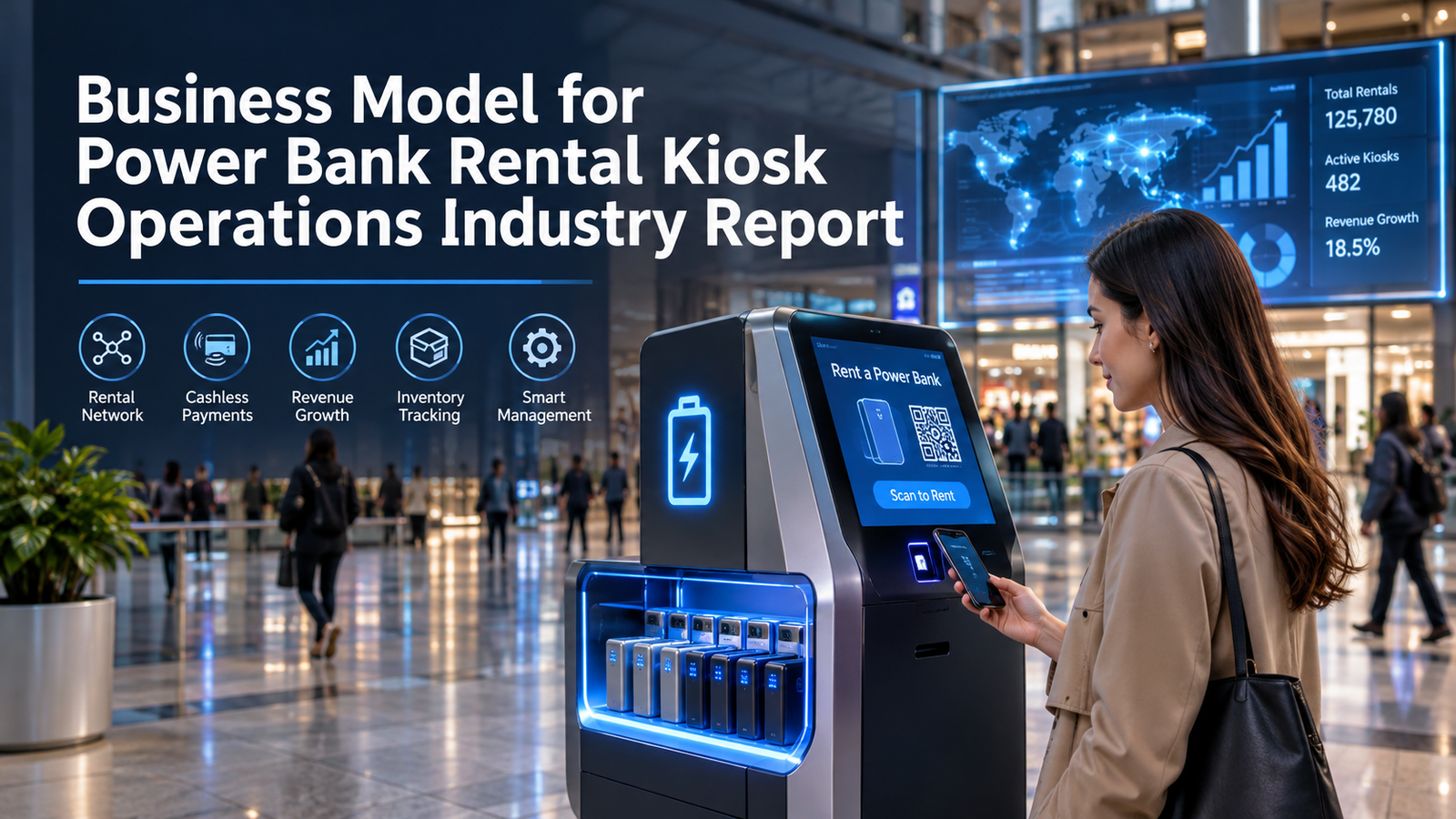
Industry analysis • Business strategy • Technology • Revenue models • Market opportunities
Introduction
The rapid expansion of smartphones, wireless devices, digital payments, and location-based services has created a growing need for convenient portable charging solutions. Consumers increasingly depend on their mobile devices for communication, navigation, entertainment, banking, shopping, transportation, and professional activities. However, battery capacity remains a practical limitation. Even modern smartphones with improved batteries can run out of power during long working days, travel, shopping trips, social events, or extended outdoor activities.
Power bank rental kiosks offer a practical solution to this problem. Instead of purchasing a portable charger or carrying one throughout the day, customers can rent a fully charged power bank from an automated station, use it while moving between locations, and return it to another participating kiosk. This arrangement combines shared-device infrastructure, automated payments, mobile applications, and location-based convenience into a service-oriented business.
The business model for power bank rental kiosk operations industry report examines how companies establish, manage, and monetize these networks. It considers the commercial foundations of the industry, including equipment procurement, kiosk placement, rental pricing, customer acquisition, technology infrastructure, maintenance, partnerships, and financial sustainability.
Unlike traditional electronics retail, a power bank rental operation does not depend primarily on selling hardware to individual customers. Its central commercial objective is to maintain a network of reusable charging devices that generate recurring rental revenue. Each power bank represents a revenue-producing asset, while each kiosk functions as a distribution, collection, and transaction point.
The business model for power bank rental kiosk operations industry report is particularly relevant to entrepreneurs, technology investors, retail operators, shopping-centre managers, hospitality businesses, transportation companies, and organizations exploring shared-device services. It provides a framework for understanding the operational requirements and financial considerations involved in developing this type of business.
The industry’s potential depends on several interconnected factors. These include smartphone usage, customer willingness to pay for temporary charging access, the availability of suitable locations, rental frequency, equipment durability, and the efficiency of the return network. A company may own excellent charging equipment but still struggle commercially if customers cannot find convenient stations or if devices are frequently unavailable.
For this reason, power bank rental kiosks should be evaluated as a complete service network rather than simply a collection of charging machines. Successful operations require an appropriate balance between infrastructure investment, user experience, network density, asset utilization, and operating costs.
This report explores those elements in detail and explains how operators can build a commercially sustainable power bank rental business.
Industry Overview: Understanding Power Bank Rental Kiosk Operations
The power bank rental industry belongs to the broader shared-mobility and shared-consumer-electronics economy. Its underlying principle is simple: consumers pay for temporary access to a useful physical asset instead of purchasing and maintaining that asset themselves.
The concept resembles other rental-based services, including bicycle sharing, car sharing, equipment rental, and short-term access to public charging facilities. However, power bank rental operations have their own commercial characteristics because the products are relatively compact, portable, and frequently used in environments where people spend time away from home.
A typical rental network consists of several components:
- Automated power bank rental kiosks.
- Rechargeable portable battery units.
- Charging slots and electronic locking systems.
- Customer-facing mobile applications or payment interfaces.
- Cloud-based management software.
- Digital payment processing.
- Location partners and commercial agreements.
- Maintenance and equipment replacement services.
- Customer support and operational monitoring.
These components work together to create a connected service.
A customer approaches a kiosk, scans a QR code or uses another supported payment method, completes the rental transaction, and removes a charged power bank. The customer then uses the device to recharge a smartphone or another compatible electronic product. Depending on the operator’s network rules, the power bank may be returned to the original station or another participating kiosk.
The ability to return a device at a different location can be particularly attractive. It allows customers to move freely without planning their entire journey around the original rental point.
The business model for power bank rental kiosk operations industry report identifies this flexibility as an important commercial advantage. A sufficiently connected network can become more useful as the number of participating locations increases.
However, network expansion also creates operational complexity. Operators must monitor where power banks are located, ensure that stations have sufficient available inventory, and maintain reliable return capacity.
Biography Table: Business Model at a Glance
Because this report examines an industry and commercial operating model rather than an individual person, the biography table is presented as an industry profile.
| Category | Details |
|---|---|
| Industry name | Power bank rental kiosk operations |
| Industry category | Shared electronics and charging services |
| Business type | Technology-enabled rental service |
| Primary product | Portable rechargeable power banks |
| Main infrastructure | Automated rental and return kiosks |
| Core customers | Smartphone users, travelers, shoppers, commuters, and event visitors |
| Main revenue source | Power bank rental fees |
| Additional revenue sources | Memberships, advertising, partnerships, and business-to-business services |
| Primary sales channel | Physical kiosk network and digital application |
| Technology requirements | IoT connectivity, cloud software, QR codes, payment systems, and inventory management |
| Main operating expenses | Hardware, battery replacement, maintenance, software, rent, payment processing, and logistics |
| Important business partners | Shopping centres, restaurants, hotels, transport hubs, event organizers, and retailers |
| Key performance indicators | Rental frequency, utilization, revenue per kiosk, return rate, and equipment availability |
| Major commercial risks | Low demand, poor locations, equipment loss, battery degradation, and regulatory requirements |
| Expansion strategy | Location partnerships, network density, franchise arrangements, and regional deployment |
| Long-term objective | Sustainable recurring revenue through an efficient shared charging network |
The table provides a foundation for understanding the industry. Individual operators may use different pricing systems, ownership arrangements, technology platforms, and distribution strategies.
Global Market Landscape and Industry Development
The power bank rental business has developed alongside the growth of the smartphone economy and the broader adoption of shared consumer services. Although portable battery products have existed for many years, the rental model changes how consumers access them. Instead of purchasing an individual device, customers obtain temporary access through a distributed network.
The market is not uniform across countries. Consumer payment habits, smartphone penetration, commercial property structures, rental regulations, and the availability of competing charging facilities all influence the commercial opportunity.
Asia-Pacific has a particularly important position in the shared power bank ecosystem. Dense urban environments, extensive food-service industries, high smartphone usage, and established QR-payment habits have supported the development of station-based rental networks. Other regions are exploring the model through shopping centres, entertainment destinations, transportation locations, and hospitality partnerships.
Market research published during 2026 illustrates the growing commercial attention surrounding this sector. For example, Emergen Research published a power bank sharing services market forecast covering 2024–2035, while other research providers use different market definitions and forecasting methods. Industry Report 2035+2
These figures should not automatically be treated as interchangeable. Some research studies include the wider shared charging ecosystem, while others measure only consumer rental expenditure, particular equipment categories, or specific service models. Differences in geographic coverage, revenue definitions, and forecasting assumptions can produce substantially different estimates.
For investors, this distinction is essential. A large headline market estimate does not establish the profitability of a particular kiosk, city, or operator. Commercial decisions should be based on local demand, realistic rental frequency, customer acquisition costs, venue commissions, equipment prices, and operating expenses.
Major Regional Characteristics
| Region | Commercial characteristics | Important considerations |
|---|---|---|
| Asia-Pacific | Established shared charging ecosystems in several major markets | Competition, network density, pricing, and location access |
| Europe | Opportunities in hospitality, retail, tourism, and public venues | Consumer privacy, payment preferences, electrical and battery compliance |
| North America | Potential in shopping centres, events, campuses, and transportation locations | Venue acquisition costs, customer awareness, and operating economics |
| Middle East | Opportunities in malls, hotels, airports, and entertainment destinations | Climate, tourism patterns, venue agreements, and local payment integration |
| South Asia | Potential in urban retail, transport, hospitality, and educational environments | Price sensitivity, payment accessibility, power reliability, and maintenance |
| Latin America | Opportunities in urban commercial and entertainment districts | Distribution, security, equipment servicing, and payment infrastructure |
The business model for power bank rental kiosk operations industry report should therefore be applied through a regional assessment rather than a single global operating assumption.
Core Business Model: How Power Bank Rental Kiosks Generate Revenue
The central business model is based on temporary access to portable charging equipment. The operator owns or controls the power banks and rental infrastructure, while customers pay for the convenience of using the equipment when required.
The commercial process normally follows a sequence.
- The operator purchases or manufactures compatible power banks and kiosks.
- Stations are installed at selected commercial locations.
- Customers discover available stations through signage, applications, QR codes, or venue recommendations.
- Customers complete a rental transaction.
- A charged power bank is released from the kiosk.
- The customer uses the device while moving around.
- The power bank is returned to an approved station.
- The operator collects rental revenue and maintains the equipment for subsequent transactions.
The business can be managed directly by one company or through a network of independent venue partners.
1. Pay-Per-Use Rental Model
The pay-per-use model is one of the simplest approaches. Customers pay according to the duration of their rental or a predefined usage period.
For example, an operator might charge a customer a small fee for an initial rental period and additional fees for extended use. Some services also establish a maximum daily charge to make longer rentals more predictable.
The main advantage is simplicity. Customers understand that they pay for the period during which they use the equipment.
The operator benefits because revenue is directly connected to rental activity. A station receiving frequent rentals has the potential to generate more income than an identical station with limited usage.
However, pricing must be carefully designed. Excessively high charges can discourage adoption, while prices that are too low may not cover equipment depreciation, venue commissions, transaction fees, and maintenance.
2. Subscription-Based Rental Model
A subscription model allows customers to pay a recurring fee for defined access privileges.
Possible arrangements include:
- Monthly charging memberships.
- A limited number of rentals per month.
- Discounted hourly or daily rental rates.
- Membership benefits across multiple participating venues.
- Premium customer-support arrangements.
Subscriptions can improve revenue predictability because the operator receives recurring payments rather than depending entirely on individual rental transactions.
Nevertheless, unlimited rental subscriptions require careful financial controls. Heavy users may consume more equipment capacity than their membership revenue justifies.
Operators should establish reasonable usage limits, transparent terms, and appropriate rules for late returns or unreturned devices.
3. Business-to-Business Deployment Model
In a business-to-business arrangement, the operator provides charging infrastructure to commercial organizations.
A shopping centre, hotel, restaurant group, university, or entertainment venue may pay for a rental station or agree to a revenue-sharing arrangement.
The commercial relationship can take several forms:
- Fixed monthly equipment rental.
- Installation and management contracts.
- Revenue-sharing agreements.
- White-label charging services.
- Corporate charging access packages.
- Managed kiosk services.
This model can be attractive because venue partners provide access to an existing customer base. It can also reduce the operator’s dependence on direct advertising and individual customer acquisition.
4. Franchise and Network Partnership Model
A franchise structure allows independent business owners to operate kiosks using an established brand, technology platform, and operating system.
The franchisor may provide equipment, software access, branding, technical assistance, and training. Franchisees invest in local deployment and earn a share of the revenue.
Potential income for the central company includes:
- Franchise fees.
- Equipment sales.
- Software subscriptions.
- Transaction commissions.
- Maintenance contracts.
- Regional licensing fees.
Franchising can accelerate geographic expansion, but it requires clear quality standards. Poorly maintained stations operated by independent partners can damage the reputation of the entire network.
5. Advertising-Supported Revenue Model
Modern kiosks can incorporate digital displays, promotional panels, or branded surfaces.
This creates an additional commercial opportunity. A kiosk positioned in a busy shopping centre may offer advertising space to local retailers, restaurants, consumer brands, event organizers, and service providers.
Advertising revenue can supplement rental income, particularly in high-visibility locations.
However, advertising should not interfere with the main customer experience. Rental instructions, pricing, safety information, and return guidance must remain easy to understand.
Customer Segments and Demand Analysis
Understanding the target customer is essential for determining where kiosks should be installed and how rental prices should be structured.
Not every smartphone owner is a likely rental customer. Demand is concentrated among people who experience battery shortages while away from their normal charging facilities.
Travelers and Tourists
Travelers frequently depend on smartphones for electronic tickets, maps, hotel reservations, translation, transportation applications, and communication.
A low battery can interrupt several important activities simultaneously. Rental kiosks at airports, railway stations, bus terminals, hotels, and tourist attractions can therefore offer considerable convenience.
Travelers may also value flexible returns because their journeys involve movement between different locations.
Shopping Centre Visitors
Shopping centres are attractive environments because customers may spend several hours visiting shops, restaurants, entertainment areas, and service facilities.
Long visits increase the possibility that a smartphone battery will become depleted.
A charging kiosk near a food court, information desk, entrance, or entertainment zone can address this demand.
Restaurant and Café Customers
Restaurants and cafés provide another promising customer segment.
People frequently use smartphones while waiting for food, communicating with friends, making payments, taking photographs, and accessing entertainment.
A compact charging station can become an additional customer amenity without requiring restaurant employees to manage individual chargers.
Event Visitors
Concerts, exhibitions, sporting events, festivals, and conferences can create temporary spikes in charging demand.
Visitors may spend extended periods at venues while using smartphones to record content, communicate, access tickets, and navigate crowded locations.
Event-based deployments may generate high rental activity during short periods, although operators must account for seasonal demand and equipment redistribution.
Students and Campus Communities
Universities and colleges contain concentrated populations of smartphone users.
Students may need charging facilities between classes, during examinations, in libraries, or while participating in campus activities.
Educational institutions can also offer suitable opportunities for long-term partnerships, particularly where the operator provides transparent pricing and convenient return facilities.
Hospital Visitors and Healthcare Facilities
Hospitals are another potential application. Visitors, patients, and accompanying family members may remain inside facilities for extended periods.
However, healthcare deployments require particular attention to hygiene, accessibility, electrical safety, and institutional policies.
Charging infrastructure must never obstruct emergency routes or interfere with medical equipment.
Choosing the Right Kiosk Locations
Location selection is one of the most important determinants of profitability.
A power bank rental kiosk is a physical service business. Even when transactions are completed digitally, customers must be able to find, access, and return the equipment.
A station with excellent hardware in an inconvenient location may perform worse than a smaller unit positioned near a natural customer gathering point.
Foot Traffic and Customer Intent
Foot traffic alone is insufficient.
A crowded corridor may produce many passing visitors but relatively few customers with an immediate charging need. Conversely, a quieter waiting area may contain people who remain in one location for an extended period.
Operators should evaluate:
- Average daily visitors.
- Average customer dwell time.
- Smartphone usage patterns.
- Availability of electrical outlets.
- Existing charging alternatives.
- Peak and off-peak traffic.
- Customer demographics.
- Nearby complementary businesses.
- Visibility and ease of access.
The strongest locations combine meaningful foot traffic with a clear charging requirement.
Location Categories
FOOD CENTRAL, CHADSTONE — MTRDC
Shopping malls
Suitable for long customer visits, dining areas, entertainment zones, and retail partnerships.
Heathrow closure disrupts UK flights in 2025
Airports and transport terminals
Useful for travelers who rely on smartphones for tickets, navigation, and communication.
Restaurants and cafés
Offer opportunities for compact stations and venue revenue-sharing agreements.
Live from Populous: Designing for Music | Populous
Entertainment venues
Can generate concentrated demand during concerts, exhibitions, and sporting events.
University of Melbourne – Smart Campus Energy Upgrades Program — Broadleaf Projects
Universities and campuses
Provide recurring demand from students, employees, and visitors.
Location Partnership Negotiations
Venue agreements should clearly define commercial responsibilities.
Important contract provisions include:
- Installation permission.
- Space allocation.
- Electricity access.
- Internet connectivity, where necessary.
- Revenue-sharing percentages.
- Responsibility for equipment damage.
- Maintenance access.
- Advertising rights.
- Insurance requirements.
- Contract duration and termination.
- Data and customer privacy responsibilities.
Operators should avoid relying on informal verbal arrangements for valuable commercial locations.
Technology Infrastructure and Software Requirements
The technological platform is the operating foundation of a modern power bank rental network.
A kiosk must do more than release a portable battery. It needs to communicate with the central system, process transactions, track device availability, and report operational problems.
Internet of Things Connectivity
Internet of Things technology allows physical kiosks to exchange information with cloud-based management platforms.
Depending on the design, a kiosk may communicate:
- Available battery inventory.
- Occupied charging slots.
- Device identification numbers.
- Charging status.
- Hardware faults.
- Temperature or other safety alerts.
- Network connection status.
- Transaction information.
Real-time monitoring enables operators to identify problems before they significantly affect customers.
The International Telecommunication Union has also worked on the functional architecture of smart power bank rental services. Its Recommendation Y.4510 addresses an IoT-based framework for the service and its functional requirements. ITU
Customer Applications
A customer-facing application may provide:
- Nearby kiosk locations.
- Station availability.
- Rental instructions.
- Digital receipts.
- Rental history.
- Payment management.
- Customer support.
- Return-location information.
- Membership features.
However, requiring every customer to download an application can introduce unnecessary friction.
QR-based web checkout, supported digital wallets, and other convenient payment methods can make the service more accessible.
Payment Processing
Payment infrastructure must be appropriate for the target market.
Potential payment methods include:
- Credit and debit cards.
- Digital wallets.
- QR-based payments.
- Local mobile payment systems.
- Prepaid customer balances.
- Corporate accounts.
The system should clearly explain rental charges, deposits, authorization holds, refunds, late fees, and unreturned-device policies.
Payment reliability is especially important because a failed transaction at the beginning of a rental can result in an immediate lost sale.
Centralized Management Dashboard
A management dashboard gives operators visibility into the entire network.
Useful functions include:
- Live kiosk monitoring.
- Rental and return tracking.
- Revenue reporting.
- Battery health monitoring.
- Station utilization analysis.
- Inventory allocation.
- Maintenance scheduling.
- Payment reconciliation.
- Customer complaint management.
- Automated operational alerts.
A mature dashboard can reduce the amount of manual work required to manage a growing network.
Cybersecurity and Customer Privacy
Because rental systems collect transaction and operational information, data security must be treated as a core business requirement.
Operators should use appropriate encryption, access controls, secure payment integrations, software updates, and incident-response procedures.
They should also collect only the customer information necessary to provide the service and meet legal obligations.
Customer location data, payment information, and rental histories should be handled according to applicable privacy requirements.
Equipment, Hardware, and Product Design
The quality of the physical equipment has a direct influence on customer satisfaction and operating costs.
A kiosk that frequently fails to release power banks or accepts returns inconsistently can quickly damage consumer confidence.
Power Bank Capacity
Battery capacity is generally measured in milliampere-hours (mAh).
Common product categories include:
- Compact units below 5,000 mAh.
- Standard units between 5,000 and 10,000 mAh.
- Higher-capacity units above 10,000 mAh.
The appropriate capacity depends on customer requirements, product weight, charging speed, battery efficiency, and replacement cost.
A larger battery may provide more charging capacity, but it can also increase equipment cost and make the portable unit heavier.
Connector Compatibility
Customers use different smartphones and electronic devices. Rental power banks should support widely used charging standards and connectors.
USB-C has become increasingly important, while other compatibility requirements may vary according to the target customer base and device generation.
Integrated cables can improve convenience, but cable durability must be considered.
Kiosk Capacity
Kiosks are available in different configurations.
Smaller countertop stations may be suitable for restaurants and cafés, while larger cabinets may be better for shopping centres, transportation hubs, and entertainment venues.
The operator should determine station capacity according to expected peak demand rather than average demand alone.
Hardware Reliability
Important hardware characteristics include:
- Durable enclosure materials.
- Secure locking mechanisms.
- Reliable electrical connections.
- Appropriate thermal management.
- Protection against overcharging and short circuits.
- Clear status indicators.
- Easy maintenance access.
- Tamper-resistant construction.
Product selection should prioritize documented safety performance and reliable technical support.
Revenue Streams and Commercial Monetization
A diversified revenue structure can improve the resilience of a rental operation. Although rental charges usually form the central source of income, additional monetization opportunities may improve the financial performance of the network.
Rental Fees
Rental charges are the primary revenue source.
Operators may use hourly pricing, daily caps, fixed-session pricing, or a combination of these structures.
The best system should be understandable and competitive within the local market.
Membership Revenue
Monthly and annual memberships can create recurring income.
They may also encourage customers to use the service across multiple locations rather than treating it as a one-time emergency solution.
Venue Partnership Income
Some operators earn money through contracts with venues that purchase managed charging services.
In other arrangements, the venue receives a commission from rentals while the operator retains responsibility for the infrastructure.
Advertising Revenue
Digital screens and branded kiosk surfaces can create advertising opportunities.
Advertising may be particularly attractive at airports, malls, and event venues where customers spend time near the equipment.
Corporate and Event Packages
Businesses can purchase charging access for conferences, exhibitions, staff facilities, and promotional events.
These arrangements may provide more predictable revenue than relying entirely on individual customers.
Unreturned Equipment Charges
A rental platform may charge a customer if a power bank is not returned within the permitted period.
Such charges can help recover the replacement cost of lost assets, but they should be transparent and consistent with consumer protection laws.
They should not become the primary commercial strategy. A sustainable business earns most of its revenue from successful rentals, not customer penalties.
Cost Structure and Operating Expenses
Revenue alone does not determine profitability. Operators must account for every expense involved in purchasing, distributing, maintaining, and managing the equipment.
Initial Capital Investment
Startup investment may include:
- Power bank procurement.
- Kiosk procurement.
- Software development or licensing.
- Installation.
- Branding.
- Payment integration.
- Initial inventory.
- Legal and administrative expenses.
- Launch marketing.
- Spare parts and replacement equipment.
The amount depends on kiosk capacity, equipment specifications, deployment scale, and whether the operator purchases or leases the technology.
Ongoing Operating Expenses
Recurring expenses may include:
| Expense category | Description |
|---|---|
| Venue commissions | Payments to location partners |
| Software | Platform subscriptions and technical support |
| Connectivity | SIM cards, data plans, or network services |
| Payment processing | Transaction fees and settlement costs |
| Maintenance | Repairs, inspections, and replacement parts |
| Battery replacement | Retirement of degraded or damaged batteries |
| Logistics | Moving devices and balancing station inventory |
| Staffing | Operations, support, and management personnel |
| Marketing | Advertising, promotions, and customer acquisition |
| Insurance | Relevant equipment and business coverage |
A financially disciplined operator should allocate costs to individual stations whenever possible. This makes it easier to identify underperforming locations and understand the economics of expansion.
Financial Model and Unit Economics
The business model for power bank rental kiosk operations industry report should include a detailed unit-economics framework.
Unit economics measure the revenue and costs associated with one kiosk, one power bank, or one completed rental transaction.
Without this analysis, an operator may expand the network while unknowingly increasing financial losses.
Illustrative Single-Kiosk Revenue Calculation
Consider a hypothetical station with the following assumptions:
| Metric | Illustrative assumption |
|---|---|
| Average rentals per day | 8 |
| Average revenue per rental | $2.00 |
| Operating days per month | 30 |
| Monthly gross rental revenue | $480 |
| Venue commission | 25% |
| Payment and platform costs | $38 |
| Maintenance allocation | $25 |
| Connectivity and miscellaneous costs | $15 |
The calculation is:
\[ 8 \times \$2.00 \times 30 = \$480 \]
The estimated monthly costs are:
\[ \$120+\$38+\$25+\$15=\$198 \]
The illustrative monthly contribution is:
\[ \$480-\$198=\$282 \]
Illustrative model
These figures are hypothetical assumptions, not verified industry averages or a forecast for any particular country. Hardware depreciation, financing, taxes, staffing, and other expenses must also be considered.
Break-Even Analysis
The break-even point represents the rental volume required to cover operating costs.
Suppose the operator receives $2 per rental and incurs a 25% venue commission plus $0.25 in transaction and variable operating costs.
The contribution per rental is:
\[ \$2-(\$0.50+\$0.25)=\$1.25 \]
If monthly fixed operating expenses are $150, the break-even rental volume is:
\[ \frac{\$150}{\$1.25}=120 \]
The kiosk therefore needs 120 rentals per month, or approximately four rentals per day over 30 days, to cover the specified operating costs.
This calculation excludes capital depreciation and financing. A complete investment model must incorporate those costs before determining the actual investment payback period.
Utilization Rate
Utilization measures how frequently the available equipment is being rented.
A simplified calculation is:
\[ \text{Utilization Rate}= \frac{\text{Rentable Device Hours}} {\text{Available Device Hours}}\times100 \]
Operators can also measure utilization through rentals per available power bank per day.
High utilization can indicate strong demand, but extremely high utilization may create stock shortages. Customers may arrive when every device is rented, resulting in lost transactions.
The objective is not simply maximum utilization. It is a balanced level of utilization that preserves availability and customer satisfaction.
Return on Investment
ROI evaluates the financial return relative to the capital invested.
\[ ROI=\frac{\text{Net Investment Return}}{\text{Initial Investment}}\times100 \]
Operators should calculate ROI using realistic revenue assumptions, replacement costs, equipment life, venue commissions, and ongoing operating expenses.
A short payback period based on optimistic rental assumptions may be misleading.
Sample Business Scenarios
The following examples illustrate how different deployment environments can influence the business model.
| Business scenario | Main demand driver | Potential commercial strategy |
|---|---|---|
| Small café network | Customer convenience | Compact kiosks and venue revenue sharing |
| Shopping mall network | Extended customer visits | Multiple high-capacity kiosks |
| Airport deployment | Traveler charging needs | Premium convenience and corporate agreements |
| University network | Recurring student usage | Campus-wide membership arrangements |
| Event-based operation | Temporary demand peaks | Short-term rental contracts |
| Citywide network | Cross-location returns | Dense station coverage and app integration |
A single pricing strategy is unlikely to work equally well in all these environments.
For example, a kiosk in a café may receive relatively few rentals but require little maintenance. An airport station may generate higher revenue but involve more expensive commercial agreements and additional security requirements.
Operators should compare each location using contribution margin, customer acquisition cost, equipment utilization, and expected asset life.
Operational Management and Network Optimization
The operational side of power bank rental services becomes increasingly important as the number of kiosks grows. A small network may be managed through basic monitoring and periodic inspections, but a citywide operation requires systematic inventory control, maintenance procedures, and performance reporting.
The business model for power bank rental kiosk operations industry report emphasizes that operational efficiency is not simply about reducing employee numbers. It is about ensuring that every station has enough functional equipment, customers can complete transactions easily, and maintenance problems are resolved before they affect service quality.
Inventory Distribution
Power banks continuously move between kiosks as customers rent and return them.
This creates an inventory-balancing challenge. A popular station may run out of available devices, while another station may accumulate more returns than it can accommodate.
Operators should monitor:
- Available power banks at each location.
- Number of rented devices.
- Return frequency.
- Charging-slot capacity.
- Daily rental volume.
- Station-specific demand patterns.
- Seasonal and event-related fluctuations.
Inventory redistribution can be planned using historical rental information and real-time station data.
Maintenance and Equipment Inspection
A regular maintenance program should include physical inspection, electrical testing, battery-health monitoring, connector checks, and software diagnostics.
Damaged or unreliable devices should be removed from circulation.
Maintenance teams should also investigate recurring station failures. Replacing a defective component may solve an immediate problem, but identifying why the component repeatedly fails can prevent future expenses.
Customer Service
Customer support is an important part of the service experience.
Common customer concerns include:
- A kiosk does not release a power bank.
- A return slot does not recognize the device.
- A payment is deducted but the rental does not start.
- A customer cannot locate an approved return station.
- A power bank charges slowly or fails to charge.
- A customer receives an unexpected billing notification.
Operators should offer accessible support channels and establish clear procedures for refunds, billing disputes, and equipment complaints.
Marketing Strategy and Customer Acquisition
A technically reliable network still needs customer awareness. People cannot use a rental service if they do not know it exists or cannot identify the nearest kiosk.
Marketing should combine physical visibility, digital discovery, and partnerships with established commercial venues.
Kiosk Branding and Visibility
The kiosk should communicate its purpose immediately.
A clear design can display:
- The rental service name.
- A simple rental instruction.
- QR-code access.
- Supported payment methods.
- Pricing information.
- Return instructions.
- Customer support details.
Instructions should be easy to understand, particularly for first-time customers.
Digital Marketing
Search visibility and location-based digital marketing can help customers discover available stations.
Potential activities include:
- Local search optimization.
- Location-based advertising.
- Social media campaigns.
- Venue-specific promotional content.
- Customer referral programs.
- Mobile application notifications.
- Partnerships with travel and lifestyle platforms.
Marketing should emphasize convenience rather than technical specifications alone. Most customers are more interested in solving an immediate battery problem than learning about the internal construction of a power bank.
Loyalty and Referral Programs
Loyalty programs can encourage repeat usage.
Examples include discounted rentals after a specified number of transactions, membership benefits, promotional codes, and referral rewards.
However, promotional discounts should be evaluated against their impact on contribution margin.
An operator should avoid building customer loyalty around unsustainably low prices.
Partnerships With Local Businesses
Partnership marketing can be particularly effective because venue owners already have relationships with their customers.
A restaurant may introduce a charging service through table signage, while a hotel may include rental information in its guest welcome materials.
These arrangements can improve visibility without requiring the operator to build an entirely independent marketing channel.
Competitive Landscape and Industry Positioning
The power bank sharing market includes specialist rental operators, charging equipment manufacturers, software providers, and businesses that offer shared charging as part of a broader service portfolio.
Competition occurs at several levels.
First, operators compete for customers through rental prices, device quality, payment convenience, and network coverage.
Second, they compete for attractive physical locations. Shopping centres, airports, and entertainment venues have limited space, and multiple providers may seek access to the same customer traffic.
Third, technology suppliers compete through equipment reliability, software capabilities, station capacity, and service support.
Market research identifies companies such as Energy Monster, Xiaodian, Jiedian, ChargeItSpot, Veloxity, ChargeBox, and other specialist providers in the wider sector. Print+1
Sources of Competitive Advantage
Network density: A larger number of conveniently positioned stations can make the service more useful.
Customer experience: Easy payments, clear pricing, dependable equipment, and simple returns can encourage repeat usage.
Location relationships: Strong partnerships provide access to valuable commercial environments.
Technology quality: Reliable software and real-time monitoring reduce operational problems.
Pricing discipline: Competitive prices must still support sustainable unit economics.
Brand trust: Customers need confidence that their devices and payments will be handled responsibly.
Network Effects
Power bank rental networks can benefit from network effects.
As more compatible stations become available, customers gain additional options for collecting and returning devices. This can increase the usefulness of the overall network.
However, network effects are not automatic. A large number of poorly distributed stations may provide less value than a smaller, carefully positioned network.
Geographic coverage, return compatibility, equipment availability, and payment consistency determine whether expansion improves the customer experience.
Battery Safety, Regulatory Compliance, and Environmental Responsibility
Battery safety is one of the most important considerations in the power bank rental business.
Rental operators manage rechargeable equipment that is repeatedly charged, transported, handled, and exposed to different environmental conditions. Poor-quality batteries or inadequate charging systems can create serious safety risks.
Battery Quality and Certification
Operators should procure products from reputable manufacturers and request appropriate technical documentation.
Depending on the jurisdiction and equipment type, relevant requirements may include:
- Applicable electrical safety standards.
- Battery performance and testing documentation.
- Transportation requirements for lithium batteries.
- Electromagnetic compatibility requirements.
- Product conformity documentation.
- Charger and power-supply certifications.
- Fire and electrical protection requirements.
Relevant battery testing frameworks include IEC 62133-2 for portable sealed secondary lithium cells and batteries. UN 38.3 testing is also important for the transportation of lithium batteries.
The exact legal requirements depend on the product, intended use, country, and distribution arrangements. Operators should obtain professional compliance advice before deploying equipment.
Charging Protection
Kiosks should incorporate appropriate protective mechanisms, including:
- Overcharge protection.
- Overcurrent protection.
- Short-circuit protection.
- Temperature monitoring.
- Suitable electrical insulation.
- Reliable charging connectors.
- Appropriate ventilation and thermal management.
The physical installation should follow manufacturer instructions and local electrical requirements.
Battery Lifecycle Management
Battery performance declines over repeated charging cycles.
Operators should monitor battery health and establish replacement criteria based on manufacturer guidance, measured performance, safety condition, and operating requirements.
Devices with swelling, physical damage, unusual heat generation, or other warning signs should be removed from circulation immediately.
Environmental Responsibility
Power bank rental can support more efficient use of portable electronics when shared equipment replaces multiple individually purchased devices.
However, environmental benefits should not be assumed automatically.
The environmental performance of the model depends on battery lifespan, utilization, charging efficiency, manufacturing impacts, transportation, repairability, and end-of-life recycling.
Responsible operators should establish procedures for:
- Separating damaged batteries.
- Using qualified recycling services.
- Avoiding informal battery disposal.
- Extending equipment life through appropriate maintenance.
- Selecting durable replacement components.
- Monitoring energy consumption.
In Pakistan, operators should also investigate applicable federal and provincial environmental requirements. Regulations covering electric-vehicle battery swapping stations should not automatically be assumed to apply identically to ordinary portable power bank kiosks. Neeca+1
Major Risks and Challenges Facing Operators
The business model for power bank rental kiosk operations industry report must examine the challenges that can affect the long-term viability of the business.
1. Low Rental Frequency
A kiosk may be installed in a location with impressive visitor numbers but receive very few transactions.
This can happen when customers carry personal chargers, have sufficient battery capacity, or have access to free charging facilities.
The solution is to test locations before committing substantial capital.
2. High Venue Commissions
Premium commercial locations may request significant revenue shares or fixed rental payments.
If the operator agrees to an expensive contract without realistic demand projections, the kiosk may generate revenue without producing an attractive operating margin.
3. Equipment Loss
Power banks are portable assets and may not always be returned.
Operators can reduce loss through transparent deposits, payment authorization, reminders, customer identification where legally appropriate, and return-network convenience.
4. Battery Degradation
Repeated charging and discharging gradually reduce battery performance.
The operator must include battery replacement in its financial model rather than assuming every device will remain productive indefinitely.
5. Competition From Personal Charging Products
Consumers can purchase inexpensive portable chargers and carry them throughout the day.
Modern smartphones also increasingly support improved battery efficiency and fast charging.
These alternatives can reduce the frequency with which customers need shared charging services. Market research identifies improvements in smartphone battery performance as a potential restraint on rental demand. Print+1
6. Technology Failures
A kiosk that loses connectivity, fails to process payments, or experiences locking-system problems can become temporarily unusable.
Operators should implement remote diagnostics, spare-part availability, software maintenance, and clear escalation procedures.
7. Poor Return-Network Coverage
Customers may hesitate to rent a power bank if they cannot find a convenient return station.
This is particularly important in point-to-point rental models.
The operator should prioritize connected locations rather than expanding randomly across a city.
8. Changing Regulatory Requirements
Product safety, consumer protection, payment processing, data privacy, and battery disposal rules may differ across markets.
Operators need a compliance process that monitors relevant requirements as the business expands.
Expansion Strategies for Power Bank Rental Businesses
Growth should be based on evidence rather than the assumption that every additional kiosk will improve profitability.
Phase One: Market Research
The first stage involves understanding customer behaviour, competitor coverage, local payment habits, and suitable commercial locations.
A practical market assessment should identify:
- Target customer groups.
- High-demand locations.
- Existing charging alternatives.
- Local equipment suppliers.
- Expected rental pricing.
- Venue partnership opportunities.
- Applicable regulatory requirements.
Phase Two: Pilot Deployment
The operator should begin with a manageable number of stations.
A pilot allows the company to evaluate rental frequency, customer feedback, device loss, payment performance, and maintenance requirements.
The objective is to learn which locations and pricing structures produce sustainable results.
Phase Three: Performance Optimization
After collecting sufficient operating data, management can identify successful and unsuccessful locations.
Stations with weak performance may be relocated, redesigned, or removed.
High-performing locations may receive additional equipment if inventory shortages are occurring.
Phase Four: Regional Expansion
Once the operating model has been tested, the company can expand into neighbouring commercial districts.
Geographic clustering can reduce logistics costs and improve return convenience.
Phase Five: Franchise and Strategic Partnerships
An established network may expand through franchisees, regional distributors, and major venue partnerships.
The central operator should maintain consistent software, branding, safety requirements, and customer-service standards.
Pakistan Market Opportunity and South Asian Considerations
Pakistan provides an interesting environment for evaluating the commercial potential of shared power bank rental kiosks.
Smartphones are widely used for digital communication, payments, social media, education, navigation, and online services. Urban commercial districts also contain shopping centres, restaurants, universities, hotels, transport facilities, and entertainment locations where customers may spend extended periods away from home.
Cities such as Karachi, Lahore, Islamabad, Rawalpindi, and Faisalabad offer different potential deployment environments.
However, market opportunity should not be confused with proven demand. A successful deployment requires local testing and an understanding of customer willingness to pay.
Karachi
Karachi offers a broad range of potential commercial environments, including shopping centres, restaurants, offices, educational institutions, hospitals, and entertainment destinations.
Its large urban population creates opportunities for geographically clustered rental networks.
Operators should prioritize locations where visitors spend sufficient time and where venue partners can provide suitable installation access.
Lahore
Lahore has extensive retail, hospitality, educational, and entertainment activity.
Shopping districts, restaurants, universities, and event locations could provide suitable opportunities for pilot deployments.
Seasonal activity and customer traffic patterns should be included in location planning.
Islamabad and Rawalpindi
The twin cities offer potential in shopping centres, hotels, office districts, universities, and transport-related locations.
A partnership-led approach may be particularly useful where venue operators can provide established customer access.
Payment Infrastructure
Payment integration is a critical consideration in Pakistan.
A service should evaluate appropriate combinations of debit and credit cards, QR payments, and locally supported digital wallets.
The checkout process should be simple enough for customers who do not want to install another application.
Pricing Strategy
Pricing must reflect local purchasing power and customer expectations.
An operator should test different rental periods, daily caps, and membership structures before selecting a permanent pricing policy.
A model that works in a premium airport location may not work in a small neighbourhood café.
Electricity and Connectivity
Kiosks require dependable electricity and, depending on their design, internet connectivity.
Operators should assess backup-power requirements, network coverage, installation conditions, and the ability to service equipment during power interruptions.
The most suitable deployment strategy may involve beginning with a small number of premium commercial partners rather than attempting immediate citywide coverage.
Strategic Outlook: The Future of Power Bank Rental Kiosks
The long-term development of the industry will depend on how effectively operators integrate hardware, software, payments, and physical distribution.
Several developments may influence the next stage of the market.
Smarter Inventory Management
Improved analytics can help operators forecast demand and redistribute power banks before stations experience shortages.
This may reduce unnecessary maintenance visits and improve equipment availability.
Better Customer Experience
Simpler QR checkout, faster payment confirmation, clearer pricing, and improved return instructions can make the service more accessible.
Customer experience will remain an important competitive factor.
Venue-Based Digital Advertising
Kiosks may increasingly function as small digital media platforms.
Advertising partnerships could provide additional income, although rental transactions should remain the primary service objective.
Corporate Charging Solutions
Hotels, office complexes, universities, hospitals, and event organizers may increasingly consider managed charging as an amenity for visitors and employees.
This creates opportunities beyond conventional consumer rentals.
Improved Battery Technology
Developments in battery chemistry, charging efficiency, power management, and product durability may reduce replacement costs and improve service reliability.
However, equipment improvements must be evaluated through total lifecycle cost rather than purchase price alone.
International Standardization
The development of shared charging services may benefit from clearer technical frameworks for equipment compatibility, software functionality, and safety.
The ITU’s work on smart power bank rental service architecture illustrates the importance of establishing consistent technical expectations as the ecosystem develops. ITU
The business model for power bank rental kiosk operations industry report ultimately points toward a service industry in which convenience, technology, network availability, and operational discipline determine commercial success.
Practical Business Implementation Roadmap
An entrepreneur planning to enter the industry should use a structured implementation process.
| Stage | Main activity | Desired outcome |
|---|---|---|
| 1 | Market research | Understand demand and competitors |
| 2 | Location assessment | Identify suitable venues |
| 3 | Supplier evaluation | Select reliable hardware |
| 4 | Software selection | Establish rental and monitoring systems |
| 5 | Legal and safety review | Confirm compliance requirements |
| 6 | Pilot installation | Test actual customer behaviour |
| 7 | Financial analysis | Calculate contribution and break-even |
| 8 | Operational improvement | Reduce failures and equipment loss |
| 9 | Marketing launch | Build customer awareness |
| 10 | Network expansion | Replicate proven locations |
Important Questions Before Investing
Before purchasing equipment, an investor should answer several practical questions.
- How many rentals per day are realistically achievable?
- What percentage of revenue will go to the venue partner?
- How much does each complete kiosk cost?
- What is the expected battery replacement cycle?
- Does the software support multiple return locations?
- Are local payment systems supported?
- How will damaged or lost equipment be handled?
- What are the ongoing platform charges?
- Who is responsible for servicing the kiosk?
- How much working capital is required?
These questions should be answered through supplier quotations, location negotiations, pilot testing, and documented financial projections.
An attractive business proposal should demonstrate how the operation will earn revenue under realistic conditions, not merely present an optimistic estimate of market growth.
Investment Evaluation and Long-Term Profitability
Investors should assess the power bank rental business through several financial perspectives.
The first is capital intensity. Kiosk procurement, portable battery inventory, software integration, installation, and initial working capital can require meaningful upfront investment.
The second is revenue consistency. A location that generates stable rentals throughout the year may be more valuable than a venue that produces exceptional revenue during occasional events.
The third is asset productivity. Every power bank should contribute to the network’s earning capacity, subject to availability, charging requirements, and maintenance.
The fourth is contractual quality. Revenue-sharing arrangements should leave sufficient income for the operator after accounting for equipment costs and service obligations.
The fifth is scalability. The business should be capable of adding stations without allowing administrative and maintenance costs to increase disproportionately.
Investors should also examine the supplier relationship. Hardware warranties, software ownership, data access, spare-part availability, and the ability to migrate to another technology provider can influence the long-term value of the business.
A company that depends entirely on one supplier’s proprietary software may face operational difficulties if the supplier changes its pricing or discontinues support.
For this reason, technical due diligence should be conducted alongside financial due diligence.
The most attractive investment opportunity is not necessarily the company with the largest number of kiosks. It is the operator that can demonstrate dependable customer demand, profitable station-level economics, strong venue relationships, reliable equipment, and a repeatable expansion process.
Frequently Asked Questions (FAQs)
1. What is the business model for power bank rental kiosk operations?
It is a shared-device rental model in which customers temporarily borrow portable charging equipment from automated kiosks and pay according to usage duration, subscription arrangements, or another defined pricing structure. Operators earn revenue through rentals and may supplement it with advertising, memberships, and commercial partnerships.
2. How do power bank rental kiosks make money?
The main revenue source is customer rental fees. Additional income may come from monthly memberships, corporate contracts, advertising placements, franchise arrangements, and managed charging services for commercial venues.
3. How much investment is required to start a power bank rental business?
Investment varies according to the number of kiosks, station capacity, battery specifications, software requirements, installation expenses, and location agreements. A small pilot requires less capital than a multi-location commercial network. Investors should obtain actual supplier quotations before preparing a budget.
4. Which locations are best for power bank rental kiosks?
Shopping malls, restaurants, cafés, airports, hotels, railway stations, universities, hospitals, and entertainment venues can be suitable. The best location is one where customer traffic, dwell time, charging needs, and convenient returns combine to produce sufficient rental activity.
5. Is a mobile application necessary?
Not always. Applications can support customer accounts, payment management, station discovery, and rental history. However, QR-based web checkout and supported digital payment methods can reduce barriers for customers who do not want to download another application.
6. What are the main operating expenses?
Major expenses include kiosk procurement, power bank replacement, venue commissions, software subscriptions, payment processing, electricity, connectivity, maintenance, logistics, insurance, marketing, and customer support.
7. Can a power bank be returned to a different kiosk?
Yes, if the operator supports a compatible multi-location return network. This feature increases customer flexibility, but the operator must manage inventory distribution and ensure that participating stations have sufficient return capacity.
8. Is the power bank rental business profitable?
It can be profitable when rental demand is sufficient to cover venue commissions, equipment depreciation, maintenance, technology expenses, and other operating costs. Profitability varies significantly between locations and operators. No particular rental volume or payback period should be assumed without financial analysis.
9. What technology is required to operate a rental kiosk?
The infrastructure generally includes smart kiosk hardware, electronic locking systems, portable batteries, QR-code functionality, cloud-based management software, payment processing, network connectivity, and an inventory-monitoring dashboard.
10. What are the major risks in the industry?
Major risks include low rental demand, equipment loss, battery degradation, high venue commissions, payment failures, poor return coverage, cybersecurity issues, hardware defects, and regulatory non-compliance.
11. Can this business work in Pakistan?
It has potential in urban commercial environments, particularly malls, restaurants, hotels, universities, and entertainment venues. However, local pricing, customer adoption, payment preferences, electricity availability, equipment servicing, and location costs must be tested before large-scale investment.
12. What is the difference between a power bank rental kiosk and a conventional charging station?
A conventional charging station generally provides a fixed place where customers connect their devices. A power bank rental kiosk releases a portable battery that customers can take with them. Rental kiosks offer mobility and flexibility, while fixed charging stations are more appropriate for customers who remain in one location.
13. How do operators prevent power bank theft?
Operators may use payment authorization, deposits, transparent unreturned-device charges, rental tracking, customer reminders, and convenient return networks. Equipment identification and transaction records also help operators investigate missing devices.
14. What role does IoT play in power bank rental operations?
IoT connectivity allows kiosks to communicate with management software. Operators can monitor inventory, device status, charging performance, station connectivity, transactions, and potential hardware failures.
15. What should investors examine in an industry report?
Investors should examine market definitions, geographic demand, customer segments, competitive conditions, hardware costs, rental pricing, venue commissions, utilization rates, operating expenses, battery replacement requirements, regulatory obligations, and realistic financial projections.
16. What is the most important factor for long-term success?
The most important factor is a commercially sustainable network of well-positioned stations. Good equipment and attractive branding cannot compensate for locations that generate insufficient rental demand or a return network that customers find inconvenient.
Building a Sustainable Position in the Shared Charging Economy
The power bank rental kiosk industry represents a practical application of the shared-economy concept to everyday consumer technology. It transforms portable charging equipment from an individually owned accessory into a distributed service that customers can access when they need it.
Its commercial appeal comes from a straightforward customer proposition: immediate access to a portable battery without the need to purchase, carry, and maintain one personally. Yet the simplicity of the customer experience depends on a sophisticated operating structure involving hardware procurement, digital transactions, location partnerships, equipment tracking, maintenance, and financial management.
The strongest business strategies recognize that rental revenue alone does not guarantee commercial success. Operators must understand customer behaviour, negotiate sustainable venue agreements, maintain equipment quality, and balance network availability against the cost of idle inventory.
Regional opportunities also require different approaches. An established urban charging network in Asia may operate under different pricing and payment conditions from a new deployment in Europe, North America, or South Asia. Investors must therefore evaluate local market conditions instead of applying universal assumptions.
The business model for power bank rental kiosk operations industry report provides a framework for examining these commercial realities. It connects industry development with business strategy, financial planning, technology infrastructure, operational management, and long-term investment considerations.
Ultimately, the industry’s strongest operators will be those that turn a simple charging convenience into a dependable, well-managed service. By combining suitable locations, reliable batteries, accessible payments, intelligent software, and disciplined financial management, businesses can build networks that serve customers while creating sustainable commercial value.
