
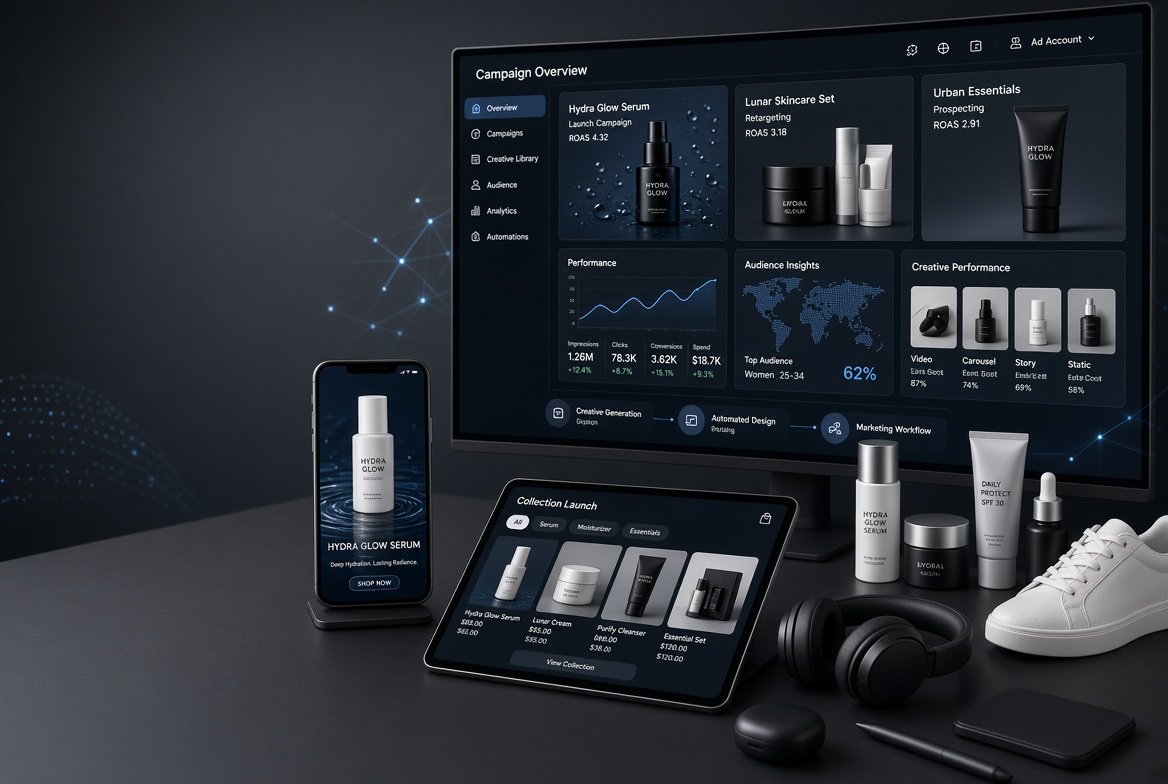
Ecommerce advertising has become increasingly competitive. Businesses are no longer competing only on product quality, pricing, or customer service. They are also competing for attention in crowded social media feeds, where a potential customer may spend only a few seconds deciding whether to stop scrolling, watch a video, explore a product, or move on to something else.
Facebook and Instagram remain important advertising channels for online retailers because they offer opportunities to reach targeted audiences through product photography, short-form videos, carousel advertisements, customer testimonials, promotional graphics, and other creative formats. However, producing enough high-quality advertising material to maintain a consistent campaign schedule can be expensive and time-consuming.
This is where the best ai tools for facebook instagram ad creatives ecommerce become particularly valuable. These platforms help ecommerce businesses develop advertising concepts, generate product visuals, create promotional videos, write persuasive headlines, produce multiple creative variations, and organize their advertising workflow.
Instead of relying entirely on traditional photoshoots, manual graphic design, and lengthy video-production processes, businesses can use specialized creative software to accelerate production while maintaining greater consistency across campaigns.
Nevertheless, choosing the right platform requires more than comparing feature lists. A tool that produces attractive static advertisements may not be suitable for creating realistic product demonstration videos. Another platform may generate impressive promotional content but provide limited control over brand identity or product accuracy.
The best solution depends on the store’s product category, advertising budget, production requirements, audience, and marketing objectives.
This comprehensive guide examines the leading creative platforms, their practical applications, strengths, limitations, and suitability for different ecommerce businesses. It also explains how to build a more effective Facebook and Instagram advertising workflow without sacrificing authenticity, visual quality, or customer trust.
Understanding Ecommerce Advertising Creatives
Before comparing individual platforms, it is important to understand what advertising creatives actually represent.
An advertising creative is the visual and written material that communicates a promotional message to potential customers. It may include a photograph, video, headline, product demonstration, customer testimonial, animation, graphic design, or combination of several elements.
For ecommerce businesses, creatives perform an especially important function because customers cannot physically examine products before purchasing them online.
A successful advertisement must communicate several things quickly:
- What product is being advertised?
- What problem does the product solve?
- What makes it different from competing products?
- Why should someone consider purchasing it?
- What action should the viewer take next?
These questions influence how an advertisement should be designed.
For example, a skincare advertisement may emphasize texture, ingredients, packaging, and an authentic demonstration. A clothing advertisement may focus on styling, fabric quality, fit, and different ways to wear the product. An electronics advertisement may prioritize product specifications, demonstrations, convenience, and practical benefits.
A single creative approach cannot effectively communicate every type of product.
Why Creative Quality Matters on Facebook and Instagram
Facebook and Instagram offer several advertising placements, including feeds, Stories, Reels, and other supported formats. Each placement creates a different viewing experience.
A square product advertisement may work well in certain feed environments, while a vertical demonstration video may be more appropriate for a full-screen mobile placement.
Creative quality involves more than attractive colors or professional photography. It also includes message clarity, product accuracy, visual hierarchy, relevance, and the relationship between the advertisement and its landing page.
An advertisement may attract attention but still generate disappointing sales if the product description is unclear or the offer does not match the customer’s expectations.
For this reason, ecommerce brands should treat advertising creatives as part of a larger customer journey rather than isolated pieces of promotional artwork.
Biography Table: Best AI Tools for Facebook and Instagram Ad Creatives Ecommerce
The following comparison table provides an overview of the major platforms discussed in this guide. The category descriptions indicate their primary applications rather than suggesting that every platform offers identical functionality.
| Tool | Primary Specialization | Best Suited For | Main Creative Format |
|---|---|---|---|
| Meta Advantage+ Creative | Native advertising enhancements | Advertisers using Meta Ads Manager | Images and videos |
| Canva Magic Studio | Visual design and editing | Small businesses and designers | Static ads, carousels, videos |
| AdCreative.ai | Advertising creative generation | Ecommerce marketing teams | Images, banners, videos |
| Creatify | Product-focused video production | Product sellers and online stores | Video advertisements |
| Predis.ai | Social and advertising content | Small ecommerce brands | Images, videos, carousels |
| Adobe Firefly | Image generation and editing | Professional creative teams | Product visuals and imagery |
| Photoroom | Product photography enhancement | Online retailers and marketplaces | Product images |
| HeyGen | Presenter-led video creation | Demonstration and explanatory campaigns | Avatar videos |
| InVideo AI | Video production and editing | Ecommerce content creators | Promotional videos |
| Pencil | Performance-oriented creative workflows | Advertising teams and agencies | Creative variations and analysis |
The comparison is intended as a practical starting point. Features, integrations, usage limits, and subscription arrangements can change, so businesses should verify current plan details before purchasing a subscription.
1. Meta Advantage+ Creative: A Convenient Starting Point
Meta Advantage+ Creative is one of the most practical starting points for businesses advertising directly through Facebook and Instagram.
Unlike independent creative-generation platforms, Meta’s native advertising enhancements operate within its advertising ecosystem. This makes the feature particularly convenient for businesses that want to improve existing assets without introducing another software subscription.
Advertisers can provide their original creative materials and use available enhancements to adapt certain elements for supported advertising placements.
The exact options depend on the campaign setup, account eligibility, asset type, and current Meta features.
Main Features
Meta’s creative tools can support several advertising tasks, including:
- Creative enhancements for eligible images and videos.
- Adaptation of assets for supported placements.
- Variations of certain creative elements.
- Automated improvements to selected advertising presentations.
- Integration with the existing Ads Manager workflow.
One major advantage is convenience. Businesses do not necessarily need to export every asset into another design application before preparing a campaign.
Ecommerce Applications
Imagine an online store selling wireless headphones.
The business already has several professional product photographs but needs advertising material for different placements. Instead of manually preparing every version, the advertiser can explore available creative enhancements within Meta’s advertising environment.
The original product image remains the starting point, while supported adjustments may help adapt the presentation.
This can reduce repetitive work, particularly for stores running multiple campaigns.
Advantages
- Convenient integration with Meta advertising.
- Useful for advertisers who already have product assets.
- Reduces certain repetitive creative adjustments.
- No separate creative-platform subscription is necessarily required.
- Suitable for testing eligible creative variations.
Limitations
Meta’s native enhancements should not be confused with a complete professional design studio. They may not provide the same level of creative control as dedicated graphic-design applications.
Advertisers should also inspect every generated or enhanced version. Product appearance, packaging, proportions, and important visual details must remain accurate.
Who Should Use It?
Meta Advantage+ Creative is particularly suitable for beginners, small ecommerce businesses, and established advertisers who want to improve their existing campaign assets without creating an unnecessarily complicated production process.
It is a sensible first option before purchasing additional creative software.
2. Canva Magic Studio: Best for Flexible Ecommerce Design
Canva has become a widely used visual-design platform because it makes professional-looking content accessible to people without extensive graphic-design experience.
Its Magic Studio combines design assistance, image editing, content generation, and other creative capabilities within the broader Canva environment.
For ecommerce brands, this combination is valuable because advertisements frequently require more than a single product photograph.
A promotional campaign may need a product image, discount announcement, headline, background, brand logo, supporting graphic, and several alternative layouts.
Canva provides an accessible environment for assembling these components.
Main Features
Canva’s Magic Studio includes tools designed to accelerate different parts of the design process.
Depending on the available plan and feature eligibility, users may access:
- Magic Design for creating initial layouts.
- Magic Edit for modifying selected image areas.
- Background editing and visual adjustments.
- AI-assisted image creation.
- Video-design features.
- Brand Kit functionality.
- Templates for social media content.
Magic Design can help transform a written description or uploaded media into an initial design concept. Magic Edit can assist with selected image changes, making it easier to experiment with backgrounds and visual details.
Why Canva Works for Ecommerce
Consider a clothing store preparing a seasonal sale.
The marketing team may need:
- A Facebook feed advertisement.
- An Instagram Story promotion.
- A vertical promotional graphic.
- A product carousel.
- A discount announcement.
- Several alternative headlines.
Canva allows the team to create and edit these assets within a familiar visual workspace.
Its templates can also help maintain consistency across different promotional materials.
Advantages
- Accessible interface for beginners.
- Extensive design-template library.
- Useful image-editing capabilities.
- Flexible control over typography and layouts.
- Suitable for static graphics and video projects.
- Helpful for maintaining brand consistency.
Limitations
Canva is not a replacement for a complete advertising-performance platform.
It helps produce creative material, but it does not automatically guarantee that an advertisement will achieve profitable sales.
Some advanced features and usage allowances are also restricted by subscription level.
Who Should Use It?
Canva Magic Studio is particularly suitable for small ecommerce businesses, independent designers, social media managers, and marketing teams that need flexibility without adopting complicated professional design software.
It is one of the strongest general-purpose choices in the best ai tools for facebook instagram ad creatives ecommerce category.
3. AdCreative.ai: Best for Producing Multiple Advertising Variations
AdCreative.ai focuses on advertising creative generation and is particularly relevant to businesses that need multiple promotional concepts within a relatively short period.
Traditional advertising production can become inefficient when marketers need to create numerous variations of the same campaign.
For example, an ecommerce business may want to compare different product backgrounds, promotional messages, headlines, layouts, and calls to action.
Producing every variation manually can require considerable design time.
AdCreative.ai is designed to help accelerate this process.
Main Features
Its advertised capabilities include:
- Static advertising creative generation.
- Promotional banner production.
- Copywriting assistance.
- Creative variation generation.
- Creative scoring and analysis.
- Product-focused visual production.
- Video advertising capabilities.
The platform also promotes performance-oriented creative insights intended to help businesses evaluate advertising concepts before launching campaigns.
However, predictive scores should be treated as guidance rather than guaranteed performance results.
Practical Ecommerce Example
Suppose an online business sells premium kitchen appliances.
The marketing team wants to advertise a new blender.
Rather than relying on one promotional design, it could develop several creative concepts:
- A product-focused advertisement.
- A kitchen lifestyle advertisement.
- A convenience-focused promotion.
- A feature-comparison graphic.
- A discount-oriented campaign.
- A demonstration-led creative.
The business can then select the most relevant versions for controlled testing.
Advantages
- Designed specifically around advertising production.
- Useful for generating multiple creative concepts.
- Supports different advertising formats.
- Offers copywriting assistance.
- Can help reduce repetitive design work.
- Provides creative evaluation features.
Limitations
Generated designs may still require editing. Product images, text placement, brand colors, and promotional details should be reviewed carefully.
A visually attractive advertisement is not necessarily a commercially effective one.
Businesses should also evaluate subscription allowances and generation credits before committing to a plan.
Who Should Use It?
AdCreative.ai is worth considering for ecommerce brands, marketing agencies, and advertising teams that regularly need fresh static advertising concepts.
It is particularly relevant when creative production volume is the main operational challenge.
4. Creatify: Best for Ecommerce Product Video Advertisements
Video has become an important creative format for social media advertising because it can demonstrate product functionality, show real-world applications, and communicate a promotional message through movement and narration.
Creatify focuses on simplifying video-ad production.
One of its notable workflows allows users to provide a product URL and generate a video advertisement using information and assets available from the product page. It also supports manually supplied product information and media. Creatify+1
Main Features
Creatify’s advertised capabilities include:
- Product URL-to-video generation.
- Product-focused video advertisements.
- Presenter and avatar-based formats.
- Script generation.
- Video editing.
- Multiple creative variations.
- Support for different languages.
How Ecommerce Businesses Can Use Creatify
Imagine an online store selling a portable rechargeable fan.
The store has a product page containing:
- Product photographs.
- A description.
- Technical specifications.
- Available colors.
- Main product benefits.
The marketing team can use this information as a starting point for developing a promotional video.
The resulting creative might introduce the product, highlight portability, demonstrate its use, and finish with a clear shopping message.
This can be particularly useful when a business wants to explore several video concepts without organizing a complete production shoot for every variation.
Advantages
- Product URL-based video workflow.
- Useful for creating promotional video concepts.
- Supports uploaded product assets.
- Editing options for generated videos.
- Suitable for testing different video hooks.
- Can help reduce production time.
Limitations
Automated product-page extraction is not always perfect. The system may select an unsuitable image or misunderstand certain product details.
Businesses should review every scene and ensure that demonstrations accurately represent the actual product.
Artificial presenters should also be used carefully. A video that appears unnatural may reduce customer confidence.
Who Should Use It?
Creatify is especially relevant to ecommerce sellers, dropshipping businesses, product marketers, and smaller advertising teams that want to produce more promotional video variations without relying entirely on traditional filming.
5. Predis.ai: Best for Combined Social Media and Advertising Content
Predis.ai combines social media content creation with advertising-focused production.
This makes it relevant to businesses that manage both organic social media publishing and paid promotional campaigns.
For many smaller ecommerce companies, these activities are handled by the same person or marketing team. Maintaining separate systems for everyday social posts and advertising creatives can create unnecessary complexity.
Predis.ai attempts to bring several of these activities together.
Main Features
The platform advertises capabilities such as:
- Static advertising generation.
- Product-focused video production.
- Carousel creation.
- Caption and headline generation.
- UGC-style video concepts.
- Product URL-based creative generation.
- Brand customization.
- Social media scheduling.
It also supports creative variations and different social media formats. predis.ai+1
Ecommerce Applications
A beauty brand, for example, may publish educational content about skincare ingredients while simultaneously running promotional campaigns for specific products.
Predis.ai can help develop different types of content within one production workflow.
The business might create:
- Product announcement graphics.
- Ingredient-focused promotional posts.
- Short product videos.
- Seasonal campaign advertisements.
- Carousel advertisements.
- Social media captions.
This approach can help maintain a more consistent publishing schedule.
Advantages
- Combines multiple social content workflows.
- Supports product-oriented advertisements.
- Useful for short-form video concepts.
- Provides content scheduling capabilities.
- Supports different social platforms.
- Helpful for smaller marketing teams.
Limitations
A broad content-production platform may not provide the same specialist control as dedicated video-editing or advanced graphic-design software.
Businesses should also avoid publishing every generated design without reviewing its relevance, accuracy, and visual quality.
Who Should Use It?
Predis.ai is particularly suitable for small ecommerce brands, social media managers, entrepreneurs, and businesses that need a combination of organic content and paid advertising material.
6. Adobe Firefly: Best for Advanced Product Visuals and Creative Editing
Adobe Firefly is part of Adobe’s broader creative ecosystem.
It is particularly useful for businesses that need more control over visual presentation and want to incorporate generative image and editing capabilities into professional design workflows.
Unlike platforms built primarily around automatic advertising generation, Firefly is more closely associated with visual creation and editing.
Main Features
Depending on the available product version and subscription, Firefly capabilities include:
- Text-to-image generation.
- Generative image editing.
- Background and scene modifications.
- Visual composition assistance.
- Generative design workflows.
- Video-related creative capabilities.
Adobe has also integrated Firefly-related technology into parts of its wider creative software ecosystem. news.adobe.com
Ecommerce Applications
Consider a furniture retailer advertising a modern dining table.
The business may have a straightforward product photograph against a plain background.
A more sophisticated advertising concept might require the table to appear in a carefully styled dining room with appropriate lighting, furniture, and decorative elements.
Firefly can help explore visual directions and develop supporting imagery.
However, product accuracy must remain the priority. The generated environment should complement the real product rather than change its physical characteristics.
Advantages
- Flexible visual generation.
- Useful image-editing capabilities.
- Professional creative ecosystem.
- Helpful for developing advertising backgrounds.
- Suitable for more sophisticated visual concepts.
- Integrates with Adobe creative workflows.
Limitations
Firefly is not an automatic replacement for ecommerce advertising strategy or campaign management.
Some projects require additional editing, and generated environments can introduce inaccurate product details if not carefully reviewed.
Subscription access and generative-credit allowances should also be considered.
Who Should Use It?
Adobe Firefly is particularly appropriate for professional designers, established ecommerce brands, creative agencies, and businesses that prioritize visual quality and detailed editing control.
7. Photoroom: Best for Product Photography and Background Editing
Product photography is one of the most important elements of ecommerce advertising.
Customers want to see the actual item clearly. Poor lighting, distracting backgrounds, and inconsistent product presentation can make even a high-quality product appear less appealing.
Photoroom focuses on product-image preparation and visual editing.
Main Features
Its core use cases include:
- Background removal.
- Background replacement.
- Product-photo enhancement.
- Image composition.
- Batch product-image processing.
- Promotional image preparation.
Ecommerce Applications
Imagine a seller with a catalog of 150 products.
The original images may have been photographed under different lighting conditions, with inconsistent backgrounds and varying levels of image quality.
Preparing every image manually would require significant time.
A product-focused editing tool can help standardize the presentation.
For example, a store selling cosmetics could prepare consistent product images with clean backgrounds, subtle shadows, and campaign-specific visual arrangements.
Advantages
- Particularly useful for product photography.
- Helps remove distracting backgrounds.
- Supports consistent visual presentation.
- Useful for large product catalogs.
- Reduces repetitive image-editing tasks.
Limitations
Photoroom is primarily an image-production and editing solution rather than a complete advertising strategy platform.
It does not replace the need for persuasive copywriting, audience research, campaign planning, or performance measurement.
Who Should Use It?
Photoroom is particularly suitable for product sellers, marketplace retailers, fashion businesses, cosmetics brands, and ecommerce stores that need clean and consistent product photographs.
8. HeyGen: Best for Presenter-Led Product Advertisements
Some products require explanation before customers understand their value.
A simple photograph may be sufficient for a basic accessory, but a complicated software product, electronic device, or educational product may benefit from a presenter explaining its features.
HeyGen focuses on presenter-led video creation using digital avatars and generated speech.
Main Features
Its capabilities include:
- Digital avatar presentations.
- Script-based video production.
- Voice generation.
- Multilingual video creation.
- Video translation and localization.
- Presenter-led communication.
Ecommerce Applications
Consider a company selling a specialized home security device.
Potential customers may want to understand installation, connectivity, important features, and practical benefits.
A presenter-led video can introduce the product and explain its functionality in a structured manner.
The same basic script can also be adapted for different markets and languages.
Advantages
- Useful for explanatory videos.
- Supports presenter-led advertising concepts.
- Helps create multilingual content.
- Can reduce the need for repeated filming.
- Suitable for product introductions.
Limitations
Not every ecommerce product needs a digital presenter.
For visually appealing products, authentic customer footage or real demonstrations may communicate value more effectively.
Businesses should also ensure that generated speech, presentation style, and product claims are accurate.
Who Should Use It?
HeyGen may be suitable for educational ecommerce products, electronics, software subscriptions, product demonstrations, and businesses operating across several language markets.
9. InVideo AI: Best for Flexible Promotional Video Production
InVideo AI provides a video-production environment designed to help users develop video content from written instructions and supplied materials.
For ecommerce advertisers, it can support the production of promotional videos, product introductions, explanatory content, and short-form campaign concepts.
Main Features
Depending on the current product plan, its capabilities may include:
- Prompt-based video creation.
- Script development.
- Video editing.
- Stock-media integration.
- Voiceovers.
- Text overlays.
- Scene arrangement.
- Social media video formatting.
Ecommerce Applications
A store selling travel accessories could develop a promotional video showing the problems its products address.
For example, a campaign might demonstrate how a compact travel organizer helps customers keep their luggage organized.
The video could include product footage, supporting scenes, explanatory text, and a final promotional message.
Advantages
- Useful for creating promotional video concepts.
- Supports different video-production workflows.
- Helpful for short-form social content.
- Offers editing and customization.
- Can reduce the time needed for initial video production.
Limitations
Automatically assembled footage may not always represent the actual product.
Ecommerce businesses should prioritize real product images and authentic demonstrations whenever product accuracy is important.
Generated scripts and visual sequences also need editorial review.
Who Should Use It?
InVideo AI is suitable for ecommerce marketers, content creators, small businesses, and social media teams that need to produce promotional video material regularly.
10. Pencil: Best for Performance-Oriented Creative Development
Pencil is associated with performance-focused advertising creative workflows. Its positioning is particularly relevant to businesses that want to connect creative development with campaign performance insights.
The platform’s product positioning and availability may evolve, so businesses should verify the current product offering and branding before selecting it.
Main Features and Applications
Performance-oriented creative platforms can help teams:
- Develop advertising variations.
- Organize creative assets.
- Explore different messaging approaches.
- Connect creative decisions with campaign data.
- Identify opportunities for creative refreshes.
- Improve the advertising production process.
The important distinction is that generating an advertisement and evaluating its performance are two different activities.
A business may produce 30 advertisements but still struggle to determine why some perform better than others.
A performance-oriented workflow attempts to make that process more systematic.
Ecommerce Applications
Suppose an online clothing store has been running several advertisements for a new collection.
The marketing team wants to understand whether customers respond more strongly to:
- Product-focused photographs.
- Lifestyle imagery.
- Customer-style testimonials.
- Price-based promotional messages.
- Short product demonstration videos.
Organized creative analysis can help identify patterns and guide the next production cycle.
Advantages
- Performance-oriented creative workflows.
- Useful for structured creative development.
- Relevant to established advertising teams.
- Can help connect creative production with campaign insights.
Limitations
Advanced creative workflows may be unnecessary for very small stores with limited advertising activity.
Businesses should evaluate current availability, integrations, pricing, and actual analytical capabilities before choosing a platform.
Who Should Use It?
Pencil is worth investigating for ecommerce marketing teams and agencies that manage multiple campaigns and want a more systematic approach to creative testing.
11. Choosing the Right Tool for Your Ecommerce Business
There is no universal winner among creative platforms. Each business has different requirements, and the most suitable solution depends on its operational challenges.
A small business selling handmade products may need simple product photography and promotional graphics. A large fashion retailer may require hundreds of creative variations, professional video production, and a structured testing process.
The following comparison provides a more practical way to select a platform.
| Business Requirement | Recommended Starting Tool |
|---|---|
| Free native advertising enhancements | Meta Advantage+ Creative |
| Simple promotional designs | Canva |
| Multiple static ad variations | AdCreative.ai |
| Product-page-to-video production | Creatify |
| Social content and advertising together | Predis.ai |
| Advanced image generation and editing | Adobe Firefly |
| Product photography improvement | Photoroom |
| Presenter-led promotional videos | HeyGen |
| Flexible promotional video creation | InVideo AI |
| Performance-focused creative workflows | Pencil |
The recommendation should be based on the actual production problem rather than the popularity of a software brand.
A store that already has excellent product photographs may gain little from purchasing another image-generation subscription. Its greatest need may be video editing or creative testing instead.
Likewise, a business that produces hundreds of product images may benefit more from batch image-processing capabilities than from an advanced presenter-video platform.
12. How to Create High-Performing Facebook and Instagram Ecommerce Ads
Selecting the right software is only one part of successful advertising. The creative strategy determines how effectively the business communicates its product’s value.
A well-designed advertisement should have a clear purpose. It should attract the right audience, introduce a relevant benefit, establish confidence, and encourage an appropriate action.
The following process can help ecommerce businesses develop a repeatable creative-production system.
Step 1: Understand the Product Before Designing the Advertisement
Every successful product advertisement begins with an understanding of the item being promoted.
Before generating visuals or writing headlines, identify:
- The product’s main purpose.
- Its most important features.
- The customer problem it addresses.
- Its strongest competitive advantages.
- Its intended audience.
- Its price and available offers.
- Any limitations customers should understand.
For example, an advertisement for a portable blender should communicate portability, charging convenience, practical usage, and relevant product specifications.
Simply describing the item as an innovative kitchen appliance is unlikely to provide enough information to persuade a potential customer.
Step 2: Identify the Target Audience
Different customers respond to different messages.
A skincare business targeting customers interested in simple daily routines may emphasize convenience and product ingredients. A premium cosmetics company may focus on presentation, formulation, and brand positioning.
Audience research should consider:
- Age groups and relevant demographics.
- Customer interests.
- Shopping preferences.
- Common purchasing objections.
- Budget expectations.
- Product-related problems.
- Reasons customers choose competing products.
The purpose is not to create stereotypical advertisements. It is to understand what information different customers need before making a purchase.
Step 3: Develop Several Creative Concepts
One of the most common mistakes in ecommerce advertising is relying on a single visual concept.
A better approach is to develop different creative angles.
For a fitness accessory, possible concepts include:
Problem-and-solution creative: Demonstrate the inconvenience the product addresses.
Product demonstration: Show how the product works in an everyday situation.
Lifestyle creative: Present the product as part of a realistic lifestyle.
Feature-focused creative: Highlight important specifications and practical benefits.
Customer-experience creative: Use authentic customer feedback or appropriately authorized testimonial material.
Promotional creative: Communicate a genuine discount, bundle, or limited-time offer.
These approaches provide different ways to communicate the same product’s value.
Step 4: Write a Strong Advertising Hook
The opening seconds of a video and the first visible elements of a static advertisement are particularly important.
A hook should create interest without misleading the audience.
For example, an advertisement for an organizing product might begin with:
“Struggling to keep your travel essentials organized?”
A product demonstration could follow, showing how the organizer separates different items.
The message is effective because it introduces a recognizable problem and immediately connects the product to a possible solution.
Other useful hook approaches include:
- A common customer frustration.
- An unexpected product feature.
- A practical demonstration.
- A relevant question.
- A clear comparison.
- An interesting use case.
The strongest opening is usually the one that attracts the intended buyer rather than simply generating attention from everyone.
Step 5: Create Visuals That Preserve Product Accuracy
Product accuracy should remain a central requirement throughout creative production.
A generated image might introduce attractive lighting or a sophisticated background, but it should not change the product’s shape, color, packaging, dimensions, or functionality.
This is especially important for:
- Electronics.
- Cosmetics.
- Clothing.
- Furniture.
- Food products.
- Health-related merchandise.
- Branded accessories.
Customers expect the advertised item to resemble the product they receive.
An advertisement that creates unrealistic expectations may attract clicks but ultimately damage customer trust.
Step 6: Adapt the Creative for Different Placements
Facebook and Instagram provide several advertising environments.
Businesses should consider the viewing experience when preparing each asset.
For example:
- Feed advertisements should communicate their main message clearly.
- Story advertisements should work in vertical, full-screen layouts.
- Reels advertisements should establish interest quickly.
- Carousel advertisements should present a logical sequence of product information.
Advertisers should check the latest placement specifications in Meta Ads Manager before exporting their final files.
Important visual information should remain inside appropriate safe areas, especially when using vertical video with platform interface elements.
Step 7: Develop Multiple Versions
A single advertisement rarely reveals every possible customer preference.
Businesses should develop controlled variations that test specific creative differences.
For example, a clothing store could compare:
- A product-only photograph against a lifestyle photograph.
- A benefit-focused headline against a price-focused headline.
- A short demonstration against a longer product explanation.
- A static creative against a video.
Changing too many elements simultaneously makes it difficult to understand why performance changed.
A structured approach allows marketers to learn from campaign results.
Step 8: Review Every Creative Before Publishing
No generated advertisement should be published without a quality-control review.
The review should check:
- Correct product representation.
- Accurate product specifications.
- Correct pricing and promotional information.
- Spelling and grammar.
- Brand identity.
- Visual consistency.
- Readability on mobile devices.
- Appropriate advertising claims.
- Landing-page consistency.
- Copyright and usage permissions.
This final review is particularly important when businesses produce advertising material at scale.
13. Best Creative Formats for Ecommerce Advertising
Different advertising formats communicate information in different ways. Understanding their strengths helps businesses choose the most appropriate production tools.
Static Image Advertisements
Free AI product photography: Create beautiful product images for listing
Static advertisements remain useful because they can communicate a product’s appearance and central benefit quickly.
They are especially suitable for products that are visually understandable without extensive explanation.
Examples include clothing, accessories, cosmetics, home decorations, and simple household products.
A strong static advertisement usually includes:
- A recognizable product image.
- A clear headline.
- A relevant benefit.
- A restrained visual layout.
- An appropriate call to action.
Canva, AdCreative.ai, and Photoroom can help businesses produce this type of material.
Carousel Advertisements
Using Catalog Ads as a beauty and cosmetics brand – Confect.io
Carousel advertisements allow businesses to present multiple images or videos within a single advertising unit.
They are useful when a product requires additional explanation or when a store wants to showcase several products.
A cosmetics company might use individual cards to introduce different products in a collection.
An electronics retailer might use separate cards to explain the main features of a device.
The sequence should feel logical rather than like a collection of unrelated promotional graphics.
Short-Form Video Advertisements
Short-form video is particularly useful for products that benefit from demonstrations.
A video can show how an item works, explain a practical advantage, or demonstrate its appearance in everyday use.
A strong structure might include:
- An opening hook.
- A product introduction.
- A demonstration.
- One or two important benefits.
- A clear call to action.
Creatify, InVideo AI, and other video-production platforms can help develop these formats.
User-Generated-Content-Style Advertisements
How to Create AI UGC Ads in 3 Easy Steps | Postcrest
User-generated-content-style advertising borrows the visual language of ordinary customer-created content.
It may feature a person discussing a product, showing how it works, or explaining a personal experience.
This format can feel more conversational than conventional studio advertising.
However, businesses should distinguish between authentic customer testimonials and simulated promotional presentations. A fictional presenter should not be represented as a genuine customer with personal experience.
Customer statements must also be used with appropriate permission and should not be edited to change their meaning.
14. How to Build a Complete Ecommerce Creative Workflow
The strongest creative systems combine several complementary capabilities instead of expecting one application to perform every task.
A practical workflow can be divided into five stages.
Stage One: Research and Planning
Begin by identifying the product, customer audience, campaign objective, and promotional message.
Study customer questions, product reviews, common objections, and competitor positioning.
The objective is to discover useful advertising angles rather than simply imitate another brand’s visual presentation.
Stage Two: Product Asset Preparation
Collect accurate product photographs, packaging images, videos, logos, and product descriptions.
Use a product-image editing platform when photographs require background removal or visual standardization.
Ensure that the original product information remains available throughout the production process.
Stage Three: Creative Production
Choose the appropriate platform according to the desired format.
For example:
- Canva for flexible promotional designs.
- AdCreative.ai for static creative variations.
- Creatify for product-focused video concepts.
- Adobe Firefly for advanced visual editing.
- Predis.ai for combined social content production.
The business should avoid subscribing to several overlapping tools without a clear production requirement.
Stage Four: Quality Control and Campaign Preparation
Review the final assets, confirm promotional information, and adapt them to the intended advertising placements.
Prepare the associated headlines, primary text, descriptions, and landing-page destinations.
A visually excellent advertisement can still perform poorly when the accompanying message is confusing.
Stage Five: Testing and Improvement
Launch controlled creative tests and evaluate the results.
Review the relationship between creative engagement and actual business outcomes.
If one advertisement generates clicks but few purchases, investigate the landing page, product offer, shipping conditions, and audience relevance before assuming the creative itself is responsible.
A continuous improvement process is more valuable than repeatedly generating new advertisements without examining previous results.
15. Important Metrics for Evaluating Advertising Creatives
Creative production should be connected to measurable business objectives.
The most attractive advertisement is not necessarily the one that generates the greatest commercial value.
Ecommerce businesses should understand several important advertising metrics.
| Metric | Meaning | Why It Matters |
|---|---|---|
| CTR | Click-through rate | Measures the proportion of impressions that generate clicks |
| CPC | Cost per click | Shows the average cost of obtaining a click |
| CPM | Cost per thousand impressions | Measures the cost of reaching audiences |
| CPA | Cost per acquisition | Measures the cost of obtaining a desired action |
| ROAS | Return on ad spend | Compares attributed revenue with advertising expenditure |
| CVR | Conversion rate | Measures how frequently visitors complete a desired action |
| Frequency | Average exposure | Helps identify repeated audience exposure |
| Hook retention | Early video engagement | Helps assess whether viewers remain interested after the opening |
Click-Through Rate
CTR helps advertisers understand whether their creative and messaging encourage people to visit the destination.
A higher CTR can indicate stronger initial interest, although it does not necessarily mean the advertisement produces profitable customers.
Cost Per Click
CPC provides information about the average cost of generating a click.
It should be interpreted alongside conversion quality. A cheaper click is not automatically more valuable if the visitor has little purchase intent.
Conversion Rate
Conversion rate helps reveal whether the traffic generated by an advertisement completes the intended action.
A campaign can attract substantial attention but still generate disappointing sales if the product page is confusing or the offer is uncompetitive.
Return on Ad Spend
ROAS compares advertising-attributed revenue with advertising expenditure.
For example, if a campaign spends $500 and generates $2,000 in attributed revenue, its ROAS is 4.
However, ROAS is not identical to profit. Product costs, fulfillment, shipping, payment processing, returns, and other operating expenses must also be considered.
Creative Fatigue
Creative fatigue occurs when an advertisement becomes less effective over time.
Repeated exposure, audience saturation, changing customer preferences, and competing advertisements can all influence performance.
Refreshing creative concepts can help businesses maintain relevance.
However, replacing every advertisement immediately after a temporary performance fluctuation is not always sensible. Marketers should consider adequate data, campaign objectives, and the broader account context.
16. Common Mistakes Ecommerce Businesses Should Avoid
Even sophisticated creative software cannot compensate for poor marketing decisions.
Several mistakes frequently reduce the effectiveness of ecommerce advertising.
Depending Entirely on Automated Generation
Automated production can accelerate design, but human judgment remains necessary.
Businesses should review the message, product representation, visual quality, and commercial accuracy of every advertisement.
Using Generic Advertising Messages
Phrases such as “Best Quality Product” and “Amazing Offer” provide little meaningful information.
Specific benefits are more persuasive because they explain what customers can actually expect.
Overloading Advertisements With Text
A crowded design can make it difficult for customers to understand the central message.
Prioritize the product, the main benefit, and one clear action.
Supporting details can appear in the accompanying advertisement copy or on the product page.
Ignoring Brand Consistency
A business should maintain a recognizable identity across its advertisements.
Colors, typography, photography, tone, and promotional presentation should feel connected.
Consistency does not mean every advertisement must look identical. It means customers should be able to recognize the brand across different creative concepts.
Making Unsupported Product Claims
Advertising claims should be accurate and supported.
Businesses should avoid exaggerated promises, fabricated customer experiences, misleading before-and-after imagery, and unsubstantiated performance claims.
This is particularly important for products related to beauty, wellness, finance, and personal safety.
Ignoring the Landing Page
An advertisement and its destination should communicate a consistent message.
If an advertisement promotes a discount, the landing page should clearly explain that discount.
If the creative highlights a particular product feature, customers should be able to find accurate information about it after clicking.
Choosing Software Without Evaluating Its Limitations
A platform may advertise impressive capabilities but still be unsuitable for a particular business.
Before subscribing, evaluate:
- Output quality.
- Product-image accuracy.
- Editing flexibility.
- Commercial usage rights.
- Export formats.
- Usage allowances.
- Integration requirements.
- Customer support.
- Total subscription cost.
The best purchasing decision is based on practical usefulness rather than the longest feature list.
17. Budget Planning: How Much Should an Ecommerce Business Spend on Creative Tools?
Creative software budgets should reflect the size and complexity of the business.
A new ecommerce store does not necessarily need an expensive collection of subscriptions.
A sensible starting arrangement might include a free design workflow, native Meta advertising enhancements, and access to a basic product-image editing application.
As advertising activity grows, the business can introduce specialist software.
For example, a retailer producing large volumes of product videos may benefit from a dedicated video-generation subscription. A company with a large product catalog may prioritize batch photography tools.
Starter-Level Businesses
New stores should prioritize essential product assets and a clear brand identity.
The objective is to establish a reliable production process without accumulating unnecessary monthly expenses.
Growing Ecommerce Brands
Businesses with consistent advertising activity may benefit from combining design, image editing, and video production.
At this stage, the ability to create and test several creative approaches becomes increasingly important.
Established Advertising Teams
Larger businesses may require shared brand assets, approval workflows, campaign analysis, organized creative libraries, and more sophisticated production systems.
For these organizations, software should be evaluated according to its contribution to the overall marketing operation.
The best ai tools for facebook instagram ad creatives ecommerce are not necessarily the most expensive. Their value depends on how effectively they solve a real business problem.
18. Copyright, Product Accuracy, and Advertising Responsibility
Creative automation introduces important responsibilities for ecommerce businesses.
An advertisement is a commercial communication. Its images, statements, product representations, and promotional promises can influence purchasing decisions.
Businesses should therefore establish clear standards for the material they publish.
Copyright and Image Ownership
Before using photographs, illustrations, music, or video footage, confirm that the business has the appropriate rights or permissions.
A generated image does not automatically grant unrestricted rights to every element included in it. Background artwork, recognizable characters, trademarks, and third-party material may raise separate legal questions.
Product Representation
Generated product scenes should not change important characteristics of the actual item.
For example, an advertisement for a smartphone should not display a camera configuration or screen feature that the product does not possess.
Similarly, clothing advertisements should avoid presenting unrealistic product colors, materials, or fits.
Authentic Testimonials
Customer testimonials should reflect genuine experiences and be used with appropriate authorization.
Businesses should not create fictional customer stories and present them as verified reviews.
Where a presenter is digitally generated, the advertisement should not create a misleading impression about the person’s identity or personal experience.
Privacy and Customer Information
Businesses should be careful when uploading customer photographs, private conversations, order information, or other personal data into third-party creative platforms.
Review the provider’s privacy policy, data-handling arrangements, and applicable consent requirements before uploading sensitive material.
Platform Advertising Policies
Facebook and Instagram advertising must comply with applicable Meta advertising standards.
Businesses should pay particular attention to rules concerning misleading claims, restricted products, personal attributes, sensitive topics, and prohibited commercial practices.
A technically impressive advertisement is of little value if it creates compliance problems or damages customer confidence.
19. The Future of Ecommerce Advertising Creative Production
The relationship between creative production and advertising technology continues to evolve.
Several developments are particularly relevant to online retailers.
More Personalized Creative Experiences
Businesses increasingly seek ways to present relevant products and messages to different audience segments.
Personalization may involve different creative themes, product recommendations, languages, and promotional approaches.
The challenge is to make these variations relevant without creating inconsistent or intrusive advertising experiences.
Faster Video Production
Video production has traditionally required filming, editing, voice recording, and post-production.
New creative workflows can reduce the time needed to develop initial concepts and alternative versions.
This may make video advertising more accessible to smaller ecommerce businesses that cannot maintain an extensive production team.
Greater Integration With Advertising Platforms
Native creative features and independent production tools are becoming increasingly connected to broader marketing workflows.
This creates opportunities for advertisers to move more efficiently between creative preparation, campaign publishing, and performance evaluation.
However, integration should not be mistaken for complete automation. Businesses still need to decide which products to promote, what messages are appropriate, and how campaign outcomes should be evaluated.
Better Creative Measurement
Advertisers are increasingly interested in understanding which visual elements and messaging approaches contribute to business results.
Rather than evaluating advertisements only through superficial engagement, businesses can examine their relationship with customer acquisition, conversion, and profitability.
Stronger Demand for Authenticity
As generated content becomes more common, authentic product demonstrations and credible customer experiences may become increasingly important differentiators.
Businesses that combine efficient production with genuine product information can build stronger long-term relationships with customers.
20. Recommended Tool Combinations for Different Ecommerce Businesses
Using multiple tools can be useful when each application serves a distinct purpose. The objective should be to create a complementary workflow, not to purchase software simply because it offers additional features.
| Ecommerce Business | Suggested Combination | Main Objective |
|---|---|---|
| New online store | Canva + Meta Advantage+ Creative | Basic advertisements and campaign preparation |
| Fashion retailer | Photoroom + Canva + Creatify | Product imagery and promotional videos |
| Beauty brand | Adobe Firefly + Canva + Predis.ai | Visual consistency and social content |
| Dropshipping business | Creatify + AdCreative.ai | Product videos and static variations |
| Large product catalog | Photoroom + Predis.ai | Product-image preparation and bulk content |
| Marketing agency | AdCreative.ai + Canva + Pencil | Creative production and organized testing |
| Electronics store | Creatify + HeyGen + Canva | Product demonstrations and explanatory content |
| Small social commerce business | Predis.ai + Canva | Organic publishing and promotional creatives |
A Practical Combination for Beginners
A beginner should avoid building an unnecessarily complicated system.
Meta Advantage+ Creative can provide a convenient starting point for campaign enhancements, while Canva can support basic design work.
If product photography becomes a bottleneck, a specialist image editor can be added later.
A Practical Combination for Growing Brands
A growing ecommerce company may benefit from combining static creative production with product-focused video generation.
AdCreative.ai and Creatify can address different production requirements, while Canva can help refine brand presentation.
A Practical Combination for Larger Teams
Established teams should consider how creative generation connects with approval, testing, and performance analysis.
Their priority should be an organized workflow that allows designers, advertisers, and managers to collaborate efficiently.
The right combination ultimately depends on actual campaign volume and the capabilities of the existing team.
21. How to Measure Whether a Creative Tool Is Worth Paying For
A subscription should be evaluated according to the time, resources, and commercial opportunities it provides.
For example, imagine that an ecommerce business previously spent ten hours preparing a collection of promotional graphics.
After introducing a design platform, the same initial production task takes four hours.
The time saved may be valuable, but the business should also evaluate whether the output meets its quality standards.
Consider these questions:
- Does the platform reduce production time?
- Are the generated assets suitable for commercial use?
- Can designers make necessary adjustments?
- Does it maintain brand consistency?
- Does it support the required advertising formats?
- Does the subscription provide enough monthly usage?
- Does it help the team test more useful creative concepts?
- Is the final output better than the existing production method?
The answer should be based on actual business needs.
A platform that generates hundreds of designs may provide little value if most require extensive correction. Another tool may produce fewer assets but offer greater consistency and editing control.
For this reason, businesses should test software with real products before making long-term commitments.
Frequently Asked Questions (FAQs)
1. What are the best AI tools for Facebook and Instagram ad creatives ecommerce businesses can use?
Some of the strongest options include Meta Advantage+ Creative, Canva Magic Studio, AdCreative.ai, Creatify, Predis.ai, Adobe Firefly, and Photoroom.
Each platform serves a different purpose. Canva is useful for general design, AdCreative.ai focuses on advertising variations, Creatify supports product videos, and Photoroom specializes in product imagery.
2. Which tool is best for creating Facebook ads automatically?
AdCreative.ai is worth considering for generating multiple advertising concepts, while Meta Advantage+ Creative offers convenient native enhancements inside Ads Manager.
The best choice depends on whether the business needs complete creative concepts or improvements to existing advertising assets.
3. What is the best tool for Instagram ecommerce video advertisements?
Creatify is a strong option for product-focused promotional videos, particularly when a business wants to start with a product URL or existing product images.
InVideo AI is another option for developing promotional videos with more flexible editing workflows.
4. Can I create Facebook and Instagram advertisements without hiring a designer?
Yes. Platforms such as Canva, Predis.ai, and AdCreative.ai make it possible for small business owners to create advertising material without advanced design experience.
However, professional review remains important when advertisements contain complex product information, detailed branding, or important commercial claims.
5. Are there free tools for creating ecommerce advertisements?
Yes. Canva offers a free entry-level design experience, and Meta provides native creative features within its advertising environment.
Some other platforms also offer limited free access or trial arrangements. The available features and usage allowances can change.
6. Is Canva good for Facebook and Instagram ecommerce ads?
Canva is a useful choice because it provides templates, image editing, brand customization, and visual-design capabilities.
It is particularly appropriate for product promotions, carousel advertisements, seasonal campaigns, and social media graphics.
However, campaign performance still depends on the advertising strategy, creative message, audience, and product offer.
7. Can I create product video advertisements using a product URL?
Yes. Creatify and Predis.ai advertise workflows that can use product URLs as starting points for video and promotional content.
Businesses should inspect the extracted information and ensure that the resulting advertisement represents the actual product accurately.
8. What is the best tool for creating multiple ecommerce ad variations?
AdCreative.ai is a relevant option for businesses that need numerous static creative concepts.
Predis.ai can also help develop different advertising formats and messaging variations.
The most useful approach is to create meaningful alternatives that test different customer motivations rather than producing many nearly identical designs.
9. How many creative variations should an ecommerce business test?
There is no universal number.
The appropriate volume depends on advertising budget, audience size, campaign structure, and available data.
A smaller business may begin with three or four substantially different concepts, while an established team may have the resources to test more.
The priority should be meaningful comparisons rather than generating an unnecessarily large collection of advertisements.
10. Are generated advertisements suitable for dropshipping businesses?
They can be useful for dropshipping businesses that need to create product demonstrations, promotional images, and multiple creative concepts quickly.
However, dropshippers should verify product photographs, specifications, shipping information, and delivery promises.
The advertised product must match what the supplier actually provides.
11. Can generated advertising creatives guarantee higher ROAS?
No. Creative-generation software cannot guarantee a particular return on advertising expenditure.
ROAS depends on several factors, including product demand, pricing, customer acquisition costs, audience relevance, competition, landing-page quality, and conversion rates.
Creative tools can support production and experimentation, but commercial outcomes must be measured through actual campaigns.
12. How can I prevent creative fatigue in Facebook and Instagram campaigns?
Businesses can reduce the risk of creative fatigue by developing fresh messaging, testing different visual approaches, introducing relevant product demonstrations, and reviewing audience exposure.
Refreshing an advertisement should involve more than changing its background color. New creative concepts should communicate meaningful differences in product benefits or customer use cases.
13. Which creative format is best for ecommerce advertising?
There is no single format that works equally well for every product.
Static images are useful for straightforward product promotions, carousel advertisements can communicate multiple features, and videos can demonstrate products in practical situations.
Businesses should select formats according to customer needs and campaign objectives.
14. Should I use several creative platforms or just one?
Most beginners should start with one or two complementary platforms.
For example, Canva and Meta’s native advertising tools may be sufficient for a small store.
A business producing large quantities of product videos may benefit from adding Creatify. A company with extensive product photography requirements may prefer Photoroom.
The purpose of combining tools is to improve efficiency without creating unnecessary costs.
15. What should I check before publishing an automatically generated advertisement?
Review product accuracy, spelling, pricing, promotional terms, brand consistency, image rights, customer testimonials, and advertising-policy compliance.
Also ensure that the landing page accurately reflects the advertisement.
A final human review is essential because automated production does not eliminate the business’s responsibility for published content.
Building a Sustainable Creative Strategy for Ecommerce Growth
The development of ecommerce advertising is changing the way online retailers approach promotional content. Businesses can now explore more creative concepts, prepare different visual formats, and develop product-focused advertising material through increasingly accessible software.
However, the long-term value of these capabilities depends on how intelligently they are used.
A successful ecommerce brand does not simply produce more advertisements. It develops a deeper understanding of its customers, communicates product benefits clearly, and continuously improves its creative approach using reliable campaign information.
The best ai tools for facebook instagram ad creatives ecommerce should therefore be selected according to their practical contribution to the business. Some platforms are valuable for static design, others for product photography, and others for video production or performance-oriented creative development.
For a new business, a straightforward combination of Canva and Meta’s native tools may provide everything necessary to establish an initial advertising workflow. A growing retailer may benefit from adding AdCreative.ai or Creatify, while an established creative department may require more advanced visual production and analytical capabilities.
The most sustainable approach combines efficient production with accurate product representation, consistent branding, thoughtful experimentation, and genuine customer communication.
Ultimately, software should support the marketing strategy rather than replace it. Ecommerce businesses that understand this distinction can build advertising systems that are more organized, adaptable, and valuable over time.
