Boyz n the Hood is one of the most influential coming-of-age films in American cinema. Released in 1991, the movie was written and directed by John Singleton and focuses on Tre Styles, a young man growing up in South Central Los Angeles. Through Tre’s experiences, the film explores friendship, family, fatherhood, violence, responsibility, education, and the difficult choices young people can face in a challenging environment.
What makes Boyz n the Hood especially memorable is the way it combines a personal story with a much larger social picture. Instead of presenting its characters as simple stereotypes, the movie gives them individual personalities, hopes, fears, and conflicts. Tre is trying to figure out what kind of man he wants to become, while his friends Doughboy and Ricky are following very different paths.
The film also became important because of the perspective behind the camera. John Singleton was only 23 when he directed Boyz n the Hood, making him the youngest person at the time to receive an Academy Award nomination for Best Director. His personal connection to Los Angeles helped give the movie a grounded quality that audiences could feel throughout the story.
The Story of Boyz n the Hood
At the center of Boyz n the Hood is Tre Styles, who is initially sent to live with his father, Furious Styles, in the Crenshaw neighborhood of Los Angeles. Tre’s mother believes that his father can provide the structure and guidance he needs while growing up. Furious takes that responsibility seriously and tries to teach his son about discipline, education, money, respect, and making thoughtful decisions.
Tre grows up alongside his childhood friends, including Doughboy and Ricky Baker. Although the boys come from the same neighborhood, their lives develop in different directions. Their personalities and family situations influence the choices they make as teenagers and young adults.
As the story progresses, the friendship between Tre, Ricky, and Doughboy becomes increasingly complicated. Ricky is focused on football and hopes to earn a college scholarship. Doughboy becomes more involved with street life. Tre, meanwhile, is encouraged by his father to think about his future and avoid becoming trapped by the circumstances around him.
The movie gradually builds toward a series of emotional events that force Tre to confront the consequences of violence. Rather than treating these events as isolated incidents, the film shows how one decision can affect families, friendships, and entire communities.
Tre Styles and His Journey
Tre Styles is the emotional center of Boyz n the Hood. As a child, he is curious and energetic, but he does not always understand the world around him. His father becomes an important influence as Tre gets older, teaching him that becoming a responsible adult requires more than simply being physically strong.
One of Tre’s most important characteristics is his ability to think about consequences. He is surrounded by people who make different choices, and he has opportunities to follow several possible paths. His father’s guidance helps him understand that his environment does not have to completely determine his future.
Tre’s relationship with his father is also one of the strongest elements of the movie. Furious is strict, but his strictness comes from concern for his son’s future. Their conversations give the audience insight into the values that Furious wants Tre to develop.
Tre’s journey is ultimately about maturity. He has to learn that growing up means accepting responsibility for his choices while understanding the realities faced by the people around him. His experiences throughout the film gradually transform his understanding of friendship, love, anger, and adulthood.
Furious Styles and Fatherhood
Furious Styles is one of the most memorable characters in the film. Played by Laurence Fishburne, he is intelligent, outspoken, protective, and deeply committed to his son’s future. His parenting style is demanding, but the character is not simply a strict father figure.
Furious believes that education and financial independence are important tools for protecting a family. He wants Tre to understand how larger social and economic forces can affect individuals. His conversations with Tre often move beyond ordinary father-son advice and become lessons about responsibility and self-respect.
The character also represents a form of fatherhood that is sometimes missing from stories about difficult neighborhoods. Furious is present in his son’s life, pays attention to his behavior, and challenges him to think critically. He does not pretend that the world is easy, but he refuses to accept that Tre has no control over his future.
His influence becomes increasingly clear as Tre grows older. Even when Tre makes mistakes, the lessons from his father remain in his mind. Furious therefore serves as both a parent and a moral guide throughout the movie.
Doughboy and the Reality of Street Life
Doughboy is one of the most complicated characters in Boyz n the Hood. Played by Ice Cube, Doughboy grows up in circumstances that shape his worldview. He becomes involved in street activity and develops a tough exterior, but the film shows that there is more to him than his reputation.
Doughboy’s relationship with his family is particularly revealing. His mother treats him differently from Ricky, creating a complicated dynamic between the brothers. This difference contributes to the tension within the household and helps explain some of Doughboy’s anger and insecurity.
Unlike a simple villain, Doughboy is portrayed as someone who has been shaped by his environment and personal experiences. He makes destructive choices, but he also demonstrates loyalty toward people he cares about. The film allows viewers to see both sides of his personality.
His storyline is one of the movie’s most tragic elements. Doughboy’s life demonstrates how violence can become part of a cycle that is difficult to escape. His character also raises questions about whether people are defined by their decisions, their circumstances, or a combination of both.
Ricky Baker and the Dream of Football
Ricky Baker represents another possible path. He is talented at football and hopes to use his athletic ability to attend college. For Ricky, sports are not simply entertainment. They represent an opportunity to create a different future.
His relationship with Tre is friendly and supportive, while his relationship with Doughboy is more complicated. Because the brothers have different personalities and ambitions, their interactions reveal the tension between personal dreams and family circumstances.
Ricky’s football ability gives him a sense of direction. He understands that his performance on the field could open doors that might otherwise remain closed. His hopes also demonstrate how young people can place enormous pressure on themselves when they see education or athletics as a possible escape from difficult circumstances.
The tragedy surrounding Ricky becomes one of the film’s most powerful reminders that talent and ambition do not always protect someone from external dangers. His story changes the emotional direction of the movie and deeply affects Tre.
The Role of Family in Boyz n the Hood
Family is one of the most important themes in Boyz n the Hood. The film shows several different types of family relationships, from Tre and Furious to Ricky and Doughboy’s complicated household.
Tre’s relationship with Furious demonstrates the positive impact that involved parenting can have. Furious does not have all the answers, but he communicates with his son and tries to prepare him for adulthood.
The Baker family presents a more difficult picture. Ricky and Doughboy experience different treatment from their mother, and this contributes to their complicated relationship. Their story shows that family conflict can influence how young people see themselves and the world around them.
The movie does not suggest that every family problem has a simple solution. Instead, it shows how parenting, communication, economic circumstances, and personal choices can interact in complicated ways.
Friendship and Loyalty
Friendship is another major part of Boyz n the Hood. Tre, Ricky, and Doughboy have known each other for years, which creates a bond that is difficult to break even as their lives move in different directions.
The movie shows that friendship can provide support, but it can also create pressure. Young people sometimes feel obligated to defend their friends even when doing so could make a dangerous situation worse.
Tre’s friendship with Ricky is particularly meaningful because their goals are compatible. Both young men want something beyond the immediate circumstances surrounding them. Ricky wants a college opportunity through football, while Tre is encouraged by Furious to build a stable future.
Doughboy’s friendship with the group demonstrates a different side of loyalty. His decisions are influenced by the people around him, and he often views loyalty as something that must be demonstrated through action. This creates tension between friendship, personal responsibility, and survival.
The Importance of Education
Education plays an important role in the film, especially through Furious Styles. He repeatedly encourages Tre to take school seriously and understand how knowledge can create opportunities.
The movie connects education with independence. Furious understands that young people need more than motivation; they need practical tools that can help them make decisions and build stable lives.
Ricky’s football ambitions also connect education and opportunity. His athletic talent could help him access college, making his academic and athletic future extremely important.
By including these different perspectives, Boyz n the Hood presents education as one possible pathway toward greater independence. At the same time, it recognizes that having ambition does not eliminate the difficulties young people may face outside school.
Violence and Its Consequences
Violence is one of the central themes of Boyz n the Hood, but the movie does not present it simply as action or entertainment. Instead, violence is shown as something that affects families, friendships, and individual futures.
The film demonstrates how conflicts can escalate quickly. A confrontation that might initially appear small can have permanent consequences. This is one reason the movie remains emotionally powerful decades after its release.
Tre’s father tries to teach him how to avoid unnecessary conflict. His advice is not about being afraid; it is about understanding when walking away is the smarter choice.
The movie also explores the emotional consequences of violence. People are left dealing with grief, anger, confusion, and sometimes a desire for revenge. In this way, Boyz n the Hood portrays violence as part of a destructive cycle rather than an isolated event.
South Central Los Angeles as a Setting
The neighborhood is almost a character in its own right. South Central Los Angeles provides the physical and social environment in which the characters grow up.
The film shows ordinary neighborhood life alongside serious problems. Children play outside, friends spend time together, families interact, and people pursue everyday goals. At the same time, there are tensions and dangers that can suddenly change someone’s life.
This balance is important because the movie does not portray the community as a one-dimensional place. There is warmth, humor, family life, ambition, and friendship alongside hardship.
John Singleton’s connection to Los Angeles helped make the setting feel authentic. Instead of treating the neighborhood as a distant backdrop, the film places viewers directly into the lives of its residents.
John Singleton’s Direction
John Singleton’s direction is one of the main reasons Boyz n the Hood became so influential. He approached the material with a personal perspective and focused heavily on character development.
The movie does not rush through its emotional moments. Singleton allows conversations and relationships to develop naturally, giving the audience time to understand the characters before major events occur.
His direction also balances serious subjects with humor and everyday moments. This makes the characters feel like real people rather than symbols created only to communicate a message.
Singleton’s work on the movie was particularly remarkable because of his age. His achievement demonstrated that a young filmmaker could tell a sophisticated story about community, identity, family, and social circumstances.
The Cast of Boyz n the Hood
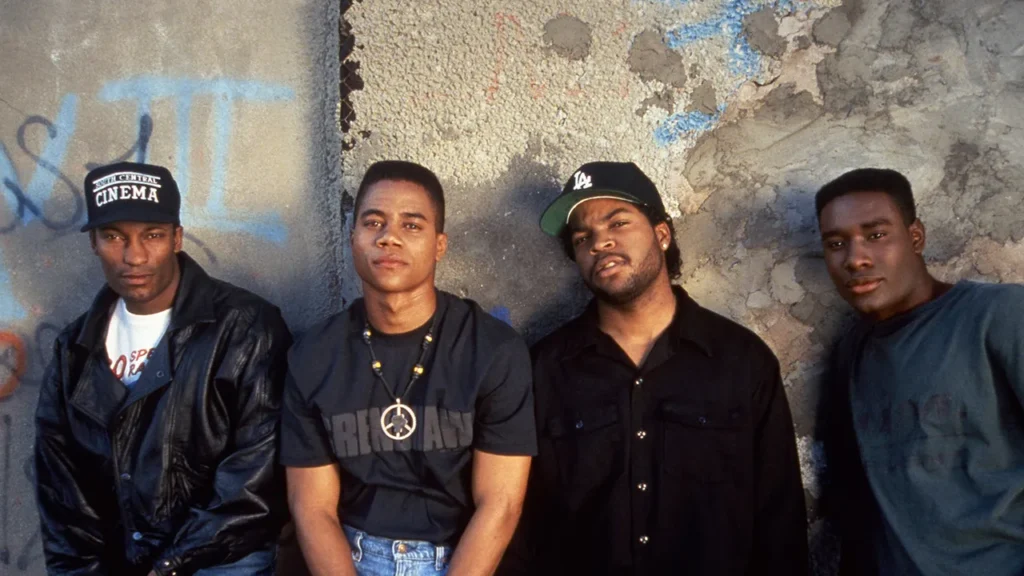
The cast of Boyz n the Hood helped make the movie memorable. Cuba Gooding Jr. plays Tre Styles, bringing a thoughtful quality to the character’s development.
Laurence Fishburne plays Furious Styles with a combination of authority and warmth. His performance gives the character credibility as a father who wants his son to become independent and responsible.
Ice Cube made his film debut as Doughboy. His performance was significant because it introduced audiences to a different side of the musician’s public persona. Doughboy is aggressive and streetwise, but Ice Cube also gives the character moments of vulnerability.
Morris Chestnut plays Ricky Baker, while Nia Long appears as Brandi. Regina King plays Shalika, and Angela Bassett portrays Reva Styles, Tre’s mother.
Together, the cast creates a believable group of characters whose relationships drive the story forward.
Ice Cube’s Performance as Doughboy
Ice Cube’s role as Doughboy became one of the most discussed performances in the movie. Before appearing in the film, he was already known as a member of the influential rap group N.W.A.
His transition into acting could have been difficult, but Doughboy gave him a role that connected naturally with the cultural environment audiences already associated with him.
At the same time, the performance is more nuanced than simply playing a tough character. Doughboy has emotions, relationships, frustrations, and personal loyalties.
The role helped establish Ice Cube as a serious screen performer and eventually contributed to a long acting career. His performance remains one of the defining elements of the film.
The Relationship Between Tre and Brandi
Tre’s relationship with Brandi adds another layer to the story. Their relationship is not presented as a simple teenage romance. Instead, it becomes part of Tre’s transition toward adulthood.
Brandi has her own values and expectations, which sometimes conflict with Tre’s ideas about relationships and responsibility. Their conversations reveal differences in how they think about the future.
The relationship also allows the film to explore themes of trust, maturity, commitment, and personal boundaries. Tre must learn that growing up involves more than making decisions for himself.
Brandi’s presence therefore contributes to the broader coming-of-age story rather than existing only as a romantic subplot.
The Film’s Approach to Masculinity
Boyz n the Hood spends considerable time examining different ideas of masculinity. Tre, Furious, Doughboy, and Ricky each represent different approaches to being a man.
Furious believes that responsibility, education, patience, and self-control are important. Doughboy has a much more confrontational understanding of strength and respect.
Tre is caught between these different influences. He has to decide what kind of person he wants to become and which values he will carry into adulthood.
This makes the movie more than a story about neighborhood violence. It is also a story about young men learning how to handle anger, responsibility, relationships, and pressure.
The Cultural Impact of Boyz n the Hood
When Boyz n the Hood was released, it attracted significant attention for its portrayal of Black life in Los Angeles. It became an important part of early-1990s American popular culture.
The movie influenced later filmmakers who wanted to tell stories about communities that had often been represented through stereotypes or simplified narratives.
Its influence can also be seen in the careers of its cast members. Cuba Gooding Jr., Ice Cube, Laurence Fishburne, Morris Chestnut, Nia Long, and Regina King all continued to build successful careers in entertainment.
The film’s impact extends beyond Hollywood. It has become a frequent subject of discussions about filmmaking, race, community, fatherhood, youth culture, and American society.
Why Boyz n the Hood Still Matters
One reason Boyz n the Hood continues to receive attention is that its central themes remain understandable to modern audiences. Friendship, family expectations, education, ambition, peer pressure, and difficult choices are not limited to one generation.
The technology and cultural references may belong to the early 1990s, but the emotional experiences of the characters remain recognizable.
The movie also encourages viewers to think about the circumstances surrounding individual choices. Rather than reducing every character to a simple label, it gives them histories and relationships that influence their behavior.
That complexity is part of the reason the film has remained relevant in conversations about American cinema.
Boyz n the Hood and Hip-Hop Culture
Hip-hop culture is closely connected to the world of Boyz n the Hood. The film arrived during an important period in the development of West Coast hip-hop, particularly the Los Angeles scene.
Ice Cube’s involvement gave the film an especially strong connection to hip-hop audiences. His background in N.W.A. meant that viewers already understood his cultural significance.
The movie and contemporary hip-hop shared several themes, including neighborhood identity, economic inequality, police relations, friendship, ambition, and everyday life.
However, Boyz n the Hood should not be understood simply as a visual extension of rap music. It has its own storytelling structure and focuses heavily on family relationships and personal development.
The Movie’s Message About Choices
One of the strongest ideas in Boyz n the Hood is that circumstances matter, but choices matter too. The characters are influenced by their environment, yet they do not all respond to that environment in the same way.
Tre’s story demonstrates the importance of thinking about consequences. Furious repeatedly encourages him to make decisions based on his long-term goals instead of temporary emotions.
Doughboy’s story presents a much more difficult cycle. His choices are connected to his experiences, relationships, and understanding of survival.
The film does not provide an easy answer about where responsibility begins and circumstances end. Instead, it leaves viewers with a complicated picture of human behavior.
The Legacy of John Singleton
John Singleton’s work on Boyz n the Hood established him as a major filmmaker. His success demonstrated that stories centered on Black communities could receive major attention from mainstream Hollywood.
Singleton went on to direct and produce numerous projects, working across different genres. However, Boyz n the Hood remained one of the defining works associated with his career.
His approach also influenced discussions about representation in filmmaking. The movie showed the importance of allowing filmmakers with personal connections to a community to tell stories from their own perspectives.
Singleton’s legacy is therefore connected not only to the film itself but also to the opportunities and conversations it helped create.
Boyz n the Hood as a Coming-of-Age Story
Although the movie deals with serious social issues, its core is a coming-of-age story. Tre begins as a child and gradually becomes a young man who has to understand the consequences of adulthood.
His father serves as a guide, but Tre ultimately has to make his own decisions. This is an important part of growing up: parents can provide advice, but children eventually have to apply those lessons independently.
The experiences Tre shares with his friends also shape his development. He learns from both their successes and their mistakes.
By the end, Tre has a clearer understanding of responsibility and the kind of future he wants. His journey gives the movie its emotional structure.
Final Thoughts on Boyz n the Hood
Boyz n the Hood remains a landmark film because it combines personal storytelling with broader social themes. At its heart, it is about young people trying to understand life, friendship, family, responsibility, and the consequences of their choices. Tre’s relationship with Furious provides the film with its strongest emotional foundation, while Doughboy and Ricky show how people from similar surroundings can develop very different goals and experiences.
The movie’s portrayal of South Central Los Angeles is also important. It presents the neighborhood as a real community filled with families, friendships, ambitions, humor, and challenges rather than reducing it to a single stereotype.
YOU MAY HAVE MISSED