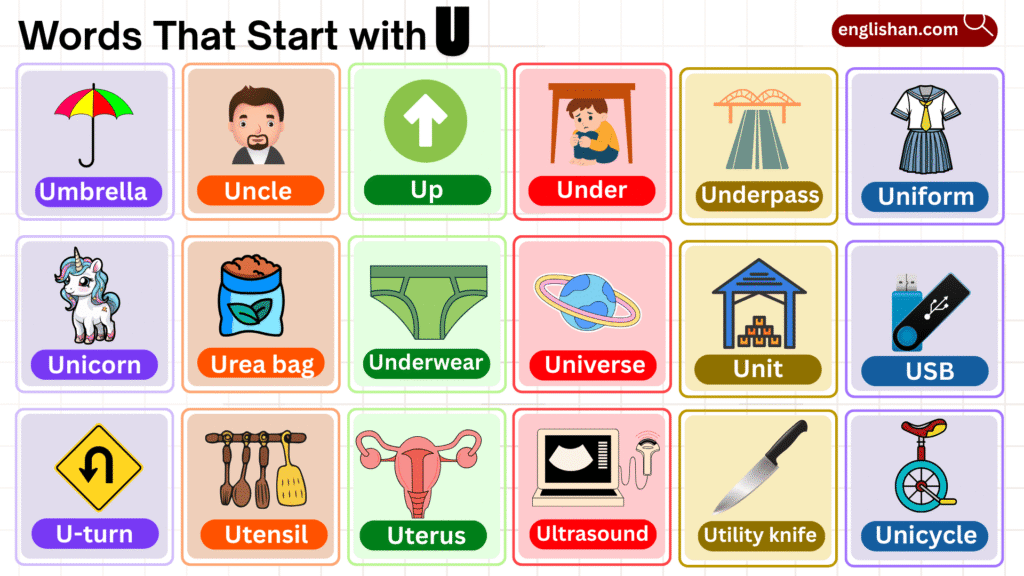
Words are the building blocks of language, and every letter brings its own personality to vocabulary. The letter U is especially interesting because it appears in thousands of English words ranging from everyday terms such as “under” and “use” to more unusual words such as “ubiquitous” and “umbrage.” Learning words that start with U can improve vocabulary, spelling, writing, reading, and communication skills.
Whether you are a student looking for vocabulary practice, a writer searching for better word choices, a teacher preparing a language lesson, or simply someone who enjoys discovering new words, a collection of U words can be surprisingly useful. Some are short and easy, while others are advanced and rarely heard in everyday conversation.
This guide explores words that start with U in a practical and interesting way. Instead of simply presenting a dictionary-style list, we will look at different categories, meanings, examples, vocabulary levels, and ways to remember these words.
Why Learn Words That Start With U?
Learning words beginning with a particular letter is an easy way to expand vocabulary. When learners focus on one letter at a time, they can recognize patterns in spelling and pronunciation while gradually becoming comfortable with unfamiliar terms.
The letter U has an interesting collection of words because it appears in common grammatical words as well as highly descriptive vocabulary. Words such as “under,” “until,” “upon,” and “usually” appear frequently in normal conversations and writing.
At the same time, U introduces learners to sophisticated vocabulary. Words such as “unprecedented,” “unanimous,” “unpredictable,” and “unnecessary” can make writing more precise. Learning these terms is particularly useful for essays, professional communication, academic work, and creative writing.
Common Words That Start With U
Some U words are so common that people use them every day without thinking about their vocabulary value. Examples include use, useful, usually, under, understand, unit, until, university, unique, and umbrella.
“Use” can function as both a noun and a verb. For example, you might say, “I use this computer every day,” or “This tool has many uses.” “Understand” is another extremely common word that describes the ability to grasp information or meaning.
Words such as “under,” “up,” “upon,” and “until” are also important because they frequently help construct sentences. These shorter words may not seem impressive, but they are essential for clear communication.
Easy U Words for Beginners
Beginners often benefit from learning short and familiar vocabulary first. Simple U words include up, us, use, unit, uncle, under, ugly, useful, and usual.
For example, “up” describes a higher position or movement toward a higher place. “Us” is a pronoun used when referring to the speaker and another person or group. “Use” describes the action of doing something with an object or resource.
These words are excellent for young learners because they are relatively easy to understand and appear frequently in everyday language. Once students become comfortable with basic U words, they can gradually move toward longer and more advanced vocabulary.
Positive Words That Start With U
There are many positive words beginning with U. Unique, useful, understanding, upbeat, uplifting, united, unforgettable, and unbeatable are examples that can communicate favorable ideas.
“Unique” describes something that is special or different from others. “Understanding” can describe someone who is compassionate and willing to recognize another person’s feelings or situation.
“Uplifting” is another useful word because it describes something that improves someone’s mood or creates a sense of encouragement. These words can be particularly useful in personal writing, reviews, speeches, social media content, and motivational messages.
Negative Words That Start With U
The letter U also introduces vocabulary with negative meanings. Examples include ugly, unfair, unhappy, unhealthy, unpleasant, uncertain, unfortunate, unnecessary, and unreliable.
“Unfair” describes something that does not treat people equally or reasonably. “Unreliable” describes someone or something that cannot consistently be trusted to perform as expected.
Many negative U words begin with the prefix un-, which often creates an opposite meaning. For example, “happy” becomes “unhappy,” “fair” becomes “unfair,” and “certain” becomes “uncertain.”
U Words That Describe People
Vocabulary beginning with U can be useful when describing personalities, behavior, or characteristics. Words such as understanding, unbiased, unusual, unpredictable, upbeat, unassuming, and unconventional can describe different aspects of a person.
An “understanding” person is usually someone who listens carefully and considers other people’s feelings. An “unassuming” person does not behave as though they are more important than others.
“Unconventional” describes someone or something that does not follow traditional methods or expectations. Depending on context, this can be neutral, positive, or negative.
U Words for Feelings and Emotions
Several U words can describe emotional experiences. Upset, unhappy, uneasy, uncertain, uncomfortable, and overwhelmed are particularly useful in everyday communication.
“Upset” is a common word for emotional distress or disappointment. “Uneasy” describes a feeling of discomfort, worry, or nervousness without necessarily indicating extreme fear.
“Uncomfortable” can describe both physical and emotional experiences. Someone might feel uncomfortable sitting in an awkward chair, or they might feel uncomfortable during an unpleasant conversation.
U Words for School and Education
Students encounter many U words in academic environments. University, undergraduate, unit, understanding, university-level, useful, and usually are common examples.
A “university” is an institution of higher education. An “undergraduate” generally refers to a student studying for a first university degree.
The word “unit” is especially flexible. In education, a unit can refer to a section of a course or curriculum. In mathematics and science, it can also describe a standardized quantity used for measurement.
Advanced Words That Start With U
Once basic vocabulary becomes comfortable, learners can explore advanced U words. Some useful examples include ubiquitous, unequivocal, unprecedented, uncompromising, unorthodox, utilitarian, ubiquitous, and untenable.
“Ubiquitous” describes something that appears to be everywhere. For example, smartphones have become ubiquitous in many societies.
“Unequivocal” means clear and leaving little or no room for doubt. “Unprecedented” describes something that has not happened or existed before in a comparable way.
These words can add precision to formal writing when they are used correctly.
Uncommon Words That Start With U
The English language contains many U words that are rarely used in ordinary conversation. Examples include ululate, umbrage, usurp, uxorious, ubiquitous, unctuous, and ursine.
“Ululate” means to produce a long, loud, wavering cry or sound. “Umbrage” refers to offense or annoyance, especially when someone feels insulted.
“Usurp” means to take a position, power, or authority without having the rightful claim to it. These words are not necessary for casual conversations, but they can be interesting additions to an advanced vocabulary.
Long Words That Start With U
Long U words can be useful for spelling practice and vocabulary development. Examples include uncharacteristic, understandably, unconstitutional, underestimation, uninterrupted, unintentional, and unprecedented.
Long words often contain smaller words or recognizable prefixes and suffixes. Understanding these components can make them easier to remember.
For instance, “unintentional” can be broken into “un-,” “intent,” and “-ional.” Recognizing these pieces gives learners clues about the word’s meaning and structure.
Short Words That Start With U
Short words are often the foundation of English communication. Examples include up, us, use, urn, unit, upon, under, undo, and ugly.
Even short words can have multiple meanings. “Use,” for example, can refer to employing something for a purpose, while “use” as a noun can describe the purpose or benefit of an object.
Learning short words first can help students build sentences before they begin working with longer vocabulary. They are also useful in word games and spelling exercises.
Verbs That Start With U
There are many useful verbs beginning with U. Examples include use, understand, unite, update, upgrade, upload, uncover, undo, unlock, unwrap, upset, and utilize.
“Update” means to make something current by adding newer information or improvements. “Upgrade” generally means improving something by moving it to a better or more advanced version.
“Uncover” means to reveal something that was hidden. “Unlock” can refer to opening something physically, but it can also be used metaphorically, such as “unlocking potential.”
Nouns That Start With U
U words also include many common nouns. Examples include umbrella, university, uniform, unit, uncle, utensil, universe, user, utility, and utensil.
An “umbrella” is a portable object used to protect someone from rain or sunlight. A “uniform” is a specific set of clothing worn by members of an organization, school, team, or profession.
“Universe” is one of the broadest nouns in the English language, referring to the entirety of space, time, matter, and energy as understood in modern scientific contexts.
Adjectives That Start With U
Adjectives beginning with U can make descriptions more specific. Examples include unique, unusual, useful, ugly, unfair, uncertain, unhappy, urgent, universal, and unlimited.
“Urgent” describes something requiring immediate attention. “Universal” describes something relating to everyone or everything within a particular context.
“Unusual” is a flexible adjective that describes something different from what is normal or expected. It is common in both casual and formal writing.
Adverbs That Start With U
Although there are fewer common U adverbs than nouns and verbs, several are highly useful. Examples include usually, ultimately, unexpectedly, unfortunately, undoubtedly, universally, and uniquely.
“Usually” means something happens in most cases or under normal circumstances. “Ultimately” refers to what happens in the end or after considering the final result.
“Unfortunately” is frequently used to introduce an undesirable fact or situation. These adverbs can help connect ideas and explain how or when something happens.
U Words Used in Everyday Conversation
Everyday English relies heavily on words that begin with U. People commonly say things such as “understand,” “usually,” “use,” “until,” “up,” and “unfortunately.”
Consider a simple conversation: “I usually wake up early, but today I stayed up late.” This sentence uses several U words naturally without sounding unusual.
This is why vocabulary learning should not focus only on complicated words. Common vocabulary is just as important because it forms the foundation of normal communication.
U Words for Writing
Writers can use U words to make their sentences clearer and more descriptive. Instead of repeatedly using simple phrases such as “very different,” the word “unique” may sometimes provide a more concise alternative.
Similarly, “unprecedented” can describe an event that has no comparable previous example, while “unpredictable” can describe something difficult to anticipate.
However, advanced vocabulary should never be added simply to make writing sound complicated. The best word is the one that communicates the intended idea accurately and naturally.
U Words in Professional Communication
Professional writing requires clarity, and many U words can help achieve it. Words such as update, urgent, understand, useful, unavailable, upcoming, and uncertainty frequently appear in workplace communication.
For example, a manager might request an “update” on a project. A colleague might explain that certain information is “unavailable” or that an “upcoming” deadline requires attention.
Using familiar words correctly is often more effective than filling professional writing with unnecessarily complex vocabulary. Precision and context matter more than difficulty.
U Words in Creative Writing
Creative writers have even more freedom when choosing U words. Words such as unknown, unusual, untamed, underground, unforgettable, mysterious, and unreal can help establish atmosphere.
An author might describe an “unknown road” to create curiosity or an “untamed forest” to establish a wild setting. These words can influence how readers imagine a scene.
The prefix “un-” is especially useful in creative writing because it can create words that communicate absence, reversal, or contrast. Writers can use these forms to make descriptions more expressive.
Words Beginning With “Un”
One of the most important patterns in U vocabulary is the prefix un-. It frequently creates an opposite or negative form of an adjective.
Examples include unable, unhappy, unfair, uncertain, uncomfortable, unnecessary, unusual, unreliable, unsuccessful, and unknown.
Understanding this pattern can make vocabulary learning much easier. Once you know the root word, you can often recognize the general meaning of its “un-” version.
Words Beginning With “Under”
Another important U pattern is under-. This prefix often relates to something below, beneath, insufficient, or less than expected.
Examples include understand, underground, underwater, underestimate, underdeveloped, underpaid, and underweight.
The meaning depends on the word. “Underwater” literally describes something beneath the surface of water, while “underestimate” means to judge something as less significant or capable than it actually is.
Words Beginning With “Ultra”
The prefix ultra- often suggests something beyond, extreme, or unusually high in degree. Examples include ultraviolet, ultramodern, ultrasound, ultrafast, and ultra-sensitive.
“Ultraviolet” refers to electromagnetic radiation beyond the violet end of visible light. “Ultrasound” refers to sound waves at frequencies above the range normally audible to humans and also describes medical imaging technology that uses such waves.
In everyday language, “ultra” can also be used informally to emphasize an extreme quality.
U Words for Word Games
Words beginning with U can be valuable in games such as Scrabble, crossword puzzles, word searches, and other vocabulary challenges.
Short words such as “up,” “us,” and “use” can be useful when players have limited spaces or awkward letter combinations. Longer words such as “unusual” and “understand” can provide opportunities when the board allows them.
Learning less common U words can be especially helpful for experienced word-game players. However, players should always check the rules and accepted dictionary for the particular game.
How to Remember U Words Easily
Memorizing a huge vocabulary list can become boring, so it is better to organize words into groups. You can create categories such as positive U words, negative U words, verbs, nouns, adjectives, school vocabulary, and advanced vocabulary.
Another effective method is to create sentences. Instead of memorizing “ubiquitous = everywhere,” create a sentence such as, “Smartphones are ubiquitous in modern society.” Connecting the word to a meaningful sentence makes the vocabulary easier to recall.
Visual associations can also help. When learning “umbrella,” imagine an umbrella. When learning “underground,” picture a train moving beneath a city. The stronger the mental connection, the easier the word may be to remember.
How Students Can Practice U Words
Students can begin by writing ten U words each day and using every word in a sentence. After several days, they can review the previous vocabulary before adding new words.
Another useful activity is creating alphabetical lists. For example, students can find one U noun, one U verb, one U adjective, and one U adverb.
Teachers can also turn vocabulary practice into games. Students might compete to find the longest U word, the most unusual U word, or the largest number of valid U words within a set time.
U Words for Kids
Children can start with familiar words such as up, us, use, uncle, umbrella, under, unit, and uniform.
Picture-based learning works especially well with young children. An illustration of an umbrella can help connect the object with the word, while a picture of something under a table can demonstrate the meaning of “under.”
As children become more comfortable, they can move toward words such as “unhappy,” “unique,” “useful,” and “unusual.” This creates a gradual path from basic vocabulary to more advanced language.
U Words for English Learners
English learners can benefit from studying U words because many contain useful prefixes and grammatical patterns. Understanding “un-,” “under-,” and “ultra-” can help learners decode unfamiliar vocabulary.
Pronunciation should also be practiced alongside meaning. English spelling does not always provide an obvious pronunciation, so listening to words in context can be valuable.
Learners should also focus on collocations. For example, English speakers commonly say “understand the situation,” “use a computer,” “urgent matter,” and “unique opportunity.” Learning words in natural combinations improves fluency.
Interesting Facts About the Letter U
The letter U has a fascinating history. In modern English, it serves as both a vowel and part of various letter combinations.
U appears in extremely common words and in technical vocabulary across fields such as science, medicine, technology, education, and law.
The letter also frequently appears in prefixes. This makes U especially interesting for vocabulary study because learning one structural pattern can help learners understand multiple words.
A Useful List of U Words
Here is a selection of U words covering different difficulty levels:
- Up — toward a higher position
- Us — a pronoun referring to the speaker and others
- Use — to employ something for a purpose
- Under — below something
- Until — up to a particular time
- Uncle — the brother of a parent
- Umbrella — an object used for protection from rain or sun
- Unique — different or one of a kind
- Useful — helpful or practical
- Urgent — requiring immediate attention
- Unusual — not common or ordinary
- Understand — to comprehend
- Update — to make something current
- Upgrade — to improve something
- Uncover — to reveal something hidden
- Unlock — to open or make accessible
- Uncertain — not known or definite
- Unprecedented — never previously experienced or known
- Ubiquitous — present or found everywhere
- Unequivocal — completely clear or unambiguous
The Importance of Context
A word’s meaning becomes much easier to understand when it is placed in context. Simply memorizing dictionary definitions may not teach you how people actually use a word.
For example, “unique” is often used to describe something distinctive. “Urgent” normally suggests that something needs immediate attention. “Uncertain” communicates doubt or lack of confidence about an outcome.
Reading articles, books, conversations, and other real-world material exposes learners to these words naturally. Over time, context helps vocabulary become part of active language rather than remaining a memorized list.
Common Mistakes When Learning U Words
One common mistake is trying to memorize too many words at once. A smaller group of words learned thoroughly is usually more useful than a huge list that is quickly forgotten.
Another mistake is using advanced words incorrectly. A word should be chosen because it fits the intended meaning, not simply because it sounds impressive.
Pronunciation can also cause problems. Some U words may not sound exactly as a learner expects based on spelling. Listening practice and dictionary pronunciation guides can help reduce these errors.
How U Words Improve Vocabulary
Learning U words can strengthen vocabulary in several different ways. Common words improve everyday communication, while advanced terms provide greater precision.
The prefixes found in many U words also teach learners how English vocabulary is constructed. Once students understand patterns such as “un-” and “under-,” unfamiliar words may become easier to analyze.
A stronger vocabulary can make reading more comfortable and writing more flexible. It can also help speakers express ideas more accurately instead of relying on the same simple words repeatedly.
Frequently Asked Questions About Words That Start With U
What is a common word that starts with U?
“Use” is one of the most common U words in English. Other highly familiar examples include “under,” “up,” “until,” “usually,” and “understand.”
What is a positive U word?
“Unique,” “useful,” “uplifting,” “understanding,” and “upbeat” can all communicate positive ideas depending on context.
What is a difficult U word?
“Ubiquitous,” “unequivocal,” “unprecedented,” and “utilitarian” can be challenging for learners because they are less common or have more specialized meanings.
Are there short U words?
Yes. Examples include “up,” “us,” and “use.” Short words are particularly useful for beginners and word games.
Why do so many U words begin with “un”?
“Un-” is a common English prefix that can create words expressing negation, absence, reversal, or an opposite quality. Examples include “unhappy,” “unfair,” “unknown,” and “unusual.”
What are some U words for students?
Students can learn words such as “university,” “understand,” “unit,” “useful,” “update,” “unique,” and “usually.” These words are useful in both academic and everyday communication.
Conclusion
words that start with U is a simple but effective way to build a stronger English vocabulary. The letter offers an impressive mixture of everyday words, academic terminology, descriptive adjectives, useful verbs, uncommon vocabulary, and words built from important prefixes. Beginners can start with simple terms such as “up,” “us,” “use,” “under,” and “uncle.” Intermediate learners can explore words such as “unique,” “useful,” “urgent,” and “unusual.” Advanced learners can move toward vocabulary such as “ubiquitous,” “unequivocal,” “unprecedented,” and “utilitarian.”
YOU MAY HAVE MISSED