The word concave appears in mathematics, physics, optics, engineering, architecture, design, and even everyday descriptions of objects. Although the basic idea is fairly simple, the term can become confusing when it is used in different subjects. Understanding what concave means gives you a useful foundation for recognizing shapes, surfaces, mirrors, lenses, graphs, and structures that curve inward.
In simple language, something is described as concave when its surface or shape curves inward rather than outward. A helpful way to picture it is to imagine the inside of a bowl. The middle area goes inward compared with the outer edges, creating a curved depression. This inward-curving quality is the main idea behind the word concave.
The concept becomes even more interesting when you look at how concave shapes behave.In geometry, a concave figure has a different structure from a convex figure.In optics, a concave mirror can reflect and focus light in useful ways. In mathematics, a concave graph can describe changing rates and patterns. Because of these different applications, learning the core meaning of concave makes many technical subjects easier to understand.
What Does Concave Mean?
Concave generally means curved inward. If you look at a surface and notice that its central portion seems to dip away from you while the edges extend toward you, you are likely looking at a concave surface. The easiest everyday example is the inside of a spoon, although the exact shape of a spoon is not necessarily a perfect geometric curve.
The word is commonly used as the opposite of convex. A convex surface curves outward, while a concave surface curves inward. Thinking about the two as opposites is one of the easiest ways to remember the distinction. A ball is generally convex on its outer surface, while the inside of a bowl provides a familiar example of a concave shape.
Concavity is not limited to physical objects. The term can also describe mathematical functions and graphs.In that context, concave refers to the way a curve bends rather than simply whether an object has an inward-facing surface.This is why the meaning of concave depends somewhat on the subject in which it is being used.
Concave and Convex: Understanding the Difference
The difference between concave and convex becomes much easier when you use everyday objects. Consider a bowl. The inside of the bowl curves inward and can hold water, so it provides a useful example of a concave surface. If you turn the bowl over and look at its outside, that outer surface curves outward and behaves more like a convex surface.
Another easy example is a lens or mirror. Concave mirrors have reflective surfaces that curve inward, while convex mirrors curve outward. Their different shapes cause them to handle light differently. A concave mirror can bring incoming parallel light rays toward a focal point under suitable conditions, while a convex mirror spreads reflected rays outward.
The distinction is also important in geometry. A convex polygon has all of its interior angles less than 180 degrees, while a concave polygon has at least one interior angle greater than 180 degrees. This mathematical definition is more precise than simply saying that one shape looks inward and another looks outward.
What Is a Concave Shape?
A concave shape is a shape that contains an inward indentation or curves inward in a meaningful way.The exact definition depends on the type of geometry being discussed, but the central concept remains the same: part of the shape bends or points inward rather than remaining entirely outward-facing.
In two-dimensional geometry, a concave polygon has at least one interior angle greater than 180 degrees. Imagine a simple arrow-shaped polygon. The point where the sides create an indentation can produce a reflex interior angle. That indentation is what makes the shape concave instead of convex.
Concave shapes can also appear naturally. Leaves, shells, containers, architectural structures, and many manufactured objects can contain concave sections. Designers often use these curves for functional reasons, such as directing movement, improving comfort, controlling airflow, collecting light, or making an object easier to hold.
Concave Shapes in Geometry
Geometry provides one of the clearest formal definitions of concavity.A polygon is considered concave when at least one of its interior angles is greater than 180 degrees. This creates an indentation in the boundary of the shape, meaning the entire polygon does not bulge outward in the same consistent manner.
One useful method for recognizing a concave polygon is to draw imaginary line segments between points inside the shape. In a convex polygon, a line segment connecting any two points in the polygon remains completely inside it. For a concave polygon, it is possible to select two points where the connecting segment passes outside the polygon. This property gives concavity a precise mathematical meaning.
Concave geometry is important because it teaches students that shapes cannot always be classified simply by appearance. Some complicated figures may contain both inward and outward-looking sections. By applying formal geometric rules, you can determine whether a shape is genuinely concave rather than relying only on visual judgment.
Examples of Concave Shapes in Everyday Life
Many everyday objects demonstrate the idea of concavity. The inside of a traditional bowl is one of the easiest examples because its central area is lower than its surrounding rim. A spoon also has an inward-curved side that can hold liquid or food, making it another familiar example.
Other examples include certain satellite dishes, the inside of some helmets, curved containers, and specific architectural surfaces. These objects are not necessarily concave throughout their entire structure. Instead, a particular surface or section can be concave while another section is convex or relatively flat.
The human body also contains naturally curved surfaces that can be described using the language of concavity.Anatomical descriptions sometimes use concave and convex to explain the shape of bones, joints, organs, and other structures. In these situations, the terms provide a useful way to describe three-dimensional curves without relying on vague language.
Concave Mirrors
A concave mirror is a curved mirror whose reflecting surface bends inward.It can be imagined as a small section taken from the inside of a spherical surface. Because of its shape, a concave mirror can reflect parallel incoming light rays toward a common region called the focus.
The focusing ability of a concave mirror makes it useful in several applications. Depending on its size, curvature, and position relative to an object, it can produce different types of images. The resulting image may be real or virtual, enlarged or reduced, and upright or inverted.
Concave mirrors are used in devices and systems where controlling light is important.They can appear in optical instruments, certain lighting systems, scientific equipment, and reflecting telescopes. Their ability to concentrate light makes them particularly valuable when designers need to gather or direct electromagnetic radiation.
How a Concave Mirror Works
When parallel light rays strike a concave mirror, the curved reflecting surface changes their direction according to the law of reflection. For an ideal spherical concave mirror, rays arriving parallel to the principal axis are reflected toward a point near the principal focus.
The focal point is one of the most important concepts associated with a concave mirror. It is the location where parallel rays are brought together after reflection, assuming the idealized conditions used in basic optics. The distance from the mirror’s pole to the focal point is called the focal length.
The position of an object relative to the focal point and center of curvature determines the type and size of image produced. This is why moving an object closer to or farther from a concave mirror can dramatically change what you see. The same principle is used in optical calculations and practical mirror design.
Uses of Concave Mirrors
One important use of concave mirrors is in optical instruments. Reflecting telescopes use large curved mirrors to collect light from distant astronomical objects. Instead of relying on a large lens, the telescope uses a mirror to gather and direct light toward an appropriate optical system.
Concave mirrors can also be used in certain lighting applications. A light source placed near the focus of a properly designed concave reflector can produce a more directed beam. This principle has been used in various lamps, searchlights, headlights, and other illumination systems.
Another familiar application is the magnifying mirror used for grooming. When an object is positioned close enough to a concave mirror, the mirror can produce an upright, enlarged virtual image. This makes small details easier to see and is useful for tasks that require visual precision.
Concave Lenses
A concave lens is another important application of the concept. Unlike a convex lens, which is generally thicker in the middle and thinner at the edges, a typical concave lens is thinner in the center and thicker toward the edges. Its surfaces curve inward relative to the surrounding structure.
Concave lenses cause parallel light rays to diverge after passing through the lens. The rays appear to originate from a virtual focal point on the same side of the lens as the incoming light. This behavior makes concave lenses fundamentally different from converging convex lenses.
Concave lenses are used in optical systems where light needs to be spread or adjusted. They can be combined with other lenses to create desired optical properties. Eyeglasses designed for certain types of vision correction may also use concave lens designs to alter how incoming light reaches the eye.
Concave vs. Convex Lenses
The easiest way to remember the difference between the two lens types is to focus on what happens to parallel light. A convex lens generally causes parallel rays to converge toward a focal region, while a concave lens causes them to diverge.
Their physical shapes also provide a useful visual clue. A typical convex lens is thicker at its center and thinner around the edges. A typical concave lens is thinner in the center and thicker around its edges. These shapes are directly connected to the way the lenses bend light.
Neither lens is universally better than the other. Each serves different purposes. Optical engineers select lens types based on what the system needs to accomplish. In many practical optical devices, multiple lenses are combined to control magnification, focus, distortion, and image quality.
Concave Functions in Mathematics
The word concave also has a special meaning in mathematics, particularly in calculus. When mathematicians describe a function as concave, they are usually talking about the direction in which its graph bends. This is different from the geometric meaning of an inward-curved physical surface.
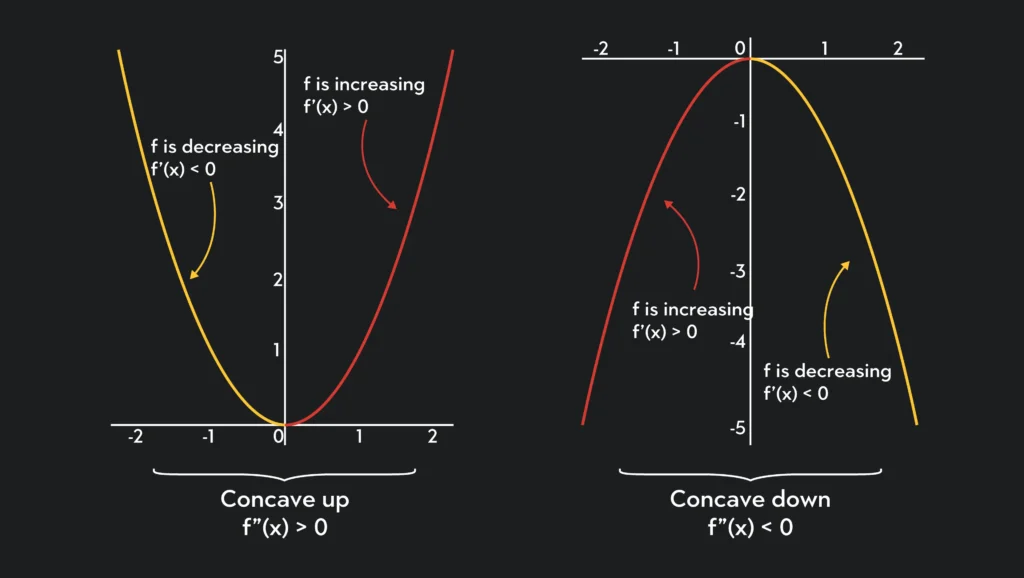
A function can be described as concave up or concave down. A graph that bends upward like a cup is commonly called concave up, while a graph that bends downward like an upside-down cup is called concave down. These descriptions are connected to the behavior of the function’s derivatives.
The second derivative is often used to determine concavity. If the second derivative is positive over an interval, the function is generally concave up there. If the second derivative is negative, the function is generally concave down. This provides a powerful way to analyze how a mathematical relationship changes.
Concave Up and Concave Down
Concave up describes a graph that bends upward. A useful visual example is the graph of a basic quadratic function such as y = x². Its curve resembles a bowl opening upward. As x changes, the slope becomes progressively larger, which is reflected in the positive second derivative.
Concave down is the opposite behavior. A graph such as y = -x² opens downward and resembles an upside-down bowl. Its slope becomes progressively smaller as you move from left to right, and its second derivative is negative.
The terms can initially seem confusing because the visual orientation does not always match the simple physical meaning of the word concave. In calculus, however, concave up and concave down are technical descriptions of curvature. Learning the derivative rules makes the terminology much easier to apply correctly.
Points of Inflection and Concavity
A point of inflection is closely related to concavity. It is generally a point where a function changes its concavity, such as moving from concave up to concave down or from concave down to concave up. Finding these points can reveal important information about the behavior of a graph.
The second derivative is often used as part of the process. If the second derivative changes sign around a particular point, that point may represent an inflection point. However, simply finding a location where the second derivative equals zero is not always enough. A genuine change in concavity should be established.
Inflection points are useful in mathematical modeling because they can indicate a change in how quickly a quantity is increasing or decreasing. They appear in economics, physics, engineering, statistics, and many other fields where understanding changing rates matters.
Concavity in Economics
Concavity is also used in economics to describe the shape of utility functions, production functions, cost relationships, and other mathematical models. In these contexts, concavity can help explain how a quantity responds as an input changes.
For example, a concave utility function can represent diminishing marginal utility. In simple terms, this means that receiving additional units of something may continue to increase satisfaction, but each additional unit may provide a smaller increase than the previous one.
Concavity is important in optimization as well. Under suitable conditions, a concave objective function can make it easier to identify a global maximum. This is one reason mathematical concavity is more than a classroom concept. It plays a practical role in analyzing real economic decisions and models.
Concavity in Engineering and Design
Engineers use concave forms for both functional and structural reasons. A curved inward surface can help control fluids, air, sound, light, or mechanical movement. The exact application depends on the shape and material involved.
In product design, concave surfaces can improve ergonomics. Handles, grips, seats, containers, and control panels may include inward curves that fit naturally with the human body. These shapes can make an object more comfortable and easier to use.
Architecture also makes extensive use of curved surfaces. Concave structures can create visual depth, guide movement, improve acoustics, or serve specific structural purposes. Modern designers often combine concave and convex curves to create buildings and spaces that are both practical and visually distinctive.
Concave Surfaces in Nature
Nature provides countless examples of curved surfaces, including shapes that can be described as concave. Natural forms rarely follow perfect mathematical curves, but the concepts of inward and outward curvature still provide useful descriptions.
The interiors of shells, plant structures, rock formations, and certain biological surfaces can contain concave regions. These curves may develop because of growth patterns, environmental forces, biological functions, or physical constraints.
Studying these natural forms can also inspire human design. Engineers and architects often look to nature when developing structures and products. A naturally occurring curve may suggest a way to manage stress, reduce material use, control fluid movement, or improve efficiency.
Why Concave Shapes Matter
At first glance, concavity may seem like a simple vocabulary word, but it has a surprisingly broad influence. It helps people describe shapes accurately, understand how mirrors and lenses behave, and analyze mathematical graphs.
In science, the concept can explain how light interacts with curved surfaces.In mathematics, it can describe the behavior of functions.In engineering, it can help communicate the design and performance of curved structures. Having one basic concept that connects these areas makes concavity especially useful.
Understanding concave shapes also improves visual reasoning. Once you train yourself to recognize inward curvature, many objects become easier to analyze. Instead of simply saying that something is curved, you can identify the direction and characteristics of that curve.
Common Mistakes When Understanding Concave
One common mistake is assuming that anything curved inward is automatically a concave geometric figure. Geometry uses specific definitions, particularly when discussing polygons and sets. A visual impression alone may not be enough to classify a mathematical object correctly.
Another mistake is confusing concave mirrors with concave lenses. Both involve inward-curved surfaces, but they interact with light differently because one primarily reflects light and the other transmits and refracts it. Their optical behavior should therefore be learned separately.
A third mistake occurs in calculus when students confuse concave up with the everyday meaning of concave. The terminology is technical in mathematics, so it is better to focus on the direction of curvature and the sign of the second derivative rather than trying to interpret the words literally.
Concave Examples at a Glance
| Area | Concave Example | Main Characteristic |
|---|---|---|
| Geometry | Indented polygon | Contains an inward section |
| Optics | Concave mirror | Reflecting surface curves inward |
| Optics | Concave lens | Typically thinner in the center |
| Everyday objects | Bowl interior | Surface curves inward |
| Mathematics | Concave-up graph | Bends upward |
| Mathematics | Concave-down graph | Bends downward |
| Engineering | Curved reflector | Can direct light or energy |
| Architecture | Inward-curved wall | Creates depth or functional space |
These examples show why the word concave cannot be understood through only one subject. The underlying idea is inward curvature, but the technical definition changes depending on whether you are talking about geometry, optics, calculus, engineering, or another discipline.
The best way to learn the concept is to connect each technical definition to a familiar visual example. Once you can picture the inside of a bowl, a concave mirror, and a concave-up mathematical graph, the different uses become much easier to remember.
How to Remember the Meaning of Concave
A simple memory trick is to associate concave with a cave. The word “cave” can remind you of something that goes inward. While this is not a scientific definition, it is a useful way to remember the basic meaning.
You can also remember the pair concave and convex together. Concave curves inward, while convex curves outward. Thinking about them as opposites helps prevent confusion, especially when studying mirrors, lenses, and geometric figures.
Visual learning is particularly effective for this topic. Draw a bowl-like curve opening upward and compare it with a dome-like curve. Then label one concave and the other convex. Repeating this simple comparison can make the distinction almost automatic.
Frequently Asked Questions About Concave
What is the simple definition of concave?
Concave means curved inward. An easy example is the inside surface of a bowl. The central region of the surface curves away from the outer edges, creating an inward shape.
The term can also have specialized meanings in mathematics and optics. In each case, the idea of curvature remains important, but the technical definition depends on the subject.
What is the opposite of concave?
The usual opposite of concave is convex. A concave surface curves inward, while a convex surface curves outward.
For example, the inside of a bowl can be described as concave, while the outside of a rounded dome is generally convex.
Is a spoon concave or convex?
A spoon can be both, depending on which surface you are examining. The inside of the spoon’s bowl is generally concave, while the outside surface is generally convex.
This makes a spoon a convenient everyday object for understanding the difference between the two terms.
What is a concave mirror?
A concave mirror has a reflecting surface that curves inward. Under ideal conditions, it can bring parallel incoming light rays toward a focal point.
Its ability to concentrate light makes concave mirrors useful in optical instruments, lighting systems, and magnifying applications.
What is a concave lens?
A concave lens is generally thinner at the center and thicker toward its edges. It causes parallel light rays to diverge after passing through the lens.
Concave lenses are used in optical systems where diverging light or specific vision correction is required.
What does concave mean in geometry?
In geometry, concavity describes a shape that has an inward indentation. For a polygon, a common formal test is whether at least one interior angle is greater than 180 degrees.
This separates concave polygons from convex polygons, whose interior angles are all less than 180 degrees.
What does concave mean in calculus?
In calculus, concavity describes the direction in which a graph bends. A function can be concave up or concave down.
The second derivative is commonly used to analyze concavity. A positive second derivative generally indicates concave-up behavior, while a negative second derivative generally indicates concave-down behavior over an interval.
Why are concave shapes useful?
Concave shapes can collect, direct, contain, or control things such as light, sound, air, liquids, and physical movement. Their inward curvature gives designers and engineers useful ways to manipulate energy and materials.
They are also valuable for visual design and ergonomics because inward curves can create comfortable or functional surfaces.
Final Thoughts on Concave
The concept of concave is much broader than a simple definition of “curved inward.” It is a fundamental idea that appears in geometry, optics, calculus, engineering, architecture, design, economics, and everyday life. Learning the basic meaning provides a foundation for understanding many more advanced topics.In geometry, a concave figure contains an inward indentation.In optics, concave mirrors can focus reflected light, while concave lenses generally spread light apart.In calculus, concavity describes the way a graph bends and helps mathematicians understand changing rates.
YOU MAY HAVE MASSED