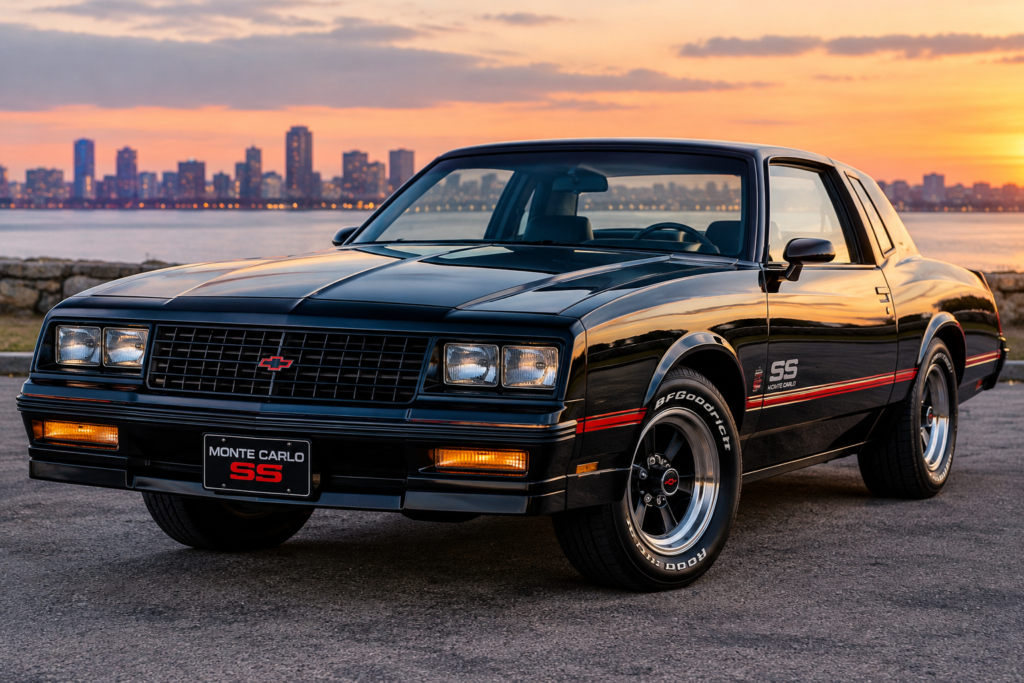
The Monte Carlo SS is one of those cars that manages to stand out even decades after it left the showroom. It combined the recognizable shape of the Chevrolet Monte Carlo with the attitude of a Super Sport model, creating a car that appealed to drivers who wanted something more exciting than an ordinary personal luxury coupe. For many enthusiasts, the name brings back memories of big American engines, long hoods, comfortable interiors, and unmistakable road presence.
The Monte Carlo itself occupied an interesting place in Chevrolet’s lineup. It was not designed to be a pure sports car in the traditional sense. Instead, it offered a combination of style, comfort, performance, and everyday usability. When Chevrolet added the SS formula, the character changed noticeably. The result was a Monte Carlo that looked more aggressive and delivered stronger performance than the standard versions.
Today, the Monte Carlo SS has become an interesting subject for classic-car fans, Chevrolet enthusiasts, collectors, and people who simply appreciate distinctive American cars. Depending on the generation, an SS can mean a very different driving experience. Earlier versions are closely connected with the classic muscle-car era, while later models brought the SS badge into a more modern front-wheel-drive environment.
What Is the Monte Carlo SS?
The Monte Carlo SS is a performance-oriented version of the Chevrolet Monte Carlo. The Monte Carlo name was introduced by Chevrolet in 1970 as a personal luxury coupe, giving buyers a stylish alternative to more conventional sedans and performance-oriented cars. The SS designation added a stronger performance identity to selected Monte Carlo generations.
The letters “SS” stand for Super Sport, a name Chevrolet has used on various performance vehicles for decades. On the Monte Carlo, the badge represented more than a cosmetic package. Depending on the model year and generation, SS versions could receive stronger engines, suspension changes, unique wheels, exterior styling details, and other performance-oriented equipment.
One important thing to understand is that there was never just one Monte Carlo SS. Chevrolet produced SS versions during different periods, and their specifications changed significantly over time. That makes the model particularly interesting because a classic early-1970s SS and a late-1990s or early-2000s Monte Carlo SS can feel like completely different cars.
The Birth of the Chevrolet Monte Carlo
Chevrolet introduced the Monte Carlo for the 1970 model year. The car was positioned as a stylish personal luxury coupe and shared engineering with other General Motors vehicles of the period. Its long hood, formal roofline, and relatively short rear deck immediately gave it a distinctive appearance.
The Monte Carlo was designed during a period when American buyers increasingly appreciated comfortable coupes that could provide a more upscale experience without reaching the price levels of traditional luxury brands. Chevrolet understood that customers wanted attractive styling and a powerful engine without necessarily buying a dedicated two-seat sports car.
That formula worked extremely well. The Monte Carlo quickly developed an identity of its own. It was large, comfortable, and visually impressive, yet it could also be ordered with powerful V8 engines. That combination eventually created the perfect environment for the Super Sport name.
The First Monte Carlo SS
The first Monte Carlo SS arrived for the 1970 model year. It represented Chevrolet’s attempt to give the Monte Carlo a stronger performance personality while retaining the car’s luxury-oriented character.
The early SS was not simply a Monte Carlo with an emblem attached to the body. It featured performance-oriented mechanical equipment and was associated with a large-displacement V8. The combination made it an important part of Chevrolet’s early-1970s performance lineup.
For enthusiasts, the first-generation SS is especially interesting because it appeared during the final years of the classic American muscle-car period. Full-size engines, rear-wheel drive, body-on-frame construction, and bold styling were still common. The Monte Carlo SS captured many of those characteristics while offering a somewhat more sophisticated presentation.
Monte Carlo SS and the Muscle-Car Era
The early Monte Carlo SS arrived at a fascinating point in automotive history. American manufacturers were producing increasingly powerful vehicles, but the industry was also approaching major changes caused by emissions regulations, insurance costs, fuel concerns, and changing consumer expectations.
The Monte Carlo SS therefore represents something of a transition. It belongs to the same broad performance culture that produced many famous muscle cars, but it also emphasized comfort and personal luxury. You could cruise in a Monte Carlo without feeling like you were driving a stripped-down track machine.
That dual personality remains one of the reasons enthusiasts enjoy the car today. The SS could look serious without becoming uncomfortable. It had performance credentials while still offering the relaxed driving character associated with the Monte Carlo name.
The Design of the Early Monte Carlo SS
Styling was always an important part of the Monte Carlo formula. The early cars featured long, flowing body lines and a substantial front end that gave the coupe a confident road presence.
The SS versions added visual details that helped distinguish them from standard Monte Carlos. Performance-oriented wheels, badging, striping, and other exterior touches gave the car a more aggressive appearance without destroying its upscale personality.
Inside, the Monte Carlo was built around the idea of comfortable long-distance driving. The cabin provided plenty of space compared with smaller sports cars of the era. That made the SS unusual in the best possible way: it could deliver an entertaining driving experience while remaining practical enough for regular cruising.
Engine Performance and the SS Philosophy
Engine performance is one of the biggest reasons people remember the Monte Carlo SS. The earliest SS models were equipped with a big-block V8, giving them the kind of torque that became a defining characteristic of American performance cars.
Big-block engines were especially impressive because they produced strong low-end and mid-range torque. Instead of requiring extremely high engine speeds to produce power, these engines could deliver a substantial shove when the accelerator was pressed.
The SS philosophy was therefore less about delicate handling or razor-sharp cornering and more about effortless power. The Monte Carlo was a large coupe, and Chevrolet used its size and available engine performance to create a car that felt strong and confident on the road.
Why the Early SS Is Important to Collectors
Classic Monte Carlo SS models attract collectors because they combine rarity, historical importance, and recognizable Chevrolet styling. Early examples are particularly interesting because they belong to an era when high-performance American coupes were becoming cultural icons.
Condition is extremely important when evaluating one of these cars. A restored example can look spectacular, but originality can also add significant interest. Factory equipment, correct engine specifications, original trim, documentation, and production details may all affect the desirability of a particular vehicle.
Collectors also pay attention to rust and structural condition. A beautiful paint job can hide expensive problems underneath, especially on an older vehicle. Anyone considering purchasing a classic Monte Carlo SS should inspect the body, frame, suspension mounting areas, floors, and other structural components carefully.
The Changing Automotive Industry
The story of the Monte Carlo SS cannot be separated from the major changes that affected American automobiles during the 1970s. Fuel prices, government regulations, insurance costs, and emissions requirements changed the performance-car market dramatically.
Large-displacement engines became harder to justify, and manufacturers began adjusting powertrains across their lineups. The Monte Carlo continued to evolve during this period, but the era of huge factory horsepower was coming to an end.
For enthusiasts, this period explains why different generations of the Monte Carlo can have such different personalities. A classic early SS belongs to one automotive world, while later Monte Carlo models were developed under completely different technical and economic conditions.
The Monte Carlo Returns to the Performance Conversation
Although the Monte Carlo continued through multiple generations, the SS name eventually returned in a very different automotive environment. Chevrolet revived the Monte Carlo SS identity in later years, giving the nameplate another opportunity to represent performance.
The later SS models were no longer enormous rear-wheel-drive muscle coupes. Automotive technology had changed, and Chevrolet was using front-wheel-drive platforms for the Monte Carlo. This made the newer cars substantially different from their classic predecessors.
Even so, Chevrolet retained the basic idea behind the SS. The goal was to make the Monte Carlo look and feel sportier while keeping the comfort and practicality that had always been part of its identity.
The 1980s and the Monte Carlo Legacy
The Monte Carlo continued into the 1980s with smaller dimensions and a more modern approach to design. By this point, the American automotive market had moved away from the huge coupes of the previous decade.
The Monte Carlo remained recognizable, but its proportions and mechanical character changed. The emphasis was increasingly on efficiency, comfort, improved packaging, and compliance with modern regulations.
Although the classic SS formula was no longer dominant, the Monte Carlo name retained a loyal following. Its combination of coupe styling and comfortable interior continued to appeal to drivers who wanted something different from an ordinary sedan.
The Return of the SS in the 1990s
The Monte Carlo was revived for the 1995 model year after a period away from Chevrolet’s lineup. This new generation was very different from the classic cars.
The modern Monte Carlo used a front-wheel-drive platform and was designed with contemporary safety, comfort, and manufacturing requirements in mind. It still looked like a coupe, but its proportions and engineering were much more modern.
The SS returned as a performance-oriented version during this era. Chevrolet used a V6 rather than the giant V8s associated with the early SS models. That change is important because it demonstrates how much the automobile industry had transformed.
The Monte Carlo SS in the Late 1990s
The late-1990s Monte Carlo SS offered a very different interpretation of performance. Instead of overwhelming power from a large V8, the car relied on a V6 and modern front-wheel-drive architecture.
For everyday driving, that approach had advantages. The car was easier to operate in normal traffic, generally more efficient than a classic big-block coupe, and equipped with technology that would have been unimaginable in a 1970 Monte Carlo.
The SS styling also helped separate the performance version from the regular Monte Carlo. Exterior details, wheels, badging, and other design changes gave it a sportier appearance while maintaining the basic Monte Carlo silhouette.
The 2000s Monte Carlo SS
The Monte Carlo entered the 2000s with another redesign. Chevrolet continued to offer the SS name, and later versions received stronger V6 powertrains.
One of the most recognizable later SS variants used the 3.8-liter V6. This engine became well known within General Motors vehicles and provided the Monte Carlo with a useful combination of power, reliability, and everyday drivability.
The later Monte Carlo SS was not attempting to recreate the exact driving experience of a 1970s big-block coupe. Instead, it represented a modern interpretation of the same basic concept: a stylish Chevrolet coupe with extra performance and a sportier personality.
Supercharged Monte Carlo SS Models
One particularly interesting chapter in the Monte Carlo story was the supercharged SS. Chevrolet offered a supercharged version of the 3.8-liter V6 during the early 2000s.
Adding forced induction significantly changed the character of the engine. A supercharger forces additional air into the engine, allowing it to produce more power than a naturally aspirated version of similar displacement.
The supercharged Monte Carlo SS is therefore an interesting bridge between the classic SS philosophy and modern performance engineering. Instead of relying on a huge engine, Chevrolet used forced induction to create additional output from a relatively compact V6.
How the Monte Carlo SS Drives
Driving a Monte Carlo SS depends heavily on the generation. A classic early-1970s SS feels completely different from a 2000s model.
The early car is large, rear-wheel drive, and heavily influenced by traditional American performance engineering. The engine’s torque is a major part of the experience, and the car feels substantial from behind the wheel.
A later Monte Carlo SS is more relaxed and modern. The front-wheel-drive layout changes how the car behaves, while the V6 provides usable power without the enormous engine size of the classic models. For many drivers, that makes the later car easier to live with every day.
Ride Comfort and Everyday Use
Comfort has always been one of the Monte Carlo’s strengths. Even the performance versions were not designed exclusively for competition driving.
The long-wheelbase design and spacious cabin made the Monte Carlo suitable for highway cruising. The car could cover long distances without feeling like a dedicated sports machine that sacrificed comfort for speed.
This is an important part of the Monte Carlo SS identity. Its appeal comes from balance. It gives the driver a performance-oriented experience while retaining the basic qualities of a comfortable personal coupe.
Interior Features and Cabin Experience
Interior design changed dramatically across the Monte Carlo’s generations. Early cars featured traditional American styling, large seats, simple controls, and a spacious cabin.
Later versions adopted more modern dashboards, improved climate controls, upgraded audio systems, power accessories, and contemporary safety equipment. The result was a much more user-friendly vehicle for daily transportation.
SS versions often included unique trim or equipment that helped create a sportier atmosphere. While these details varied by year, the goal was generally the same: make the driver feel that the SS was something special without turning the Monte Carlo into an uncomfortable performance machine.
Monte Carlo SS Versus a Regular Monte Carlo
The most obvious difference between an SS and a regular Monte Carlo is the performance focus. The exact mechanical differences depend on the generation, but SS models generally received stronger powertrains or performance-related equipment.
Styling was another important distinction. SS models were designed to communicate their performance identity through wheels, badges, body details, and other visual touches.
There is also a cultural difference. A regular Monte Carlo can be appreciated as a comfortable American coupe, while an SS carries an additional layer of enthusiast interest. For collectors, the SS designation can make a major difference when evaluating a vehicle.
Monte Carlo SS Versus Traditional Muscle Cars
It is tempting to call every classic Monte Carlo SS a traditional muscle car, but the description needs some context. The early SS certainly had muscle-car performance credentials, especially with its large-displacement V8.
However, the Monte Carlo was also positioned as a personal luxury coupe. It offered more emphasis on comfort and style than some of the stripped-down performance models of the period.
That combination makes it difficult to put the Monte Carlo into only one category. It sits somewhere between a muscle car and a personal luxury coupe, which is precisely what makes it interesting.
Why the Monte Carlo SS Still Has a Following
The Monte Carlo SS continues to attract enthusiasts because it represents a style of American automobile that has largely disappeared. Modern cars are generally more focused on efficiency, practicality, crossover packaging, or high-tech performance.
The Monte Carlo was different. It was a dedicated coupe with a long hood, a recognizable roofline, and a strong visual identity. The SS version added another layer of personality.
There is also an emotional factor. Many classic-car enthusiasts remember seeing Monte Carlos on American roads, in movies, at car shows, or in family driveways. That familiarity can make the model feel nostalgic even to people who never owned one.
Buying a Monte Carlo SS Today
Anyone considering buying a Monte Carlo SS should first identify the exact generation and model year. The name covers vehicles with very different engines, drivetrains, values, and parts availability.
For classic cars, condition should be a major priority. Rust, accident damage, poor restoration work, missing original parts, and neglected mechanical systems can turn an inexpensive purchase into an expensive project.
For later SS models, buyers should also consider mileage, maintenance history, transmission condition, electrical systems, suspension components, and the overall condition of the interior. A well-maintained car can be much more enjoyable than a neglected example with a lower purchase price.
Common Maintenance Considerations
Older Monte Carlo SS models require maintenance appropriate to their age. Rubber components, hoses, seals, suspension bushings, brake parts, cooling systems, and electrical connections can deteriorate even when a vehicle has been driven very little.
Classic engines also require careful attention. Cooling-system condition is especially important when dealing with high-output or large-displacement engines. A clean radiator, properly functioning cooling system, and correct fluids can make a significant difference in reliability.
Later Monte Carlo SS models have their own concerns. As with any older front-wheel-drive vehicle, transmission condition, engine maintenance, suspension wear, and electrical problems should be investigated before purchase.
Parts Availability and Restoration
Parts availability is another factor that varies by generation. Popular Chevrolet models generally benefit from a large enthusiast community, and many reproduction or aftermarket components exist.
However, not every part is equally easy to find. Original trim, specific interior pieces, factory wheels, badges, and unusual components can be more difficult to source than common mechanical parts.
For restoration projects, it is smart to research parts availability before buying a vehicle. A cheap project car can become expensive if important original components are missing.
Originality Versus Modification
There is no single correct way to enjoy a Monte Carlo SS. Some owners prefer factory originality, while others enjoy tasteful modifications.
A restoration-focused owner may want the correct engine, wheels, interior trim, paint, badges, and mechanical components. Maintaining originality can be particularly important for historically significant examples.
Other owners may install upgraded suspension, modern brakes, improved cooling systems, performance exhausts, modern wheels, or updated audio equipment. These modifications can make the car easier to enjoy while preserving its basic character.
The Monte Carlo SS at Car Shows
Monte Carlo SS models can be excellent car-show vehicles because they appeal to several groups at once. Chevrolet enthusiasts appreciate the brand connection, classic-car fans appreciate the styling, and performance enthusiasts are interested in the SS history.
A well-presented classic Monte Carlo can attract attention simply because it is less common than some of the more famous muscle cars. Visitors who grew up around these cars may also have personal memories associated with the model.
The best displays usually tell the story of the car rather than simply presenting a shiny exterior. Information about the model year, engine, factory equipment, restoration process, and historical background can make a display much more interesting.
The Cultural Legacy of the Monte Carlo
The Monte Carlo has had a strong presence in American popular culture. Its shape made it recognizable on television, in movies, music culture, and motorsports-related environments.
The name also became strongly associated with Chevrolet’s identity. Over several decades, the Monte Carlo evolved without completely losing its recognizable personality.
The SS badge added another layer to that legacy. It connected the Monte Carlo to Chevrolet’s wider performance tradition and helped distinguish certain versions from ordinary personal luxury coupes.
Monte Carlo SS and NASCAR Influence
The Monte Carlo also has an important connection with NASCAR. Chevrolet used Monte Carlo-based race cars in NASCAR competition, particularly during periods when the model became a recognizable part of stock-car racing.
Although a race car and a street Monte Carlo SS are very different machines, the racing association helped strengthen the public image of the Monte Carlo as a performance-oriented Chevrolet.
For fans of American motorsports, this connection adds another reason to appreciate the nameplate. The Monte Carlo was not simply a comfortable road-going coupe; it also became associated with one of America’s most recognizable forms of racing.
Fuel Economy and Modern Expectations
Comparing a classic Monte Carlo SS with a modern car highlights how much automotive technology has changed. Large-displacement engines, heavy bodies, and older transmissions generally do not deliver the fuel economy expected from modern vehicles.
That does not necessarily make the classic car undesirable. It simply means owners need realistic expectations. A Monte Carlo SS is best understood as an enthusiast vehicle rather than a modern economy car.
Later V6-powered SS models are considerably more practical from a fuel-consumption perspective, but they are still older vehicles now and should be maintained accordingly.
Safety Differences Between Generations
Safety is another area where the generations are dramatically different. Early Monte Carlo models were engineered according to the standards of their time, which were far less advanced than modern vehicle safety systems.
Later Monte Carlos benefited from decades of development in occupant protection, braking systems, airbags, structural engineering, and electronic controls.
This is worth remembering when purchasing or driving a classic. A vintage Monte Carlo SS can be enjoyable, but owners should understand that it does not provide the same level of crash protection as a contemporary vehicle.
Is a Monte Carlo SS a Good Project Car?
A Monte Carlo SS can be an interesting project car for someone who enjoys classic American vehicles and is willing to learn about restoration.
The key is choosing a realistic project. A vehicle with solid structural components and complete major parts is usually a better starting point than one that looks cheap but requires extensive bodywork and missing components.
Budgeting is equally important. Paint, interior restoration, engine work, suspension, brakes, tires, electrical repairs, and replacement trim can quickly add up. A careful inspection before purchase can prevent many unpleasant surprises.
What Makes a Monte Carlo SS Special?
The Monte Carlo SS is special because it does not fit neatly into a single category. It combines performance, comfort, styling, history, and Chevrolet heritage.
The early SS models offer a connection to the classic American performance era. Later SS models show how Chevrolet adapted the formula to modern engineering and changing customer expectations.
That evolution is part of the appeal. Rather than being one fixed vehicle, the Monte Carlo SS tells a broader story about how American cars changed over several decades.
The Future of Monte Carlo SS Enthusiast Cars
As classic-car culture continues to evolve, Monte Carlo SS models are likely to remain interesting to enthusiasts who appreciate distinctive American coupes.
Early SS examples have the strongest historical connection to the muscle-car era, while later models appeal to people who remember the Monte Carlo from the 1990s and 2000s.
Preservation will become increasingly important as surviving examples age. Cars that remain complete, properly maintained, and documented can provide future enthusiasts with a genuine connection to Chevrolet’s past.
Final Thoughts on the Monte Carlo SS
The Monte Carlo SS represents several different eras of Chevrolet history. From the big-block performance of the early 1970s to the V6-powered versions of the modern era, the SS name evolved along with the automotive industry. What remained consistent was the basic idea of combining a stylish Monte Carlo coupe with a more performance-oriented personality. The formula changed because technology, regulations, consumer preferences, and the overall car market changed, but the appeal of the SS badge remained.
YOU MAY HAVE MISSED