In N Out is one of those restaurant names that can spark an immediate reaction. For some people, it represents the classic American burger experience: a simple cheeseburger, crisp fries, a cold drink, and a restaurant that does not try to overwhelm customers with a massive menu. For others, it is a cultural landmark that has become closely associated with California and the American West.
What makes In-N-Out particularly interesting is that its appeal does not come from endless menu choices or constant reinvention. The chain has built its identity around a relatively focused selection of burgers, fries, shakes, and beverages. Instead of chasing every food trend, it has maintained a recognizable style for decades. That consistency is a major part of its reputation.
This article explores In-N-Out from several angles, including its history, menu, famous ordering options, ingredients, business philosophy, restaurant design, customer culture, expansion, pricing, and the reasons the brand continues to attract such strong interest.
What Is In-N-Out?
In-N-Out is an American fast-food restaurant chain best known for hamburgers, cheeseburgers, french fries, shakes, and a relatively simple menu. The company was founded in California and became strongly associated with the Southern California food scene before expanding into other Western states.
Unlike many modern fast-food chains, In-N-Out keeps its menu intentionally limited. Customers generally choose between a few core burger combinations, fries, and shakes rather than browsing dozens of sandwiches and seasonal products. This narrow focus allows the restaurant to concentrate heavily on its primary products.
The chain’s simplicity is part of its personality. Walking into an In-N-Out restaurant usually feels different from entering a fast-food location designed around constant promotional launches. The recognizable red-and-white visual identity, straightforward menu, and familiar burger format create a consistent experience.
Another important part of In-N-Out’s identity is the company’s emphasis on freshness. The brand has long promoted the idea that its food is prepared without relying heavily on the frozen, prepackaged approach associated with some large fast-food operations. That philosophy has helped distinguish it from competitors.
The History of In-N-Out
In-N-Out began in 1948 when Harry and Esther Snyder opened their first restaurant in Baldwin Park, California. The business was created during a period when Southern California’s automobile culture was rapidly developing, making drive-in restaurants particularly relevant.
The original concept was straightforward: customers could order food from their cars and enjoy a quick meal without leaving their vehicles. That drive-in heritage remains an important part of the company’s identity even though modern In-N-Out restaurants are designed for both drive-through and dine-in customers.
Harry Snyder is also associated with innovations intended to make drive-in service more convenient. The company’s early approach focused on efficiency and customer service rather than building an enormous menu.
Over the decades, In-N-Out expanded carefully rather than opening restaurants across the entire country. This controlled approach helped preserve the company’s regional identity and operational consistency.
The chain became particularly important in California, where it developed a loyal following. Eventually, restaurants appeared in additional Western states, but the company continued to resist the kind of nationwide expansion seen from many major fast-food competitors.
Why In-N-Out Became a Cultural Icon
A restaurant can become popular because its food tastes good, but cultural significance usually requires something more. In-N-Out became a recognizable part of Western American culture partly because of its long history and distinctive identity.
California played an especially important role. For generations of residents, visiting In-N-Out became an ordinary part of life. At the same time, people traveling outside the region often viewed the chain as something they had to try when visiting California.
That combination created an interesting dynamic. To local customers, the restaurant could be a familiar neighborhood option. To visitors, it could feel like a destination.
Social media strengthened that effect. Photos of burgers, fries, restaurant signs, and secret-menu orders circulate widely online. The company’s simple branding also photographs well, making it easy for customers to recognize and share.
In-N-Out has therefore become more than a place to buy a burger. It represents a particular style of fast food built around tradition, regional identity, and consistency.
Understanding the In-N-Out Menu
The standard In-N-Out menu is considerably smaller than what customers may find at many competing fast-food chains. The main food categories revolve around hamburgers, cheeseburgers, fries, shakes, and beverages.
The limited menu can initially seem unusual to someone accustomed to choosing from chicken sandwiches, wraps, breakfast items, desserts, salads, specialty burgers, and rotating promotions.
However, the smaller selection is intentional. When a restaurant specializes in a limited number of products, employees can focus on preparing those items repeatedly and maintaining familiar procedures.
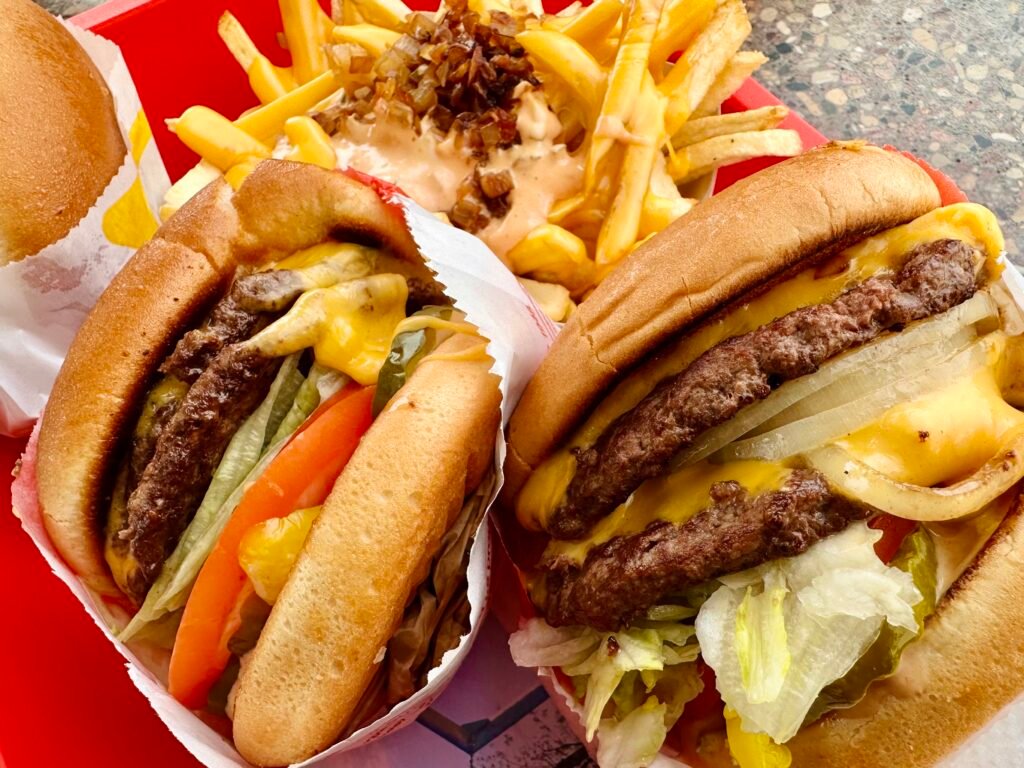
The classic hamburger is built around a beef patty, lettuce, tomato, spread, and onions depending on the selected preparation. The cheeseburger adds cheese, while the Double-Double uses two beef patties and two slices of cheese.
This basic structure gives customers several ways to customize the meal without requiring an enormous official menu.
The Famous Double-Double
The Double-Double is arguably the most recognizable In-N-Out burger. The name refers to its two beef patties and two slices of cheese.
It follows the same general flavor profile as the chain’s other burgers, combining beef, cheese, vegetables, onions, and the restaurant’s signature spread. The result is a burger that feels substantial without becoming excessively complicated.
One reason the Double-Double has remained popular is its balance. The two patties provide a stronger beef flavor, while the cheese adds richness. Lettuce and tomato contribute freshness, and the spread ties the ingredients together.
The burger also represents In-N-Out’s broader philosophy. Instead of adding dozens of toppings, the restaurant relies on a small collection of familiar ingredients prepared consistently.
For first-time visitors, the Double-Double is often one of the easiest ways to understand what the restaurant is trying to accomplish.
What Is the In-N-Out Secret Menu?
The term “secret menu” is widely associated with In-N-Out, although many of the famous off-menu combinations are better understood as established ordering variations rather than completely hidden products.
Customers can request modifications that employees recognize. These options have become part of the restaurant’s broader culture.
The most famous example is probably Animal Style. Customers can order a burger prepared with additional grilled onions, spread, and other modifications associated with the Animal Style preparation.
Protein Style is another well-known option. Instead of using a traditional hamburger bun, the burger is wrapped in lettuce.
Customers may also hear terms such as 3×3 or 4×4, referring to burgers with three or four beef patties and corresponding cheese slices. These combinations demonstrate how a relatively simple menu can provide considerable flexibility.
The popularity of these ordering terms is one reason In-N-Out has developed such a strong community around its food.
What Does Animal Style Mean?
Animal Style is one of the most recognizable In-N-Out ordering terms. It can be requested for burgers and is also associated with fries.
For burgers, Animal Style generally involves grilled onions, additional spread, and a preparation that creates a richer overall flavor. The combination changes the character of the standard burger without requiring entirely different ingredients.
Animal Style fries are typically served with cheese, spread, and grilled onions. They have become particularly recognizable online because of their distinctive appearance.
The popularity of Animal Style illustrates an important aspect of In-N-Out culture: customers enjoy learning the restaurant’s ordering language.
Once people discover the different combinations, visiting the restaurant becomes more interactive. Ordering can feel almost like learning a small vocabulary.
Protein Style and Other Customizations
Protein Style is another popular In-N-Out option. Rather than serving the burger on a conventional bun, the ingredients are wrapped in lettuce.
This option appeals to customers who prefer a lighter-feeling burger or simply enjoy the combination of crisp lettuce and the traditional burger ingredients.
Customers can also customize onions. Depending on the preparation, onions may be added fresh, grilled, or omitted altogether.
These modifications demonstrate that a limited menu does not necessarily mean limited choice. Instead, the restaurant provides a foundation that customers can adjust.
The customization system also keeps the operation relatively simple. Most modifications use ingredients already present in the kitchen, rather than requiring an entirely separate supply chain.
Why Are In-N-Out Fries So Debated?
Few fast-food fries generate as much discussion as In-N-Out fries. Some customers love them for their simple potato flavor, while others prefer the crispier texture offered by competitors.
One reason for the difference is the preparation style. In-N-Out has emphasized fresh potatoes rather than relying on conventional frozen fries.
The resulting texture can be different from what customers expect from heavily processed fast-food fries. They can have a softer interior and a texture that some people find less crisp than fries from other chains.
This has produced an interesting split in customer opinions. People who expect a particular crispy fast-food texture may be surprised, while customers who appreciate a fresh-potato character may enjoy them.
The fries are therefore a good example of how personal preference can influence the fast-food experience.
The Importance of Fresh Potatoes
Fresh potatoes are central to the way In-N-Out presents its fries. The company has long emphasized preparing potatoes in its restaurants rather than treating fries as a completely finished frozen product.
The process begins with potatoes that are prepared for frying. This approach contributes to the chain’s distinctive texture and flavor.
Fresh preparation also fits the company’s larger brand philosophy. In-N-Out has historically focused on a limited ingredient list and straightforward preparation rather than building food around extensive processing.
That does not automatically mean every customer will prefer the result. Fresh preparation can produce characteristics that differ from highly standardized frozen fries.
Still, it is an important part of understanding why In-N-Out’s food tastes different from some competitors.
In-N-Out Shakes and Beverages
Burgers and fries receive most of the attention, but shakes are another major part of the In-N-Out menu.
The traditional shake flavors include chocolate, vanilla, and strawberry. Their relatively simple selection mirrors the philosophy of the food menu.
Rather than introducing dozens of flavors, the restaurant concentrates on a few familiar choices.
A shake can also provide a sweet contrast to the salty and savory burger-and-fries combination. For many customers, the classic meal is not complete without one.
The limited beverage selection reinforces the overall sense of consistency. Customers know what to expect when they visit, regardless of which location they enter.
How In-N-Out Maintains Consistency
Consistency is one of the biggest challenges in the restaurant industry. A burger may taste excellent at one location but noticeably different at another if procedures are not controlled carefully.
In-N-Out’s relatively focused menu makes consistency easier to manage. Employees are repeatedly preparing the same core products rather than switching between a huge number of unrelated items.
Supply and operational decisions also play a role. The company’s regional expansion model helps it maintain closer control over distribution and restaurant operations.
This is one reason the brand has historically expanded more slowly than many major fast-food competitors.
Instead of maximizing the number of locations, the company has emphasized maintaining a recognizable experience.
Why In-N-Out Expands Slowly
In-N-Out’s limited geographic footprint is one of its most distinctive characteristics.
While many large restaurant chains operate across the United States and internationally, In-N-Out has concentrated primarily on Western states.
There are practical reasons for this approach. Fresh ingredients and supply logistics become more difficult when restaurants are located extremely far from distribution facilities.
A company that wants to preserve a particular preparation model may need to ensure that restaurants remain within a manageable supply network.
The slower expansion has also strengthened the brand’s regional identity. Because the restaurant is not available everywhere, visiting one can feel more special to customers who live outside its operating area.
In-N-Out and California Identity
It is difficult to discuss In-N-Out without discussing California.
The company was born in Southern California, and its history developed alongside the region’s car culture. The original drive-in concept matched a Southern California lifestyle built around automobiles and roadside dining.
Over time, the restaurant became associated with California in much the same way that certain foods, landscapes, and entertainment industries became connected with the state.
For visitors, an In-N-Out meal can therefore feel like part of the California experience.
The brand’s continued commitment to its original identity has helped preserve that association.
The In-N-Out Restaurant Experience
Walking into an In-N-Out location usually produces a recognizable visual experience. The restaurant design tends to emphasize clean lines, bright signage, and the company’s familiar red-and-white branding.
Drive-through service remains a major part of the business, reflecting the company’s historical connection to automobile culture.
Inside, customers can usually watch some of the food preparation taking place. This contributes to the perception of freshness and transparency.
The experience is intentionally uncomplicated. There is no need to navigate a massive menu board filled with dozens of categories.
Customers generally decide what type of burger, fries, and drink they want, then customize those items if desired.
In-N-Out’s Focus on Employees
The company’s approach to employees has also attracted attention over the years. In-N-Out has developed a reputation for investing in training and maintaining structured restaurant operations.
Fast-food restaurants can be challenging workplaces because employees must balance speed, accuracy, food preparation, cleanliness, and customer service.
A restaurant that wants consistent food needs employees who understand the preparation system thoroughly.
In-N-Out’s focused menu means employees can develop deep familiarity with the core products. Rather than learning an enormous catalog of unrelated dishes, workers repeatedly practice a relatively small set of preparations.
That operational simplicity can benefit both employees and customers when implemented effectively.
How In-N-Out Differs From Other Burger Chains
The easiest way to understand In-N-Out is to compare its philosophy with the broader fast-food industry.
Many chains compete through menu expansion. They add limited-time products, specialty sauces, breakfast offerings, chicken products, desserts, and seasonal promotions.
In-N-Out has generally followed a different path. It has maintained a narrow menu and built recognition around a few core products.
This creates a distinctive customer experience. Someone who enjoys variety may appreciate a larger menu elsewhere, while someone who values consistency may prefer a restaurant with fewer choices.
Neither approach is inherently better for every customer. They simply represent different restaurant strategies.
In-N-Out Prices and Value
Price is an important part of any fast-food discussion, but exact menu prices can vary by location and change over time.
In-N-Out has historically been known for offering a relatively straightforward burger meal without turning the ordering process into a premium dining experience.
The value equation depends on what a customer wants. Someone looking for the largest possible meal may compare portion sizes differently from someone who values ingredient preparation and a focused menu.
Regional operating costs can also influence prices.
For the most accurate current pricing, customers should check the menu at their local restaurant because prices can change with location and time.
Is In-N-Out Fast Food?
Yes, In-N-Out is generally classified as a fast-food restaurant, although its preparation style differs from some other fast-food chains.
The company provides counter and drive-through service, focuses on quick meals, and operates restaurants designed for high-volume service.
At the same time, its emphasis on fresh preparation gives the food a different character from some highly standardized fast-food products.
The term “fast food” describes the restaurant format, not necessarily a single preparation method. In-N-Out fits comfortably within the category while maintaining its own operational identity.
The Brand’s Visual Identity
In-N-Out’s branding is remarkably recognizable.
The red palm-tree imagery, white lettering, and red accents have become associated with the company’s restaurants. The design has remained sufficiently consistent that customers can often identify a location from a distance.
The company also uses visual elements connected with its Southern California roots.
This consistency matters because strong branding can transform an ordinary restaurant into a recognizable cultural symbol.
In-N-Out demonstrates how a simple visual system can remain effective for generations without constantly changing its appearance.
Why People Love the Simplicity
Modern consumers are often presented with an enormous number of choices. Food delivery apps can contain hundreds of restaurants, and individual chains may offer extensive menus.
Against that background, In-N-Out’s simplicity can feel refreshing.
You know the basic structure of the experience before you arrive. You choose your burger, decide how you want it prepared, select fries, and choose a drink or shake.
The limited menu can reduce decision fatigue.
It also allows customers to develop preferences. Someone might always order a Double-Double with a particular onion preparation, while another person might prefer a Protein Style hamburger.
That familiarity is part of the attraction.
In-N-Out’s Role in Fast-Food Conversations
In-N-Out frequently appears in discussions about the best-known American burger chains, partly because the company has developed such a distinct identity.
Customers compare its burgers, fries, prices, service, and regional availability with other chains.
Online discussions often become especially lively because food preferences are personal. One person’s favorite burger may be another person’s ordinary meal.
That debate has actually helped In-N-Out remain culturally relevant.
People discuss the restaurant because they have strong expectations about what the food should be like, and those expectations create a sense of community around the brand.
Visiting In-N-Out for the First Time
First-time customers can keep the experience simple.
Start with one of the standard burgers rather than immediately ordering an elaborate customization. This provides a useful baseline for understanding the restaurant’s flavor profile.
If you enjoy the basic burger, you can experiment with Animal Style or other recognized modifications on a future visit.
It is also worth trying the fries before deciding whether you like them. Their texture is different enough from some other fast-food fries that expectations can influence the experience.
A shake can round out the meal if you enjoy classic flavors.
Tips for Ordering at In-N-Out
The ordering process becomes easier once you understand the basic vocabulary.
You can order a hamburger, cheeseburger, or Double-Double, then customize onions and other recognized preparations.
If you hear people discussing Animal Style, remember that it is an established preparation rather than something that requires a complicated explanation.
Protein Style refers to replacing the bun with lettuce.
If you are uncertain, there is nothing wrong with ordering from the standard menu. The employees are accustomed to serving customers who are completely new to the restaurant.
In-N-Out and Food Quality
Food quality is subjective, but In-N-Out’s approach is easier to describe objectively.
The company has built its food around a small group of core ingredients and preparation methods.
The burgers use beef patties, fresh vegetables, cheese, buns, and the restaurant’s recognizable spread. Fries are made from potatoes, while shakes use traditional flavors.
The limited ingredient system helps create a consistent flavor identity.
Rather than relying on dozens of sauces and toppings, the restaurant gets much of its character from the interaction between a few familiar ingredients.
Why the Brand Has Lasted So Long
Longevity is one of In-N-Out’s most interesting characteristics.
Restaurant trends change constantly. New chains appear, menus evolve, and consumers move toward different dining habits.
Yet In-N-Out has maintained a recognizable identity for generations.
Part of that longevity comes from consistency. Customers who visited years ago can still recognize the basic experience today.
Another factor is cultural familiarity. A brand that becomes part of family routines can survive because customers introduce it to younger generations.
In-N-Out has therefore benefited from both operational consistency and cultural continuity.
The Future of In-N-Out
The future of In-N-Out will likely involve balancing expansion with the operational philosophy that made the company recognizable.
As the chain enters new markets, maintaining ingredient quality, restaurant standards, employee training, and supply logistics becomes increasingly important.
Rapid expansion can create challenges for any restaurant company.
In-N-Out’s history suggests that the company values controlled growth rather than pursuing maximum geographic coverage.
That approach may continue to define how customers encounter the brand in the years ahead.
Frequently Asked Questions About In-N-Out
What is In-N-Out famous for?
In-N-Out is famous for its burgers, Double-Double, fresh-potato fries, shakes, Animal Style ordering options, distinctive branding, and strong association with California and the American West.
What is a Double-Double?
A Double-Double is an In-N-Out burger containing two beef patties and two slices of cheese, along with the restaurant’s standard burger ingredients and selected toppings.
What does Animal Style mean?
Animal Style refers to a recognized preparation involving additional ingredients and preparation changes. It is particularly associated with burgers and fries.
Does In-N-Out have a secret menu?
The phrase “secret menu” is commonly used for In-N-Out’s customized ordering options. Many of these choices are widely known and recognized by employees rather than being truly secret.
What is Protein Style?
Protein Style is a burger preparation in which lettuce replaces the traditional bun.
Why are In-N-Out fries different?
In-N-Out’s fries are prepared from potatoes rather than following the same frozen-fry approach used by many other fast-food restaurants. This contributes to their distinctive texture.
Is In-N-Out only in California?
No. Although In-N-Out began in California and remains strongly associated with the state, the chain operates in several Western states.
Why doesn’t In-N-Out expand nationwide?
The company’s controlled expansion is connected to its supply, freshness, operational, and regional business model. It has historically expanded much more selectively than many major fast-food chains.
What flavors do In-N-Out shakes come in?
The classic shake flavors are chocolate, vanilla, and strawberry.
What should a first-time customer order?
A straightforward hamburger, cheeseburger, or Double-Double is a good way to experience the standard menu. Customers can explore customizations after becoming familiar with the basic burger.
Final Thoughts on In N Out
In N Out success is a useful reminder that a restaurant does not always need an enormous menu to build a powerful brand. The company has created a recognizable experience around a small selection of burgers, fries, shakes, and customization options. Its history is deeply connected with California and the development of American drive-in culture. Its controlled expansion has kept the brand relatively regional, while its ordering terminology has created a unique community among customers.
YOU MAY HAVE MASSED