Finding the right words can sometimes be surprisingly difficult, especially when you are looking for words that contain a particular letter. The letter is one of the more interesting letters in the English alphabet because it appears less frequently than many other letters. When people search for words with Q, they may be looking for vocabulary for school, crossword puzzles, word games, writing projects, spelling practice, or simply to improve their English.
Q words can also be fascinating because many familiar English words containing Q traditionally use the letter combination QU. Words such as “queen,” “quick,” “question,” and “quiet” are common examples. However, English also has words where Q appears without U, including terms borrowed from other languages and specialized vocabulary.
Learning words with Q does not have to feel like memorizing a giant dictionary. Once you understand common patterns, word families, prefixes, suffixes, and pronunciation rules, it becomes much easier to recognize and remember them. This guide explores different types of Q words, their meanings, examples, spelling patterns, and useful ways to learn them.
What Are Words With Q?
Words with Q are simply English words that contain the letter Q anywhere in their spelling. The Q can appear at the beginning, middle, or, in relatively uncommon cases, toward the end of a word. The most recognizable Q words usually begin with Q, such as “queen,” “quiz,” “quick,” and “quality.”
In traditional English spelling, Q is frequently followed by the letter U. This creates the familiar “qu” combination. In many words, the letters are pronounced together, although their exact sound can vary depending on the word. For example, “quick” begins with a sound similar to “kw,” while “unique” has a different pronunciation pattern.
There are also words containing Q that do not follow the familiar QU pattern. Examples include “qi,” a term associated with Chinese philosophy, and “qat,” a word referring to a plant traditionally used in parts of East Africa and the Arabian Peninsula. Such words can be especially useful in word games because they provide alternatives to the usual Q-plus-U pattern.
Why Learning Words With Q Is Useful
Learning words with Q can expand your vocabulary and make your writing more flexible. If you regularly practice vocabulary, Q words give you an opportunity to learn spelling patterns that are less common than those associated with letters such as S, T, or E.
Q words are also particularly valuable for word games. Games involving letter tiles, crossword clues, spelling challenges, and vocabulary competitions often make players think carefully about unusual letters. Knowing a selection of short and long Q words can give you more options when you need to use a difficult letter.
Another benefit is improved spelling confidence. Words such as “questionnaire,” “qualification,” “quarantine,” and “quintessential” may initially look complicated. However, breaking them into smaller parts makes them easier to understand and remember. Learning these words gradually can help you become more comfortable with advanced English vocabulary.
Common Words That Start With Q
Some of the easiest words with Q are common words that people encounter regularly. These include “queen,” “quick,” “quiet,” “question,” “quite,” “quality,” “quarter,” and “quiz.”
The word “queen” refers to a female monarch or, in some contexts, the female leader of a group. “Quick” describes something that happens rapidly or someone who moves with speed. “Quiet” refers to a lack of noise, while “question” refers to something asked to obtain information.
Other everyday examples include “quote,” “queue,” “quit,” “quarter,” “quality,” and “quantity.” Although these words share the letter Q, their meanings are completely different. This is a good reminder that recognizing a spelling pattern is only the first step in vocabulary development.
Short Words With Q
Short Q words are particularly useful for puzzles and word games because they allow players to use Q without needing a long word. Some examples include qi, qat, qua, qis, and qadi.
“Qi” is a word borrowed from Chinese that is commonly associated with the concept of vital energy or life force. “Qat” refers to a plant whose leaves are traditionally chewed for their stimulating effects. “Qua” is a formal word meaning “in the capacity or character of.”
Some short Q words may be unfamiliar to everyday English speakers. That does not make them unimportant, especially if your goal is vocabulary building or word-game preparation. However, it is always useful to learn the meaning and accepted usage of an unfamiliar word instead of memorizing its spelling alone.
Words With Q and U
The combination QU is one of the most recognizable spelling patterns involving Q. Many common English words use these two letters together.
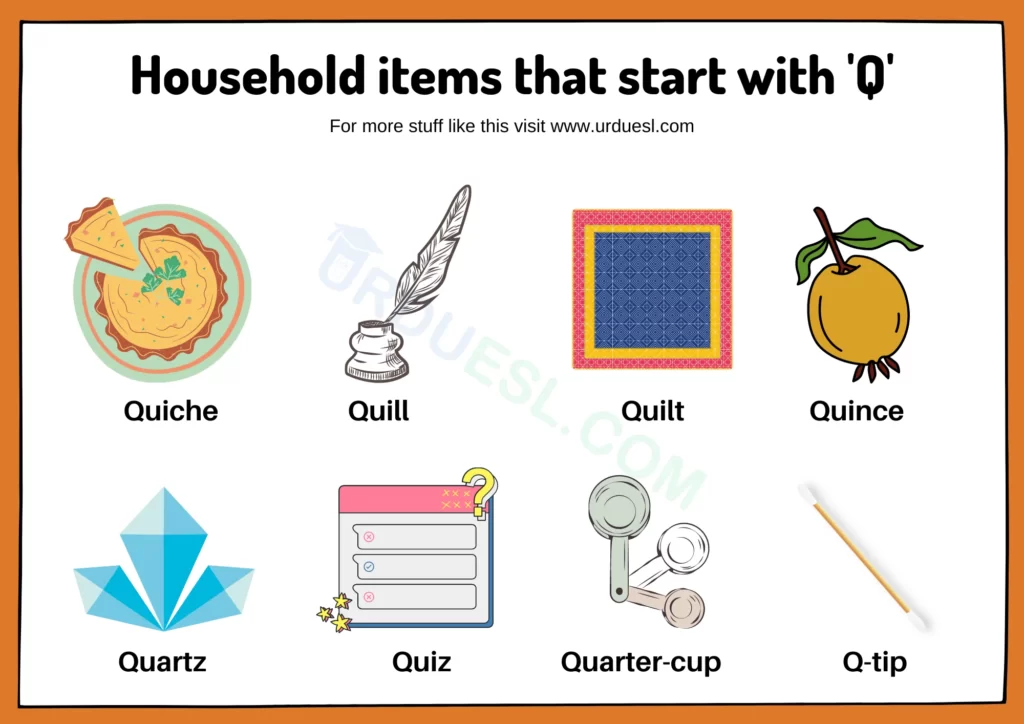
Examples include “quick,” “quiet,” “queen,” “question,” “quality,” “quantity,” “quarter,” “quilt,” “quite,” and “quote.” In many of these words, QU produces a sound similar to “kw.”
There are exceptions and variations, though. For example, in “unique,” “antique,” and “mosque,” the pronunciation of Q is different from the sound you might expect from words such as “quick.” This is one reason pronunciation should be learned alongside spelling.
Words With Q at the Beginning
Words beginning with Q are among the easiest Q words to identify. Common examples include:
- Queen
- Quick
- Quiet
- Question
- Quality
- Quantity
- Quarter
- Queue
- Quiz
- Quote
- Quarrel
- Quench
- Quiver
- Quilt
- Quotation
These words cover many different parts of speech. “Quick” can function as an adjective, while “question” can be a noun or a verb. “Quote” can also be used as both a noun and a verb.
Learning Q words through categories is often more effective than memorizing them randomly. For example, you can group words related to communication, movement, objects, emotions, and academic vocabulary.
Words With Q in the Middle
Not every Q word begins with Q. Many words contain Q somewhere in the middle, especially words formed by adding prefixes or suffixes.
Examples include “adequate,” “frequently,” “liquid,” “equal,” “equation,” “require,” “sequence,” “consequence,” “acquire,” and “conquest.”
These words are useful because they introduce more advanced vocabulary. “Adequate” means sufficient for a particular purpose, while “frequently” means happening often. “Equation” is commonly used in mathematics, and “sequence” refers to something arranged in a particular order.
Recognizing Q in the middle of words can also improve spelling. Instead of treating each word as completely separate, learners can notice recurring patterns such as “-quire,” “-quence,” and “-qual.”
Common Q Words and Their Meanings
Understanding meanings is more valuable than simply collecting a list of spellings. Here are several common Q words and what they mean.
Question means something asked to obtain information or clarification. For example, a student may ask a question during a lesson.
Quality refers to the standard or characteristics of something. A product with high quality is generally considered well-made or reliable.
Quantity refers to an amount or number of something. For example, a recipe may specify the quantity of flour required.
Quarter can refer to one-fourth of something. It can also describe a period of time, a neighborhood, or a coin depending on the context.
Queue means a line of people or vehicles waiting for something. The word is pronounced differently from how many beginners expect.
Quiz refers to a short test or a set of questions designed to check knowledge.
Positive Words With Q
There are several Q words that can be useful when describing positive qualities, experiences, or characteristics.
Words such as “quality,” “qualified,” “quick-witted,” “quiet,” “quaint,” and “queenly” can appear in positive contexts depending on how they are used.
“Qualified” describes someone who has the necessary skills, knowledge, or credentials for a particular activity. “Quick-witted” describes someone who can understand situations and respond intelligently or humorously.
“Quaint” is often used for something attractively old-fashioned or charming. “Quality” can describe something that has a high standard or desirable characteristics.
The usefulness of these words depends heavily on context. A strong vocabulary is not simply about finding positive or negative words; it is about knowing exactly when a particular word communicates the intended idea.
Advanced Words With Q
Once you are comfortable with common Q words, you can move toward more advanced vocabulary. Examples include “quintessential,” “quintessentially,” “quagmire,” “quandary,” “quintuple,” “quiescent,” and “querulous.”
“Quintessential” describes something that represents the most typical or perfect example of a particular quality or category. “Quandary” refers to a difficult situation in which someone has to choose between options.
“Quiescent” describes something that is inactive, quiet, or temporarily dormant. “Querulous” describes someone who frequently complains or expresses dissatisfaction.
These words are useful in essays, formal writing, literature, journalism, and advanced conversation. However, they should be used naturally. Choosing a complicated word simply because it sounds impressive can make writing less clear.
Words With Q for Students
Students encounter Q words in many different subjects. English classes may introduce words such as “question,” “quotation,” “qualification,” and “quantity.” Mathematics includes words such as “quantity,” “quotient,” and “quadratic.”
Science students may encounter terms involving “quantum,” “quasiparticle,” and other specialized vocabulary. History and social studies may introduce words such as “quarantine” and “quarter.”
A useful study method is to create a small vocabulary notebook. Write the word, its meaning, pronunciation, and one original sentence. Creating your own sentence is particularly helpful because it forces you to understand how the word works rather than simply memorizing its definition.
Q Words for Word Games
Word games are one of the biggest reasons people search for words with Q. A difficult letter can become much easier to use when you know a few reliable options.
Common words such as “quiz,” “quit,” “quick,” “quote,” and “queen” are easy to remember. Shorter and less familiar words can sometimes be useful when game rules permit them, but players should always check the dictionary or official word list required by their particular game.
It is also helpful to learn words that allow Q to connect with letters you commonly have available. If you always depend on U after Q, you may become stuck when U is unavailable. Learning accepted Q words without U can therefore expand your strategic options.
Q Words Without U
One of the most interesting areas of Q vocabulary is words where Q is not immediately followed by U. English has borrowed many such words from other languages.
Examples include “qi,” “qat,” and certain specialized or borrowed terms. These words can be particularly valuable in word games because they break the usual Q-U pattern.
However, their usefulness depends on the rules of the game. Some games use official dictionaries or restricted word lists, meaning that a word accepted in one setting might not be accepted in another. Checking the applicable word list is always a smart approach.
Q Words Used in Everyday Conversation
Although Q is less common than many other letters, people use Q words in everyday conversation all the time.
You might ask someone a “question,” describe something as “quick,” say that a room is “quiet,” discuss the “quality” of a product, or wait in a “queue.” You might also “quit” an activity, “quote” someone, or take a “quarter” of something.
This shows that learning Q vocabulary does not necessarily mean studying obscure dictionary terms. Many highly practical Q words are already part of everyday English.
The key is to pay attention to them when reading and listening. Once you start noticing these words, their spelling and meaning become easier to remember.
Q Words for Writing
Good writers need vocabulary that allows them to communicate precise ideas. Q words can be particularly useful because several of them express specific concepts.
For example, “qualify” can describe meeting a particular requirement. “Quantify” means to express something as an amount or number. “Questionable” describes something that may be doubtful or uncertain. “Consequently” describes a result or effect.
Words such as “frequently,” “adequately,” “equivalent,” and “subsequent” are also useful in formal writing. They can help create more precise sentences without making the writing unnecessarily complicated.
When using advanced Q words, clarity should remain the priority. A familiar word that communicates an idea clearly is often better than an unusual word that readers may struggle to understand.
Q Words Related to Education
Education provides many opportunities to use Q vocabulary. Students encounter “question,” “quiz,” “qualification,” “quotation,” “quantitative,” and “questionnaire.”
A questionnaire is a structured set of questions used to collect information. Quantitative research focuses on information that can be measured or represented numerically.
Teachers may give students a quiz to test their understanding of a topic. Students may include quotations in essays when referencing another person’s words.
Learning these words can make academic communication easier. It also helps students understand instructions, textbooks, research papers, and classroom discussions.
Q Words Related to Science and Technology
The letter Q appears in a number of scientific and technological terms. “Quantum” is one of the most recognizable examples. Quantum physics deals with physical systems at very small scales and has become an important area of modern science.
Other scientific terms include “quasar,” “quark,” and “quantum.” A quasar is an extremely luminous astronomical object powered by activity around a supermassive black hole. A quark is a fundamental particle that forms part of larger particles such as protons and neutrons.
These words demonstrate how vocabulary can vary dramatically between everyday English and specialized fields. Someone studying science may encounter Q words regularly even though casual conversation contains fewer unusual Q terms.
Q Words Related to People and Personality
Some Q words can describe people, personalities, or behavior. “Quick-witted” is a positive description for someone who responds intelligently and rapidly. “Quiet” can describe someone who does not talk much or something that lacks noise.
“Querulous” has a more negative meaning and describes someone who frequently complains. “Quizzical” can describe an expression that suggests confusion, curiosity, or questioning.
These words show why context matters. A word describing personality may carry a positive, neutral, or negative tone. Understanding that tone helps you choose vocabulary more accurately.
How to Remember Words With Q
Memorizing vocabulary becomes easier when words are organized into patterns. Instead of trying to remember dozens of unrelated Q words, group them according to spelling or meaning.
For example, you can learn a “QU” group containing words such as “quick,” “quiet,” “queen,” “question,” and “quality.” Another group can contain words with “-quire,” such as “acquire,” “require,” and “inquire.”
You can also create short sentences using several Q words. For example: “The quick student answered the question during the quiz.” A sentence like this connects multiple words through a single idea, making them easier to recall.
Common Spelling Challenges With Q
The letter Q can cause spelling problems because its pronunciation and spelling do not always behave in exactly the same way. Words such as “queue” are especially challenging because their spelling contains several letters that are not pronounced separately.
“Questionnaire” can also be difficult because it is long and contains multiple vowel combinations. “Quarantine” and “qualification” are other words that learners sometimes misspell.
A practical solution is to break longer words into smaller parts. For example, “qualification” can be connected to “qualify,” while “questionnaire” can be remembered as a word related to “question.”
Understanding word families reduces the amount of information you have to memorize independently.
Q Words in Crossword Puzzles
Crossword puzzles often make vocabulary feel like a detective game. A clue may require a Q word, but the available letters determine which answer can fit.
Knowing common Q words such as “quiz,” “quiet,” “quote,” “queen,” and “queue” can help. Familiarity with less common vocabulary can be even more useful when the clue is unusual.
The best crossword solvers generally develop vocabulary across many subjects. They do not simply memorize lists of words; they learn meanings, synonyms, abbreviations, and common word patterns.
Q Words With Different Lengths
Q words come in many different lengths. Short words are useful for quick vocabulary exercises, while longer words can be useful for writing and advanced word games.
Some short examples include “qi” and “qat.” Medium-length examples include “queen,” “quick,” “quiet,” “quiz,” and “quote.” Longer examples include “qualification,” “questionnaire,” “quintessential,” and “quantification.”
Studying words by length can be particularly helpful for word-game players. It also makes vocabulary practice more organized because you can focus on a specific challenge instead of trying to learn everything at once.
Frequently Asked Questions About Words With Q
What are some common words with Q?
Some common Q words include question, queen, quick, quiet, quality, quantity, quarter, queue, quiz, quote, quilt, and quit. These are useful in everyday English and are generally easy to recognize.
Are there words with Q but no U?
Yes. English includes some words in which Q is not followed by U, such as “qi” and “qat.” Many of these words entered English through other languages.
Why is Q usually followed by U?
English spelling developed through a combination of historical influences, including Latin, French, and other languages. The QU combination became a common spelling pattern for representing particular sounds.
What is the shortest word with Q?
“Qi” is one of the shortest English dictionary words containing Q. It is a borrowed term associated with Chinese philosophy and traditional concepts of vital energy.
What are good Q words for word games?
Words such as “quiz,” “quit,” “quick,” “quote,” “queen,” and “quiet” are useful common examples. Depending on the rules, shorter words such as “qi” may also be valuable.
What is a difficult Q word to spell?
“Questionnaire” is often considered challenging because it is long and contains several letters that can be easy to mix up. “Quintessential” and “qualification” can also require careful spelling.
Can Q appear in the middle of a word?
Yes. Examples include “adequate,” “liquid,” “equal,” “frequently,” “equation,” “require,” and “sequence.”
Final Thoughts on Words With Q
The world of words with Q is much larger and more interesting than it might initially seem. While Q is one of the less frequently used letters in English, it appears in everyday vocabulary, academic language, scientific terminology, literature, and word games. Starting with familiar words such as “question,” “quick,” “quiet,” “quality,” and “quiz” gives learners a strong foundation. From there, you can explore more advanced words such as “quintessential,” “quiescent,” “quantification,” and “questionnaire.”
YOU MAY HAVE MASSED